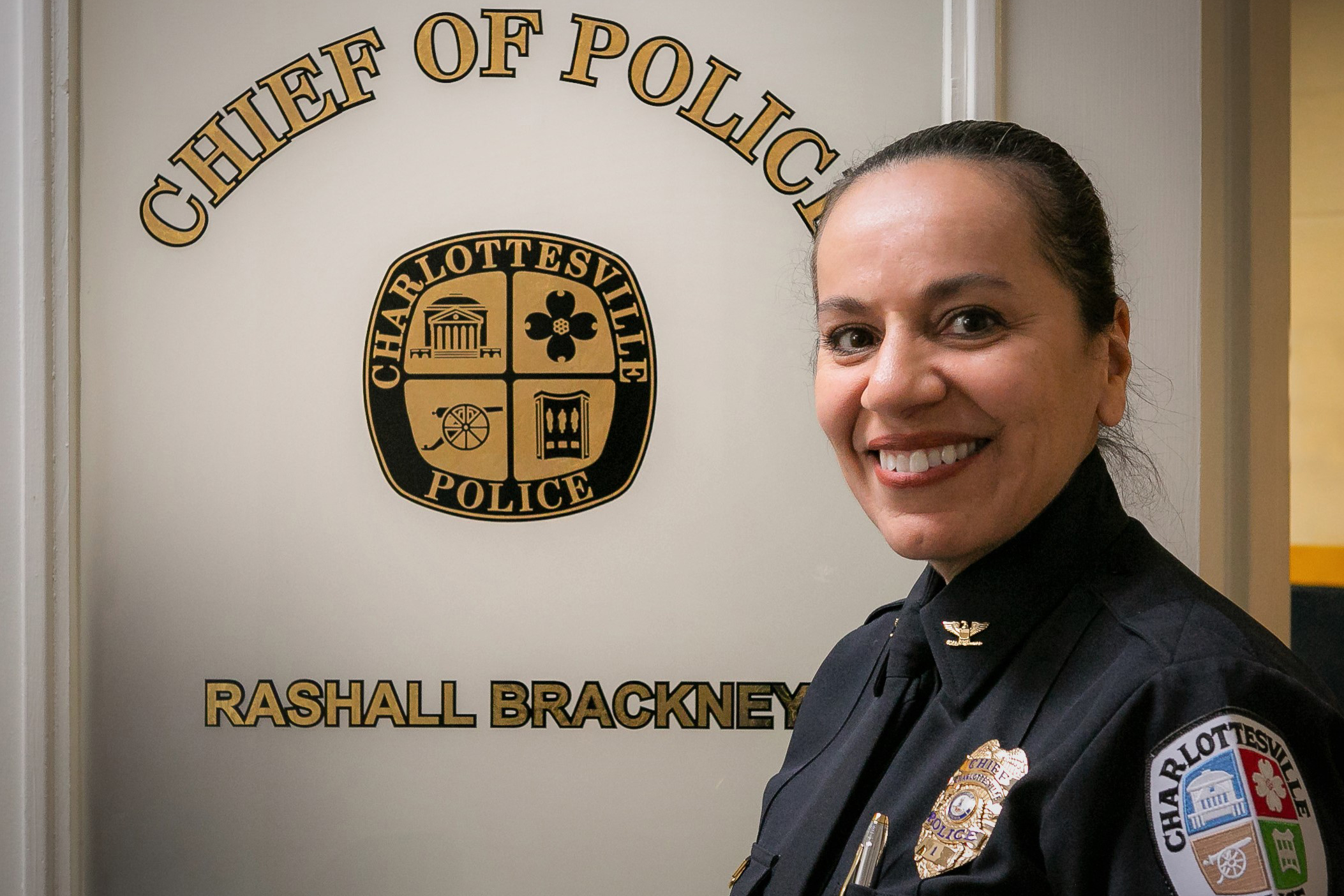
Unfinished Business: RaShall Brackney details personal determination in IPS Professional Journeys event
By Bill Brink
During RaShall Brackney’s senior year at Carnegie Mellon, she ran out of money. No student loans, no Pell grants, and financial aid covered room and board, but not much else. She was forced to withdraw, and entered the Pittsburgh Police Department.
“You’re young, you’re small, you’re a woman,” one of the men in the department told her upon entry. “These streets are tough, and you’ve never done anything in these streets except maybe cross one.”
Thirty-seven years later, Brackney is the Chief of Police in Charlottesville, Virginia. She has a Bachelor’s and Master’s degree from Carnegie Mellon and a PhD from Robert Morris University. She is a graduate of the FBI National Academy, the FBI Hazardous Devices School, and the United States Secret Service Dignitary Protection Course.
“As for my doubters,” she said, “those haters, they failed.”
Brackney, a Carnegie Mellon University Washington Semester Program Fellow, shared stories from her life and career with the CMU community during an Institute for Politics and Strategy Professional Journeys discussion. IPS hosts Professional Journeys discussions with diplomats, government officials, politicians, and thought leaders to expose students to the ways in which successful people adapt and overcome challenges. Previous sessions have featured CMU professors Jason England and Conrad Tucker and Ambassador Gina Abercrombie-Winstanley.
This fall, Brackney will teach a mini 2 course for the Washington Semester Program called "The Shading of Democracy: The Influence of Race on American Politics" (84-330). Apply to participate in the CMU/WSP in Fall 2021 here!
Brackney was one of six children born in Homewood, a neighborhood east of Pittsburgh, to a white father and a black mother. They lived in their maternal grandmother’s house, poor and proud. Their paternal grandmother called her and her siblings racial epithets and disowned her father.
“I felt disconnected,” she said. “My brothers and sisters and I were ostracized. Often labeled, called words like bastards, mutts, mixed breeds.”
Brackney avoided the bullying and teasing at school by burying herself in books. Her father, who dropped out of school in sixth grade to work in the steel mill, was the “most intelligent and smartest man I know,” elevating the discourse at the dinner table. She chose Carnegie Mellon ahead of Harvard, Princeton, Yale, and the Air Force Academy.
“As in many families, there was this dream of escaping poverty by education and it often placed an undue burden on first-gen children to succeed,” she said.
Money delayed her education, but did not end it. In the 1980s, financially stable, single with no kids, and working nights, she began writing letters to Carnegie Mellon in an effort to finish her degree. It was not until 2007 that Jay Devine, the Associate Dean of the Dietrich College of Humanities and Social Sciences, responded, with “Unfinished business” in the email’s subject line. With his help, she completed her undergraduate degree in 2009, earned her Master’s in 2011, and her PhD at Robert Morris in 2017.
In the late 2010s, Brackney was the Chief of Police for The George Washington University. Her husband, Stefan Wheelock, was (and is) a tenured professor at George Mason University. Life was good. The country was not.
“For the first time in a long time, I felt as though I belonged, but I also felt unsettled as the nation was publicly grappling with rising levels of terrorism, nationalism, and American exceptionalism,” she said.
Brackney cited the Tree of Life shooting in Pittsburgh, the Unite the Right rally in Charlottesville (which preceded, and led to, her tenure as Chief of Police there), continued police violence against minorities, and the violence at the Capitol on January 6, 2021 as examples of the fracturing of the country and the hate that is bubbling to the surface. Addressing these problems requires attention and action.
“This job is not mine or mine alone,” she said. “We can no longer embrace the status quo. Our conscious moral leadership recognizes injustices. We recognize failures, we own it, and then we act on it.”
Police reform will help, but it must go beyond that. In fact, Brackney argued, reform is the wrong word. Doctors don’t reform cancerous cells in the body. They eradicate them.
“You cannot reform a system that is diseased,” she said.
She recommended standardized police accreditation and training nationwide, the creation of a rating system (like the bar for lawyers) that reveals more than a binary yes-or-no qualification but how skilled officers are, and standards to create or maintain police department certification.
Brackney advised students to choose one area they are passionate about and create both allies and alliances while in pursuit of improving it, and she advised them to do it boldly.
“As students, advocates, activists, and alums, what does your journey and protest look like when you’re challenging those who trade in fear and isolation?” she asked. “Who will you inspire?”