
K-12 Teachers Explore Experiential Learning Through CMU Summer Camp
Heidi Opdyke
- Associate Dean of Marketing and Communications, MCS
- Email opdyke@andrew.cmu.edu
- Phone 412-268-9982
A new weeklong event brought K-12 teachers to Carnegie Mellon University’s campus to foster curiosity and discovery as they transform their students into future-ready innovators.
Hosted by CMU’s Leonard Gelfand Center for Service Learning and Outreach, the inaugural Teacher Summer Camp reflects Carnegie Mellon’s broader commitment to supporting K-12 educators and strengthening the region’s educational ecosystem. By investing in teacher professional development, CMU extends the impact of its expertise in learning science, technology, engineering, the arts and emerging fields such as artificial intelligence to classrooms across Pennsylvania and beyond.
The Teacher Summer Camp brought together 31 participants, most from across western Pennsylvania and two from Massachusetts, to interact with and learn from more than 30 CMU faculty, student and staff presenters throughout the week. Pittsburgh-based nonprofit Matt’s Maker Space sponsored the camp and hosted sessions on two of the five days.
Teachers toured the university’s facilities, conducted experiments in CMU laboratories, explored the library’s special collections and took part in workshops in areas such as art, STEM and robotics. Many of the camp's sessions were held in the newly renovated Posner Center for Special Collections.
“The most powerful tool we have at our disposal to make a real difference in regional education is through teacher professional development,” said Lindsay Forman, K-12 coordinator for the Simon Initiative, who organized the summer camp with Miriam Wertheimer, senior director of the Gelfand Center. “We can be incredibly nimble and provide really specialized translations of the innovative work happening here to teachers.”
Carnegie Mellon engages educators with training opportunities in many ways. Through the efforts of the Simon Initiative and other campus partners such as the Community-Based Work Coalition, teachers have opportunities to explore topics ranging from learning science and evidence-based instructional design to artificial intelligence in the classroom.
Faculty and staff offer a wide-range of professional development programs such as the Summer Center for Climate, Energy and Environmental Decision Making (SUCCEED) and summer workshops for physics and STEM educators, helping teachers bring cutting-edge research and hands-on learning approaches to their students.
Strengthening students’ learning foundations
In her address to the summer campers, Kate Barraclough, vice provost for education, recognized that the CMU community can share its capabilities to develop students’ learning foundations for future critical thinking and groundbreaking ideas.
“Every single day on this campus, we have brilliant, young students who do amazing things like engineering autonomous vehicles, creating art, delivering incredible performances, discovering new compounds or thinking about expanding the bounds of artificial intelligence,” she said. “But the spark, the curiosity, the energy they bring doesn’t start at Carnegie Mellon. It starts with you and the work that you’re doing … we are the direct beneficiaries of all the amazing work that teachers do.”
Barraclough noted that CMU has spent decades at the forefront of learning science research, helping to define how educators use data, technology and cognitive science to improve learning outcomes.
Inspiring learning as creative play
Trish Callaway, a preschool teacher at Shadyside Presbyterian Church Nursery School in Pittsburgh, attended the summer camp alongside her daughter, Michelle Callaway, a science teacher in Boston, Massachusetts.
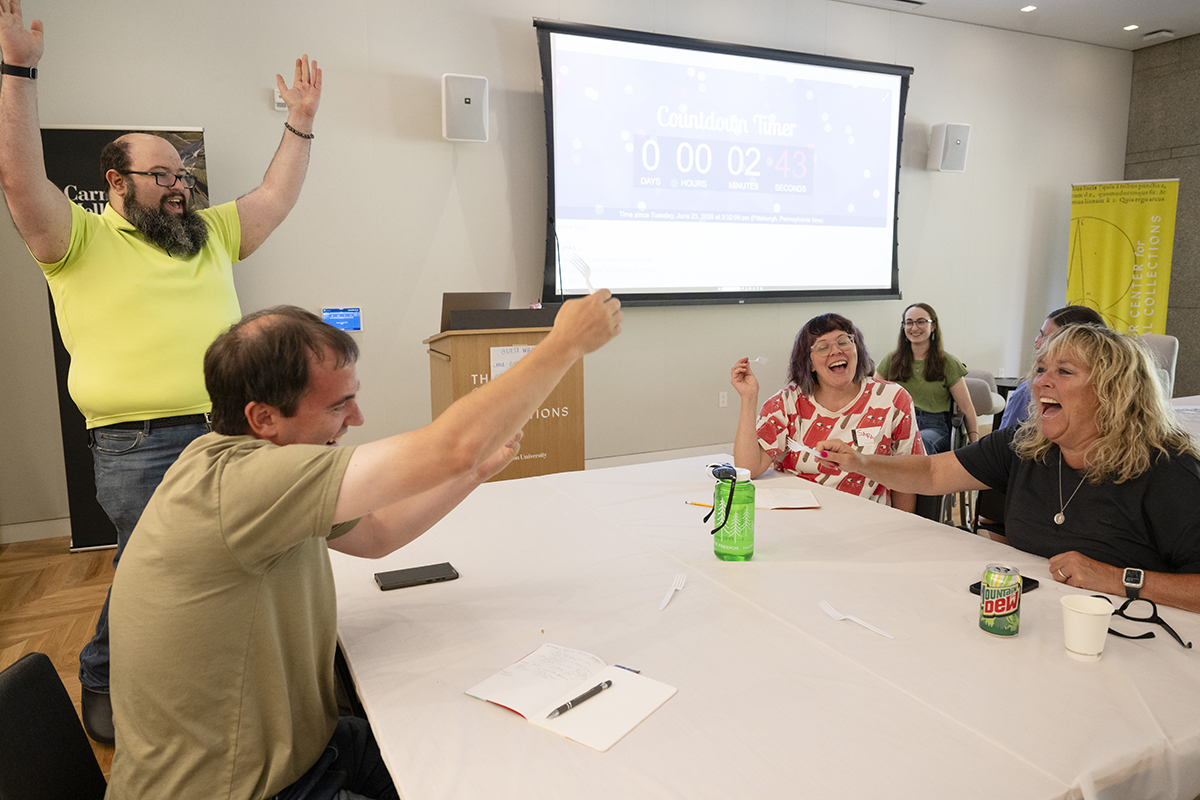
Both enjoyed a session in game design led by Rotem Guttman, a Ph.D. student with Carnegie Mellon’s Human-Computer Interaction Institute and Center for Transformational Play in the School of Computer Science. He challenged the teachers to create games using only plastic forks and everyday objects they had with them.
“The games that he brought in this particular session reminds me how important playing with something, hands-on learning, is serious, essential — and really fun too,” Trish Callaway said.
Recalling a quote by educator and television personality Fred Rogers, she said it reminded her that “for children, play is learning,” and teachers have a responsibility to carry that forward. She was grateful for Carnegie Mellon’s efforts to emphasize those concepts with professional development.
“What a perfect place to share with and support the people planting seeds so they can go on to change the world,” Trish Callaway said. “It’s a growth process, and we’re all a community of learners.”
STEM learning activities energize teachers
Other sessions included connecting with nature at the Highmark Center for Health, Wellness and Athletics, flying drones from the Carnegie Mellon Robotics Academy and soldering in CMU’s TechSpark makerspace.
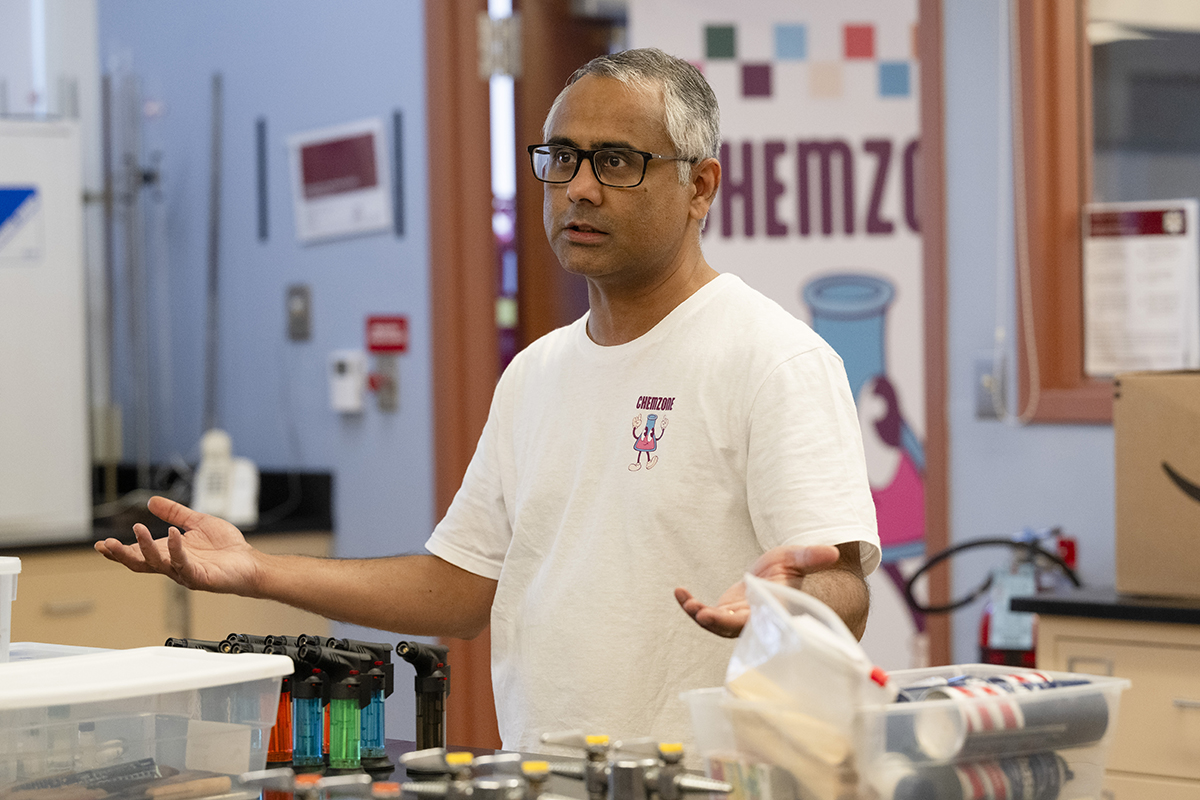
During one “kitchen chemistry” session, Subha Das, associate professor of chemistry and director of ChemZone outreach, emphasized connecting food and other relatable materials to science learning.
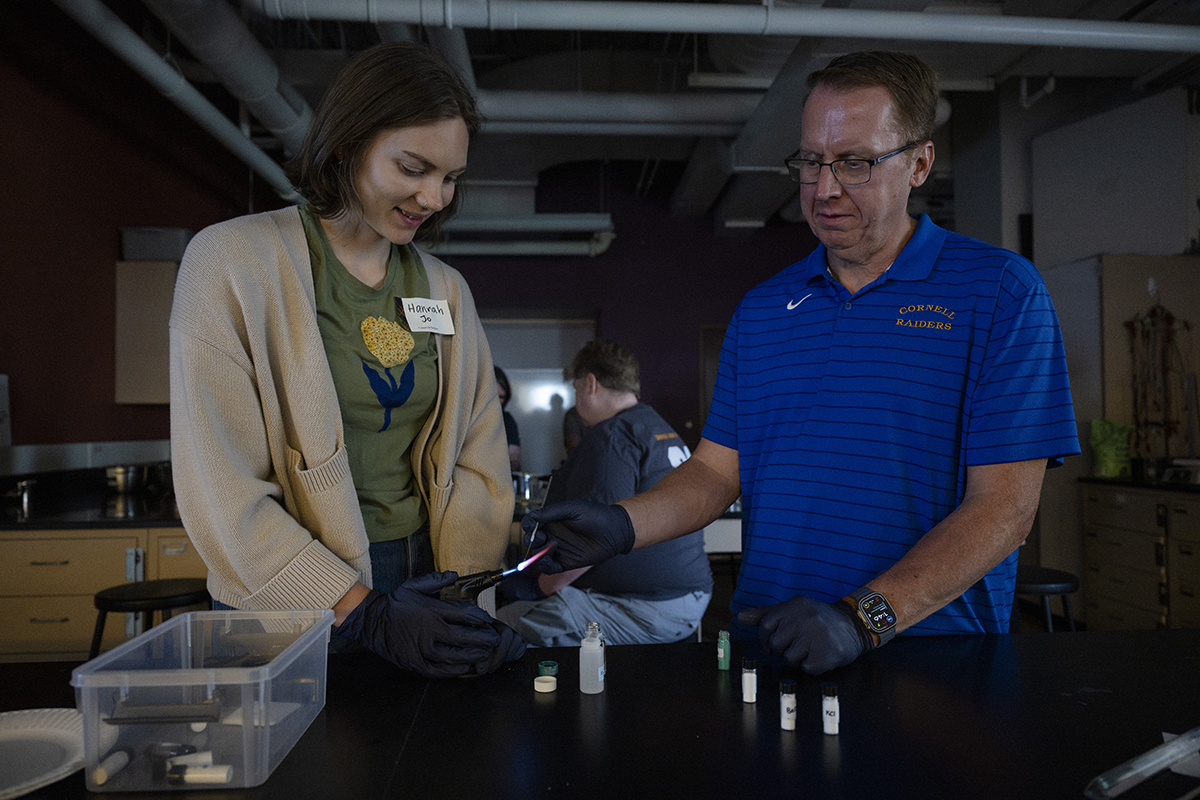
For one experiment to explain molecular energy, Hannah Jo Williams, who is transitioning from teaching second grade at Pittsburgh Urban Christian School to the Falk Laboratory School at the University of Pittsburgh in the fall, was paired with Kris Hupp, director of technology and instructional innovation at Cornell School District in Coraopolis, Pennsylvania.
In the Doherty Hall lab, the two used metal salts in flame tests to see the variety of colors produced when certain metal ions are present. Hupp held the butane lighter while Williams held the small scoop of each salt over the flame.
“A bright one!” she said after testing lithium chloride. Williams appreciated how the sessions allowed the teachers to see how “to be curious and wonder and have fun, then translate that into your teaching practice.”
With CMU’s help, teacher training advances AI course
Prior to the summer camp, Hupp worked with Forman on an artificial intelligence pathway for teacher professional development at Cornell, which has 550 students in the district.
“CMU has offered a wide variety of support for our school over the years, everything from instructional support to connecting with the latest research,” Hupp said. “It is nice that CMU is willing to take the time and resources to help our students.”
Last school year, with Forman’s help, Cornell teachers developed an AI literacy course for the district’s seventh-grade students that will be offered in the fall.
“She helped cater it to our district and develop AI-resistant strategies for assessing students’ learning versus the AI models,” Hupp said.
Similarly, Hupp plans to take the ideas and information shared during Teacher Summer Camp back to Cornell, especially its makerspaces, which students have used for the past 15 years.
“It’s a good opportunity to learn what other people are doing and how we can apply it at Cornell,” he said. “I’m really looking for new ways to think about things and do them differently.”

