Three children from Carnegie Mellon University’s Children’s School enjoy an extra special autumn surprise – pumpkins!
Carnegie Mellon’s Children’s School Is a Caring Community for Groundbreaking, Interdisciplinary Research
After nearly three decades of leadership, Sharon Carver becomes emeritus director as Linda Hancock, Catarina Vales take on new leadership roles
By Jason Bittel
It’s morning at the Carnegie Mellon University Children’s School, and the halls are echoing with delight.
Dozens of three-, four-, five- and six-year-olds are arriving for the day, and on the way in, many have already noticed that their playground has an extra special surprise awaiting them — 100 pumpkins hidden throughout the jungle gym and play area by the university’s facilities staff.
Pumpkins that they’ll be allowed to pick, play with and take home.
There’s excitement in the air for the grown-ups, too. After more than three decades of leadership and service as the Children’s School’s director, Sharon Carver is passing the torch to Linda Hancock, the new education director, and Catarina Vales, the new research director. Carver will serve as emeritus director while mentoring the new leaders.
“Linda’s been at the school longer than I have,” said Carver, who is also associate dean for educational affairs at Dietrich College and a professor of psychology. “She was my daughter’s kindergarten teacher.”
With Hancock and Vales, who has been at CMU since 2016, Carver felt assured that skilled and passionate successors were already familiar with the school and primed to lead it during a time of so much societal change.
Founded in 1968 as part of the Department of Psychology, the Children’s School is more than a day care or preschool — it’s what’s known as a laboratory school. This means that not only does it supply top-notch education and enrichment for its students, but it’s also a bustling hub for interdisciplinary research.
In one research room, a psychology student teaches a group of children ballet as a way to test whether learning patterns in one area translates to better pattern recognition in other fields. In the classroom, children don safety glasses and tinker with screwdrivers, bolts and hammers while an engineering major watches quietly, scoring each child’s fine motor skills on a clipboard. Some days the children fiddle with prototypes built by the Robotics Institute, and on others they get to create stories with props built by School of Design students down the hall.
“Educational designs, teaching strategies, policies and procedures for research, and many other aspects of CMU’s Children’s School model are routinely shared with and implemented by schools all over the world,” said Carver.
And with the new leadership of Hancock and Vales, the next decades of early childhood education have never looked brighter.
“Our community makes for a very rich learning environment, because our educators are all modeling evidence-based practices for early childhood education,” said Hancock. “We’re always looking for what is best for each child.”
“I feel very lucky to be walking into a well-oiled machine,” said Vales of the transition.
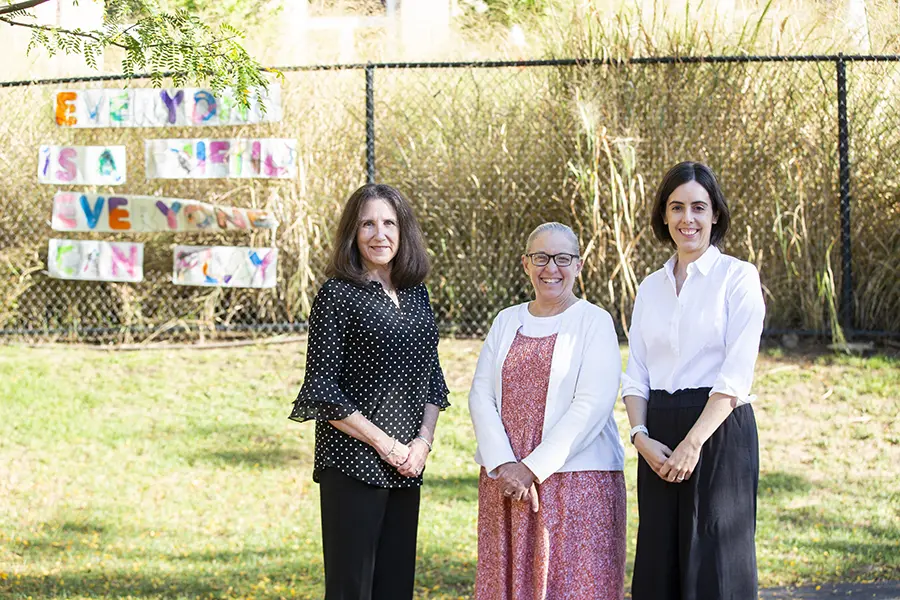
Linda Hancock, Sharon Carver, and Catarina Vales each have a new leadership role at the Children’s School.
The power of games
“This is the fishy room!” squealed an excited kindergartner in a blue dress and light-up shoes. “I like watching videos.”
After being fitted with a functional near-infrared spectroscopy (fNIRS) cap, which looks like a soft, cloth hood covered in light probes, the child watched a short video with relaxing music and colorful patterns — not unlike a desktop screensaver from the 1990s. As she did, sensors in the cap quickly and quietly measured how the blood flowed across her brain, establishing a baseline reading for a mind at ease.
Next, however, she’d be asked to play “Odd Fish Out,” which would mean focusing on a series of images depicting a row of blue-and-yellow fish. Her job was to determine which way the fish in the center was facing. The task itself was simple, but complicated by the fact that sometimes the other fish in the row were facing the same direction as the fish in the middle, and sometimes they were facing the opposite direction.
“It’s what’s known as an adapted flanker test,” said Mady Davis-Troller, a graduate student in developmental psychology. “This playful task helps researchers understand how attention and self-control are supported by the brain’s frontal regions.”
Of course, the kindergartner was oblivious to the screen behind her spitting out graphed data in real time. She was just happy to watch Dory-fish appear on the screen and tap at buttons that indicated “left” and “right.” After a few minutes of game time, she received a sticker with fish on it that encouraged her family to ask her about the experiment. She walked back to class with Davis-Troller, beaming.
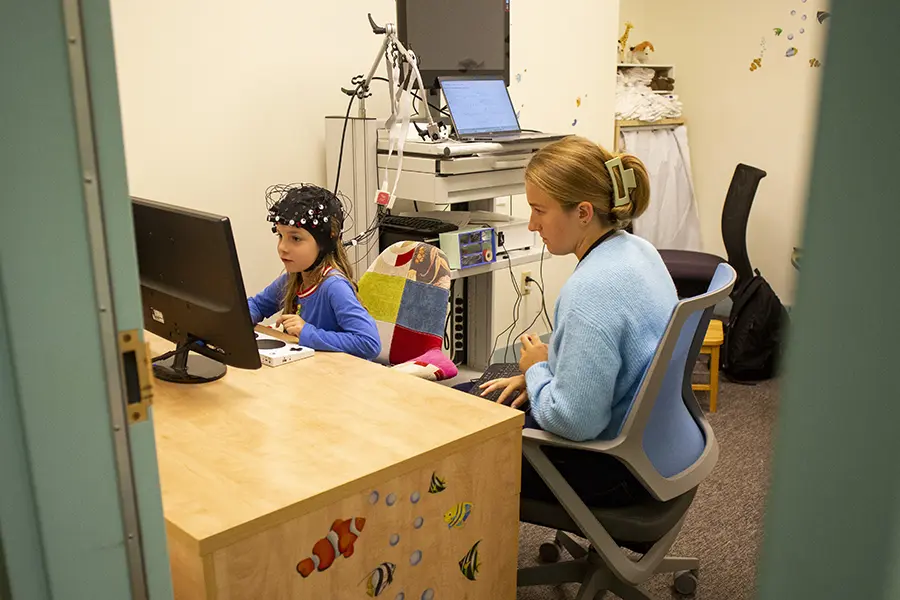
Mady Davis-Troller, a graduate student in developmental psychology, guides a child through an adapted flanker test. A functional near-infrared spectroscopy (fNIRS) cap allows her to measure brain activity to study how attention and self-control are supported by the brain’s frontal regions.
“The researchers can only be with the children for a maximum of 20 minutes, and each child can only participate in one study per day,” Vales said. “So, it’s a very small slice of their entire day.”
But for scholars like Vales, laboratory schools offer a research environment unlike any other.
Because children attend for the whole school year and often several school years in a row, researchers can conduct longitudinal studies, or studies on the same population over long periods of time. For Davis-Troller, that means being able to learn how brain connectivity in the frontal cortex changes with age and how everyday experiences relate to growth in early childhood.
Sometimes the students aren’t even doing anything differently than they normally would, but are being observed through one-way mirrors. This allows researchers to quantify myriad behaviors, such as social interaction with peers or how often a child deviates from the task at hand.
“I think the logic behind a laboratory school is bringing together educators and researchers in ways that aren’t really the norm in mainstream schools,” said Vales, who also leads the Department of Psychology’s Cognitive and Social Development Lab. “I see it as a win-win.”
What’s more, these experiments then benefit children and teachers at other schools by providing data on how to best educate the next generation.
For instance, one study conducted at the Children’s School and funded by the Department of Education quantified how too many bright and colorful decorations on a classroom wall can actually distract students and hinder their ability to focus. Similarly, a program developed by the CMU CREATE Lab and piloted at the Children’s School allows children to share photographs and audio messages with their families during the day. Known as Message from Me, the tool is now in use in preschool programs across the country.
Transfer of Learning
“Okay, now we’re going to do a tendu,” said Hilary Alonso, a senior psychology major working on her honors thesis, before demonstrating the French toe-tap ballet move.
In response, half a dozen children balanced on their right foot while extending their left leg to the side. A symphony swelled in the background, courtesy of Alonso’s phone. One child pretended to fall over, splaying out on the floor, triggering a round of giggles.
Why ballet? Well, prior research has suggested that learning patterns in one area can help children attain better pattern recognition in another area. Even if those areas are as different as ballet and, say, math. It’s what’s known as “transfer of learning,” said Alonso.
To explore this further, Alonso and Carver have designed a study where half of the class receives ballet lessons in the fall and half in the spring. That means everyone gets the enrichment, but it also allows the researchers to establish a control group — a critical component for producing data that actually establishes causality.
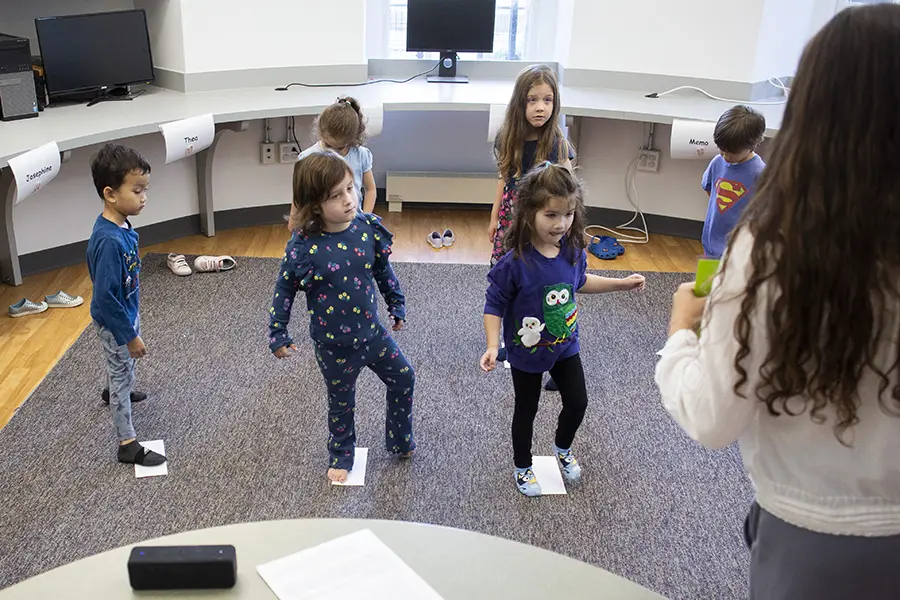
Hilary Alonso, a senior psychology major working on her honors thesis, is testing whether learning patterns in ballet can help children better recognize patterns in math.
Similar to the study where researchers changed the artwork on classroom walls to measure learning outcomes, these kinds of manipulations are extremely difficult, if not altogether impossible, to perform in more traditional school settings. And this makes the Children’s School a unique asset not just to the university, but also the community at large.
“We present at conferences. We offer workshops. We host teachers from other schools who need experience or mentorship,” said Carver. “Not every school can do that.”
The Children’s School also makes many helpful materials for families available on its website, free of charge. And Children’s School experts regularly provide training events and consultations to advance education in local, national and international communities.
Here on campus, the Children’s School also attracts and provides opportunities for students across disciplines, from fiction-writing majors to those in pre-med tracks. CMU’s Music Entrepreneurship program has partnered with the Children’s School to give its students experiences performing in front of a live audience. The children have also provided valuable feedback to students in the Integrative Design, Arts, and Technology program as they fabricated interactive, kinetic sculptures and other materials destined for children’s museums.
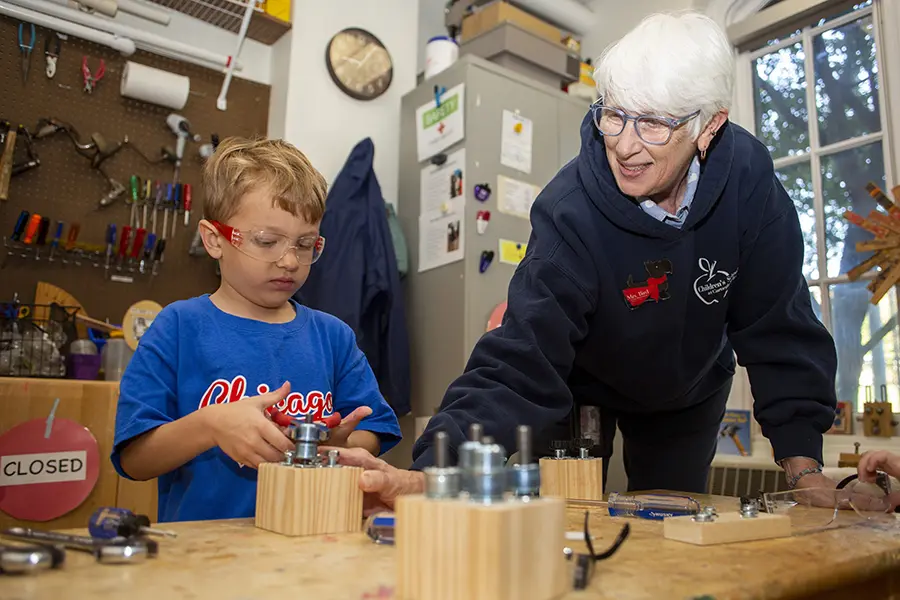
“Righty-tighty, lefty-loosey!” said Jean Bird, as she helped a child loosen a bolt with a wrench. Bird has the longest tenure of any educator at the Children’s School and was mentored by the school’s founder, Ann Baldwin Taylor.
A Community of Learners
“From the youngest child to the university students and researchers, to our teaching staff and administration, the Children’s School is a community of life-long learners,” said Linda Hancock, who started teaching at the school in 1988. “Learning is our passion.”
And many parents agree.
“Our children loved playing the ‘games’,” said Ally Aldous, a parent of four children who attended the Children’s School between 2010 and 2023. “On days when they participated in research, our children loved to give us reports on the games that they had played.”
Not only do parents and caregivers receive documentation about what their children are participating in and when, but they can also come observe their child through the same mirrors. Parent visits are also an opportunity to do science outreach with the broader community, explaining the what’s and why’s of research.
“We want parents and families to learn as much as the children,” said Hancock. “Everybody is a part of the learning process.”
“Unlike my peers, my first introductions to technology and interactions with a computer were in preschool,” said Darrah Bird, who attended the Children’s School in the early 1990s and whose son was enrolled from 2017 to 2019. “Because it was introduced as a tool as part of my learning early on, I believe it taught me to have healthier relationships with technology later.”
Darrah is actually one of three generations in her family with connections to the Children’s School. Her mother, Jean Bird, has taught at the school for over 40 years — a longer tenure than any other educator.
“That’s one thing about the Children’s School, people tend to come and stay. And I think that speaks volumes,” said Hancock.
“Sharon and I have been together for her entire tenure,” said Hancock. “And it’s been a true joy to work with her all of these years.”
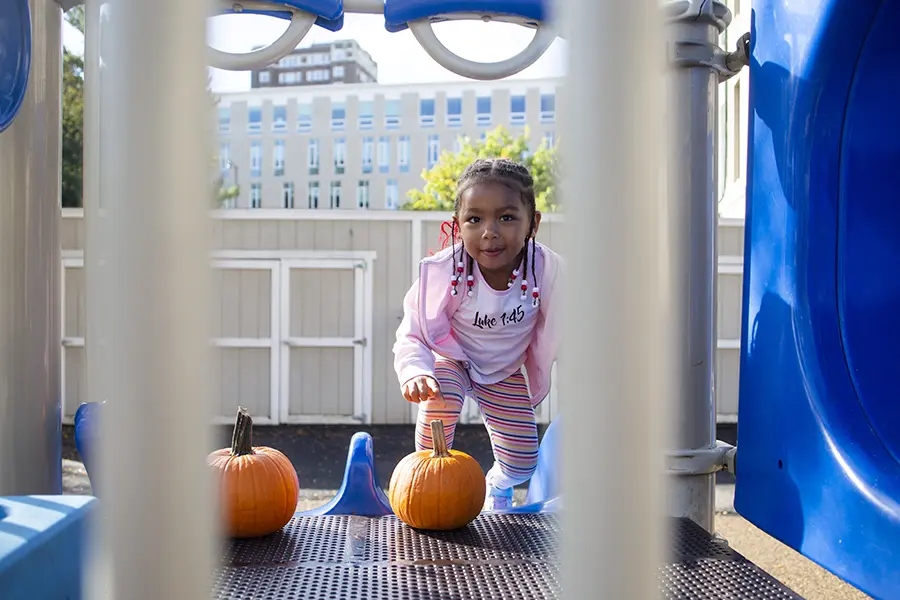
A child climbs through the playground equipment searching for the perfect pumpkin.