Faculty Spotlight: Jenelle Feather
By Jason Bittel
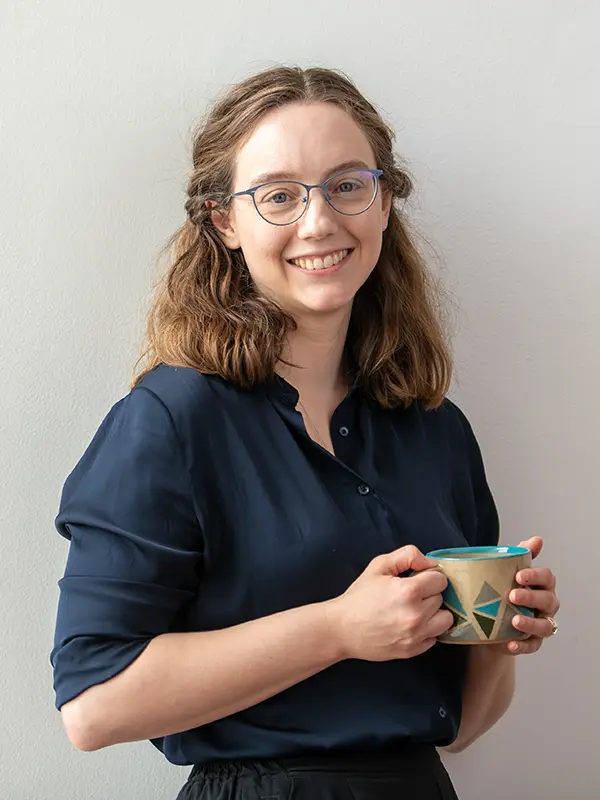
Jenelle Feather is an assistant professor in the Department of Psychology and the Neuroscience Institute. Her research seeks to understand the complex patterns of neural activity underlying perception and cognition, with real-world applications ranging from designing biologically aligned hearing aids and advanced brain-machine interfaces to building artificial intelligence systems that see and hear the world the way humans do.
Tell me about your scholarly work.
My lab works at the intersection of neuroscience, cognitive science and artificial intelligence in an area increasingly referred to as NeuroAI. Much of my work focuses on sensory systems, specifically the auditory system and the visual system. We build, train and test computational models that replicate various aspects of biological systems, including behavior and measured brain responses. Part of this work also involves developing new frameworks for comparing high-dimensional computational models to outputs we measure from biological systems.
For instance, I developed a framework using model metamers to compare artificial neural network models to human perception. This approach takes inspiration from the idea of human perceptual color metamers, which are two light sources that have physically distinct spectra but are perceived to be the same color to human observers due to the presence of only three cone types in the human retina. Model metamers are two stimuli (such as two audio waveforms) that are physically different but that produce the same response within a computational model. We can generate these from computational models and present them to human observers to see if the types of information thrown away by our models are also thrown away by humans. My lab at CMU is now building upon this framework to explicitly look at the domain of auditory event categorization, as I have a student who is really interested in how acoustic-to-semantic transformations emerge in the brain.
How is your scholarly work adding to the greater field?
It’s an incredibly exciting time to be working in neuroscience and cognitive science, as we now have models that go directly from a physical input like a sound or image and compute a predicted neural response. These “stimulus computable” models of brain responses show immense potential to be utilized in translational research. For example, imagine having a high-fidelity model of the healthy human auditory system. In this model, one could simulate different types of hearing impairment and measure how the brain responses would change due to this type of hearing loss. Going further, this impaired model could be used to design more personalized algorithms for hearing aids or cochlear implants that would help restore the neural code to be closer to what it is in the healthy space. This could be applied in many different translational domains for other types of diseases and disorders, but it critically relies on having a model that we are confident has the designed properties of the system of interest. A lot of my lab’s work involves stress testing these models to find the similarities and differences with biology and points to how we can align these systems and utilize them to their full potential.
How did you become interested in this topic?
Perhaps I shouldn’t reveal this as a new faculty member, but I’m constantly surprised at how I got here, and my path to my current research program often seems very roundabout. One thing that stands out is a period in undergrad when I took a class on perception around the same time as a physics course on vibrations and waves. While I learned the mathematical basis of Fourier transforms and how to describe waves traveling through different media in my physics course, I also learned how auditory nerve fibers respond specifically to certain frequencies due to the physical properties of the basilar membrane in the cochlea and the traveling waves that propagate through this membrane. Essentially, a floppy piece of biological material performs an elegant mathematical transformation on an incoming pressure wave of sound. Although I don’t study the mechanics of the cochlea, my current research often touches on how biology can implement efficient processing mechanisms that we can describe and understand through computational and mathematical frameworks.
What are you most excited to accomplish as a faculty member at CMU?
One thing that is incredibly exciting about working in a computational space is that often the techniques and tools we develop can be applied in many different domains or to answer many different questions. While my lab runs some experiments such as human behavioral work identifying different types of sounds or images, much of our research is done in collaboration with other researchers, and these types of collaborations often lead to results that a single person or group could not arrive at alone. At CMU, I’m excited to foster more of these collaborations and see what discoveries emerge. The psychology and neuroscience communities are full of so many exceptional scientists and labs doing incredible work, and the interdisciplinary nature and openness to collaboration are what made me most excited to join the faculty at CMU.
What are your goals for the next generation of scholars?
I hope to mentor the future generation to do serious science, but also to enjoy it and have fun. There is something that can be incredibly joyful about collecting and analyzing new results, designing an elegant experiment and crafting scientific results into a story to easily communicate to others in a paper or talk. Plus, we get to do all of this with incredibly brilliant collaborators! Yet, it seems like more and more the academic environment and the state of the world make it hard to appreciate how fun science can be. It is simply an incredible privilege to have the opportunity to do science for a living. We get to solve puzzles all day, how cool is that?