What Happens When Faculty Build Courses Around the Future
Caitlin Kizielewicz
- Email ckiz@andrew.cmu.edu
- Phone 412-554-0074
When a student told Distinguished Service Professor of Organizational Behavior and Theory Diane Rulke that he had lost a return internship offer because he lacked AI skills, it raised an important question: Were students getting the preparation employers now expect?
The answer led to a complete redesign of a course to meet the need. AI, Innovation & Competitive Advantage, is a course that helps undergraduate students at Carnegie Mellon build practical AI capabilities while learning how the technology is reshaping innovation across industries.
"That conversation prompted me to survey students about their expectations around AI tools and their application to innovation," said Rulke. "The feedback was overwhelmingly urgent and clear."
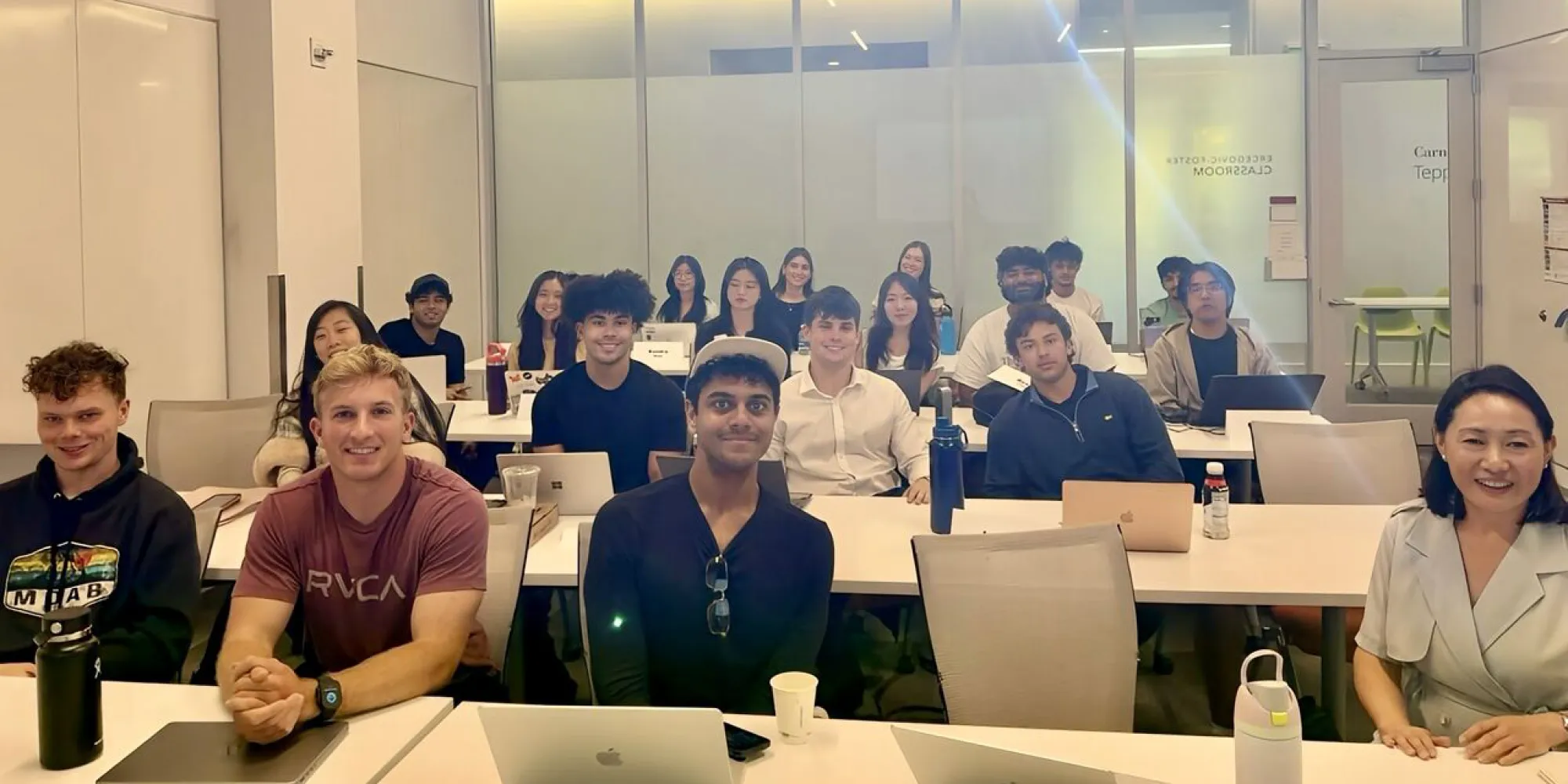
The interdisciplinary course brings together students from the Tepper School of Business, and across campus to learn how AI can accelerate innovation through hands-on projects, corporate partnerships, and real world problem solving.
In response to student feedback and evolving employer expectations, Rulke built the course around three goals: helping students develop AI skills, providing practical experience with AI tools, and demonstrating how AI can create competitive advantage.
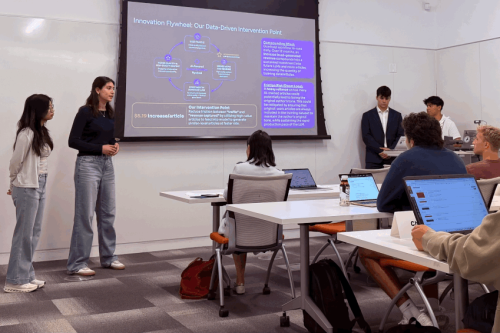
Students spend the semester building AI agents and workflows, working alongside industry partners, and applying their skills through corporate sponsored capstone projects. Rather than learning about AI in theory, they create tools designed to solve real business challenges.
Weekly lectures are paired with interactive workshops where students work directly with an agentic AI platform and receive guidance from an AI engineering manager throughout the semester. The hands-on approach allows students to build practical skills while developing solutions to challenges.
Assignments have included everything from personal productivity tools to startup concepts developed and tested with the support of AI. One project challenged students to prototype, beta test, and launch a business idea in a single week.
A defining feature of the course is its interdisciplinary approach. A great example is the Spring 2026 semester which demonstrated how students' diverse backgrounds complemented one another. Business students contributed strategic thinking and communication skills, engineering students brought structured problem solving, and computer science students added technical expertise. Capstone teams are intentionally designed to combine these perspectives, creating an experience that mirrors today's workplace.
Importantly, the course uses no code and low code tools that make AI accessible to students across disciplines while still providing opportunities for more technically experienced students to explore advanced applications. Students consistently cite this cross-disciplinary collaboration as one of the most valuable aspects of the experience, learning how to build solutions, solve problems, and present recommendations together.
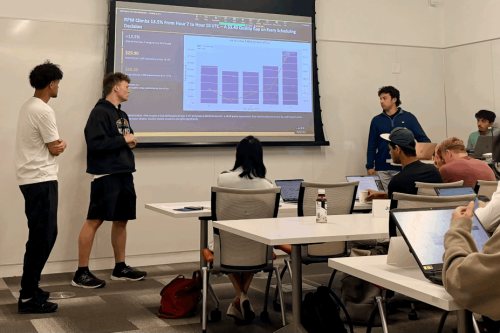
Beyond the classroom, students also learn from executives and practitioners working at the forefront of AI adoption across consulting, healthcare, finance, and technology. These industry perspectives help connect classroom learning to the realities of a rapidly evolving business landscape.
For Rulke, one of the course's most important outcomes is helping students see AI as more than a technology trend.
Industry leaders regularly visit the classroom to share how AI is transforming organizations and accelerating innovation. But Rulke believes the most powerful lessons come through direct experience.
"When students build AI projects that genuinely accelerate their own work, they feel the competitive edge firsthand," she said. "That lived experience transforms how they think about AI, not as a trend to watch, but as a capability to develop."
One example came from a sophomore business student who entered the course with no technical background. Over a single weekend, he used AI tools to build a prototype, test a market opportunity, and develop an investor pitch deck for a startup idea.
By the end of the semester, he had launched a startup concept he never believed he could pursue so early in his academic career.
Stories like that reflect a larger shift Rulke sees taking place across industries. AI is compressing the time required to move from idea to execution, dramatically lowering barriers to experimentation and innovation. For business students, that means the ability to build, test, and refine ideas is becoming increasingly important.
Ultimately, Rulke hopes students leave with more than technical knowledge.
"My hope is that they leave with a mindset," she said. "Be curious. Be high agency. Keep learning."
As AI continues to reshape industries and careers, courses like AI, Innovation & Competitive Advantage are helping students develop the skills and confidence needed to innovate in an increasingly AI enabled world. This course will be offered again in the Fall 2026 semester.
"The future will belong to people who are not just users of AI," Rulke said, "but skilled and thoughtful managers of it."
What could you build at CMU?
Explore the Tepper School's undergraduate programs and discover how you'll build the skills to lead in an AI enabled world.