
CMU Launches Data-Driven Ph.D. in Astronomy and Astrophysics
Heidi Opdyke
- Associate Dean of Marketing and Communications, MCS
- Email opdyke@andrew.cmu.edu
- Phone 412-268-9982
As demand for advanced training in astronomy surges, Carnegie Mellon University is launching a new Ph.D. designed to equip graduates with interdisciplinary skills for careers in academia, industry and beyond.
The Ph.D. in Astronomy and Astrophysics will be housed within CMU’s Department of Physics and the McWilliams Center for Cosmology and Astrophysics.
“Astronomy has expanded dramatically in the past decade,” said Tiziana DiMatteo, director of the McWilliams Center. “U.S. bachelor’s degrees in astronomy have tripled since 2010 and now exceed 700 per year. These graduates seek advanced study and, when possible, choose institutions with dedicated astrophysics Ph.D. programs.”
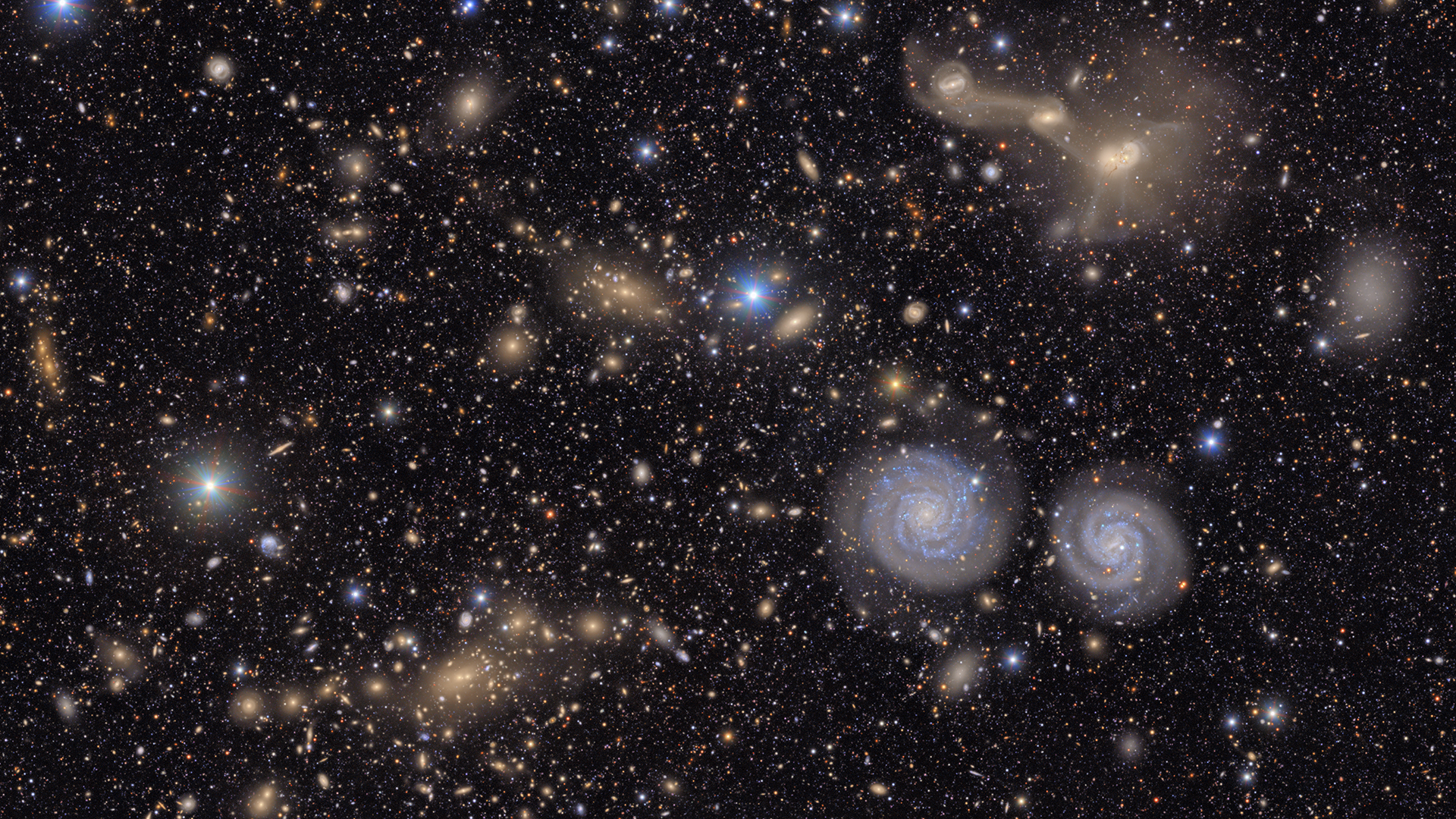
DiMatteo said that there is a scientific window happening now. New technologies such as the James Webb Space Telescope, the Vera C. Rubin Observatory and the Euclid Telescope are producing unprecedented data. Enormous simulations and the rise of multi-messenger astronomy — which uses data from diverse sources such as light, particles and gravitational waves — require researchers to have a broad set of skills.
“Programs that train researchers to analyze these data will shape discoveries for years to come,” Di Matteo said.
Starting in Fall 2025, the Ph.D. in Astronomy and Astrophysics leverages Carnegie Mellon’s strengths in computer science, robotics and statistics to create a data-driven astrophysics program that showcases the university’s interdisciplinarity.
“Embedding data-science and machine learning approaches makes the program distinctly ‘CMU,’ leveraging a campus strength few astronomy departments can match,” DiMatteo said.
The program will enhance its education through a specialized curriculum and early research. In addition, the program’s emphasis on machine learning and high-performance computing will prepare graduates for competitive careers in academia and national laboratories as well as the technology, financial and aerospace industries.
Associate Professor Hy Trac will serve as the program’s director. A member of the Atacama Cosmology Telescope and Simons Observatory Collaborations, Trac’s research involves the development and application of simulations to model and interpret the universe.
“The program streamlines learning and training through three core components: coursework, research and professional development,” Trac said. “Immediate engagement in these areas enables students to build strong portfolios that position them competitively for postdoctoral fellowships and industry opportunities."
Carnegie Mellon has previously been recognized as one of the top U.S. programs for astronomy and astrophysics by Gizmodo Magazine.
The Department of Physics currently offers an astrophysics track as part of its bachelor of science in physics program, which provides students with access to professors working on projects such as the Legacy Survey of Space and Time at the Vera C. Rubin Observatory and opportunities to conduct research alongside faculty from the university's interdisciplinary McWilliams Center for Cosmology.
The McWilliams Center also is a top destination for postdoctoral researchers. One of the center’s highest profile programs, the fellowship, a gift from the late Bruce McWilliams, provides funds to support promising scientists pursuing independent research.
The program is designed to be completed in four or more years. Students complete required and elective coursework typically after two years, and carry out research as a required component of the program starting from the first semester. Students will gain foundational training in data-intensive astronomy and astrophysics, with electives in physics and other relevant departments. There is an associated professional development program to support the students' development as scientists
Domestic students accepted into the doctoral degree may be considered for the CMU Rales Fellows program. The program, established in February 2023, is dedicated to cultivating the next generation of STEM leaders and increasing access to graduate education. It is made possible through a partnership between Carnegie Mellon University and the Norman and Ruth Rales Foundation.
Along with Di Matteo and Mandelbaum, the Ph.D. program was created by McWilliams Center faculty Assistant Professor Katie Breivik, Professor Rupert Croft, Research Professor Tina Kahniashvili, Assistant Professor Antonella Palmese, Professor Matt Walker; and Associate Teaching Professor Hael Collins, Associate Professor Rachel Rosen, and Associate Teaching Professor and Undergraduate Director of Education Gillian Ryan.