
Grad Student Maps Tumor Growth to Predict Cancer’s Next Move
Heidi Opdyke
- Associate Dean of Marketing and Communications, MCS
- Email opdyke@andrew.cmu.edu
- Phone 412-268-9982
A tumor might look like a single mass on a scan, but its cells are constantly changing and moving. As cancer grows, those cells adapt, spread and take on new characteristics, making the disease harder to understand and treat.
Carnegie Mellon University graduate student Arun Sujatha Bharath Raj, who is in the Master of Science in Quantitative Biology and Bioinformatics (MS-QBB) program, applies computational tools to track changes over time in glioblastoma, the most common and aggressive form of brain cancer. By reconstructing how individual cells change as the tumor grows, his work could help researchers develop more effective treatments.
“Given data on a patient, this could help researchers or medical professionals easily identify each stage of glioblastoma,” Sujatha Bharath Raj said.
Offered through the Mellon College of Science’s Department of Biological Sciences, the MS-QBB program trains students to combine biological expertise with computational approaches to solve complex problems in medicine and biotechnology.
The interdisciplinary foundation led Sujatha Bharath Raj to work with Russell Schwartz, professor in the Department of Biological Sciences and the Ray and Stephanie Lane Computational Biology Department, on making sense of enormous datasets that capture data on individual tumor cells.
“New advances in biotechnology have made it possible to see what is happening inside a tumor with unprecedented scope and detail, but the complexity of cancer has meant that we need sophisticated computational tools to make sense of the masses of data coming out of that analysis,” Schwartz said. “Arun has been working on a particularly promising technology.”
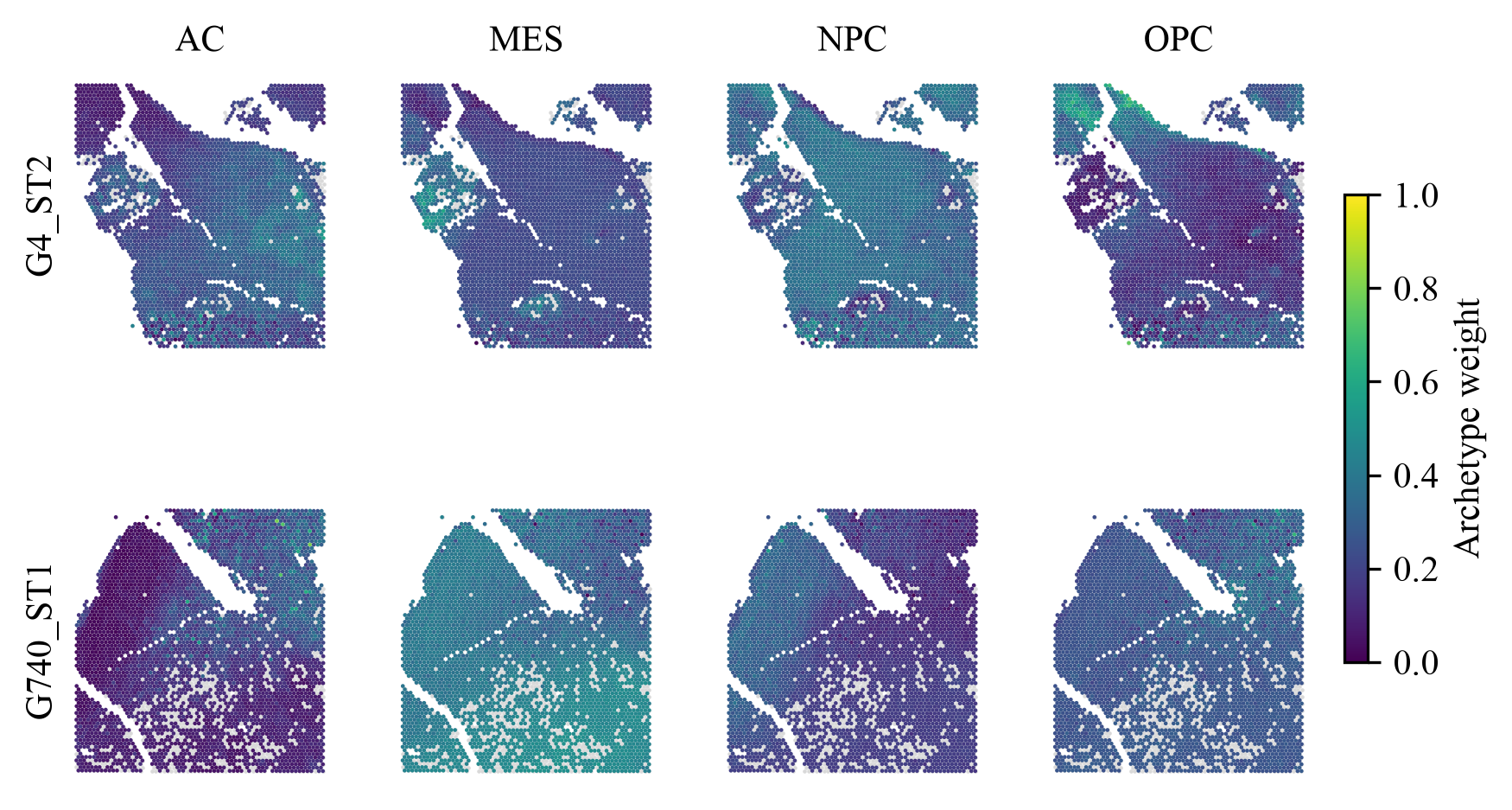
By combining biology, computer science and machine learning, Sujatha Bharath Raj creates detailed maps of tumor cells, noting any differences among individual cells and showing how cancers may change or evolve over time. His work fits into a rapidly advancing field known as spatial genomics, which allows researchers to see where cells are located within a tumor and what genes are active in those cells.
Using gene expression and spatial data from millions of tumor cells, Sujatha Bharath Raj develops computational tools that track where specific cells are located as tumors grow. By integrating data at multiple stages of development, the tools reconstruct a timeline of tumor development and help researchers predict how tumors will likely progress. He said he hopes that in the future, researchers will be able to apply the technology to biopsy samples, so they can determine a tumor’s current state and how it is likely to progress.
A background in biotechnology led Sujatha Bharath Raj to focus on the growing role of computation in medical research.
“I wanted to shift my focus toward computational approaches in biological applications,” Sujatha Bharath Raj said. “The MS-QBB program allowed me to understand the data I get out of an analysis, interpret it and work on it even further.”
Through the MS-QBB program, Sujatha Bharath Raj learned new coding and machine learning techniques that he now applies to glioblastoma research. He also learned how to use artificial intelligence to analyze genetics and design proteins. Schwartz said he watched Sujatha Bharath Raj grow as a researcher.
“Arun has proven a creative and very productive researcher,” Schwartz said. “He is skilled at translating ideas into working code, doing the hard work of testing and debugging it and bringing it to practical application to real-world data sets.”
After graduating in December, Sujatha Bharath Raj plans to pursue a career in medical research, using computational tools to better understand diseases and predict the structures of cancers or of disease-related proteins.
“In the age of AI, it’s important to learn how to understand the computational aspects of biology,” Sujatha Bharath Raj said. “I want to contribute on those fronts.”