
BTPE Alum Turns Classroom Skills Into Cancer Research
Heidi Opdyke
- Associate Dean of Marketing and Communications, MCS
- Email opdyke@andrew.cmu.edu
- Phone 412-268-9982
The way medicine works inside the body has always fascinated Shreeya Mehta.
Carnegie Mellon University’s Master of Science in Biotechnology and Pharmaceutical Engineering program helped her achieve that goal. Today, she studies how cancer cells communicate with the immune system as a full-time researcher at UPMC Hillman Cancer Center.
“BTPE was the full package. It all fit into what I wanted to do,” Mehta said.
A joint program between CMU’s Departments of Biological Sciences and Chemical Engineering, BTPE prepares students from diverse scientific backgrounds and trains them to transform how disease is treated and tackle some of healthcare’s biggest challenges. In three semesters, students gain hands-on experience in drug development, medicinal chemistry, regulatory compliance and bioinformatics.
Coming from a biology-focused background, Mehta took a foundational course in chemical engineering.
“It set us all on the same level, and I learned so much,” she said. “It was the same for those with an engineering background. We were immediately acquainted with the intersection of biology and chemical engineering.”
The interdisciplinary program exposed her to areas she hadn’t previously explored. An entrepreneurship course introduced her to patents, industry partnerships, and the path discoveries travel to get to patients from the lab.
Those classroom experiences soon connected to real-world research.
Early in the program, Shreeya joined the lab of Xi (Charlie) Ren, associate professor of biomedical engineering. There, she was introduced to extracellular vesicles, small particles that cells use to exchange information.
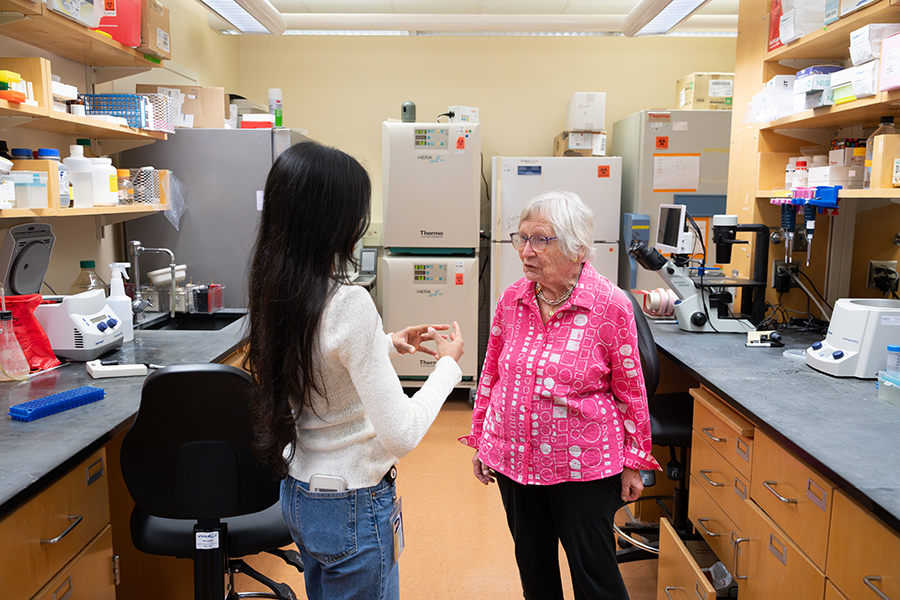
Outside of Ren’s lab, Mehta further investigated the concepts and materials she was learning. When she came across the work of Theresa Whiteside, a professor of pathology, immunology, and otolaryngology for the University of Pittsburgh at UPMC Hillman, she reached out.
Whiteside primarily studies immunology and immunotherapy and is currently investigating small EVs—exosomes — and their implications in the progression of cancers. Exosomes, specifically, carry genetic information that can be used to identify and treat the disease.
“Dr. Whiteside is one of the pioneers in exosome discoveries,” said Mehta, who joined Whiteside’s lab as a summer intern, which was extended. Today, she works full time as an immunotherapy and oncology research technician in Whiteside’s lab.
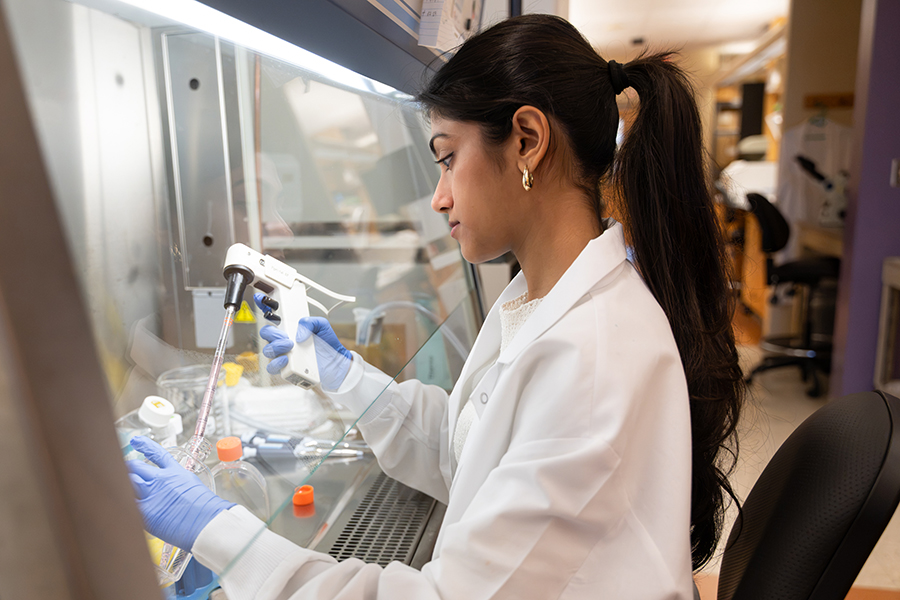
Her research focuses on understanding how tumor-derived exosomes modulate immune cells and how scientists might counter those effects to improve cancer therapies. The work combines molecular biology, functional assays and experimental design, skills she first developed through BTPE coursework and laboratory training.
Mehta’s story exemplifies what the degree is designed to do: give students the technical expertise, interdisciplinary perspective and hands-on experience needed to contribute immediately in biotechnology and pharmaceutical careers.
Working with Whiteside, Shreeya Mehta is uncovering the language of tumor exosomes to reveal how they turn other cells into cancerous cells, and, ultimately, how to put a stop to it.

