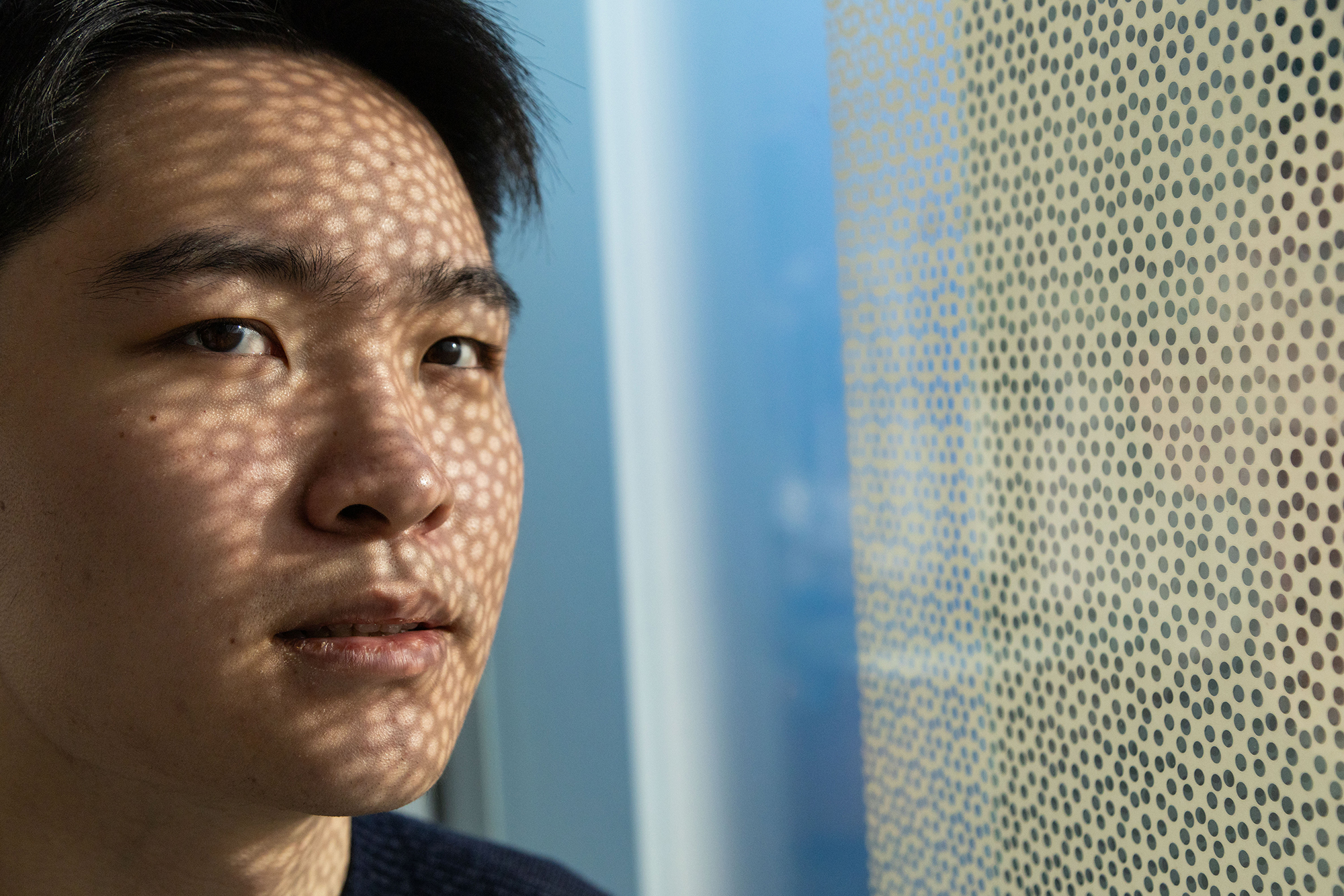

CMU Junior Creates New Tool to Inspect Epilepsy Data
Heidi Opdyke
- Associate Dean of Marketing and Communications, MCS
- Email opdyke@andrew.cmu.edu
- Phone 412-268-9982
Epilepsy is a brain condition affecting tens of millions of people around the globe. It is characterized by seizures, which are caused by abnormal electrical signals in the brain’s neurons. Despite its prevalence, Carnegie Mellon University student Zixi (Alan) Song was surprised to learn that scientists still don’t fully understand how seizures begin and spread in the brains of those affected.
To help scientists learn how the disease works at multiple levels in the brain, Song has used a Summer Undergraduate Research Fellowship to build a new software package, SortInspector, that displays brain activity data for epilepsy in a revolutionary way. Fellows are provided a stipend to conduct 8-10 weeks of full-time research on campus over the summer.
Part of the reason why the disease has been so hard to understand comprehensively, the biological sciences junior said, is because researchers often look at brain signals at different scales.
“For example, EEG captures the ‘big picture’ of brain activity across the scalp, while electrodes placed in the brain record the activity of individual neurons at millisecond precision,” Song said.
Passion and persistence
Since arriving at Carnegie Mellon, Song has pursued coursework in neuroscience, electrical and computer engineering, machine learning, psychology and robotics. But his contributions toward the treatment of neurological conditions precede his time at CMU. While attending high school in Shanghai, he worked on a project that optimized deep-learning pipelines to more accurately segment MRI scans, directly aiding clinicians in the early prediction and diagnosis of Alzheimer's disease.
“I still vividly remember the hours spent counting faint fluorescent signals under the microscope,” Song said, “and the sobering realization that even the most dedicated research cannot change life’s fragility.”
That awareness emphasized the value of research to him, and ultimately led Song to apply to Carnegie Mellon. In his application, he cited the work of Bin He, Trustee Professor of Biomedical Engineering, Professor of the Neuroscience Institute and Professor by courtesy of Electrical and Computer Engineering.
He’s Biomedical Functional Imaging and Neuroengineering Laboratory received national recognition for controlling a drone using brainwaves, as well as helping brainwave-based prosthetic limb development. This work falls under the umbrella of what he calls systems neuroengineering, an interdisciplinary field of study.
“We are developing technology that can image the brain, stimulate the brain and help the brain interface with the environment,” He said.
Epilepsy is among the neurological conditions the lab seeks to understand. While many who are diagnosed with the condition can be treated pharmaceutically, this is not always the case.
“More than 20 million people in the world cannot be treated by medication alone,” He said. In these cases, the brain can be treated with surgery, or with less-invasive neural stimulation techniques that use focused ultrasounds.
Song reached out hoping to make more inroads in neurological research. However, due to the intensive nature of its research, the He Lab does not typically bring undergraduates into its fold.
“I simply cannot accept too many students into my lab because of the bandwidth,” He said.
For this reason, the professor initially turned Song away.
“What impressed me is, he came back. Alan tried to persuade me, to show his interest in this intersection of machine learning, computational science and neuroscience,” He said. After meeting with the student over Zoom, he was won over. He agreed to bring Song into the lab to work under Postdoctoral Associate Huan Gao.
“You have interest, but then you show passion and persistence,” He said. “That is also an important qualification for the success of an undergraduate researcher. I think that's why Alan really did a great job in developing this software package.”
The impact of innovation
SortInspector helps researchers view multiple kinds of brain activity data at once, from high-level EEG recordings to individual neurons.
“We can see how groups of neurons synchronize just before a seizure starts, or how their activity changes across different seizure stages,” Song said.
Developing the final version of SortInspector, he said, was far from easy.
“I think the hardest challenge has been learning how to face failures and unexpected outcomes. For example, when developing SortInspector, the functionalities that now run smoothly represent only about 20% of my total effort; the other 80% was spent diagnosing unexpected results and reflecting on the underlying causes.”
Reading papers on the subject, understanding their contents, and implementing the lessons in code took trial and error, he said. Over the course of several days, he would often complete the process of building the software to find that it didn’t work as intended.
“If the results are disappointing once, it feels manageable, but when I spend weeks trying multiple approaches and none of them produce the expected outcome, the real challenge is maintaining patience, analyzing the results carefully, and deciding how to move forward.”
The same persistence that earned Song a place in the lab also drove him to develop the tool from start to finish, and potentially change the world. The work of the He Lab is funded by the National Institutes of Health. And through its partnerships with major health institutions like Mayo Clinic and UPMC, its researchers continue to have a direct impact on global health.
“We're doing basic research, but with immediate translational potential,” He said. “Anything we work on is going to help people.”
Improving the world through research

SortInspector continues to be used in the work of the Biomedical Functional Imaging and Neuroengineering Laboratory.
“Alan took initiative and demonstrated his strong technical skill, particularly in computational coding. He did a great job to develop this software package that we are using for actual research,” He said.
The researchers say they hope to reach a point where noninvasive treatment for seizures becomes safer, cheaper, and more common, and SortInspector is helping them learn how the brain functions in order to make this a reality.
For Song, he is continuing to pursue the goal of improving the world through research as he earns his bachelor’s degree. Having recently presented his work in CMU’s Forum on Biomedical Engineering, both Song and his work on SortInspector continue to make an impact on the research community.
Engaging with his own interests and the research community, he said, is an opportunity he greatly appreciates and attributes to SURF.
“As undergraduates, we may not yet have the same level of expertise as graduate students, but what we do have is time,” Song said. “Time gives us the chance to explore the fields we are passionate about and to take advantage of the many open opportunities offered at CMU.”