CMU Researchers Capture the Randomness of Lipid Flip-Flopping
Heidi Opdyke
- Associate Dean of Marketing and Communications, MCS
- Email opdyke@andrew.cmu.edu
- Phone 412-268-9982
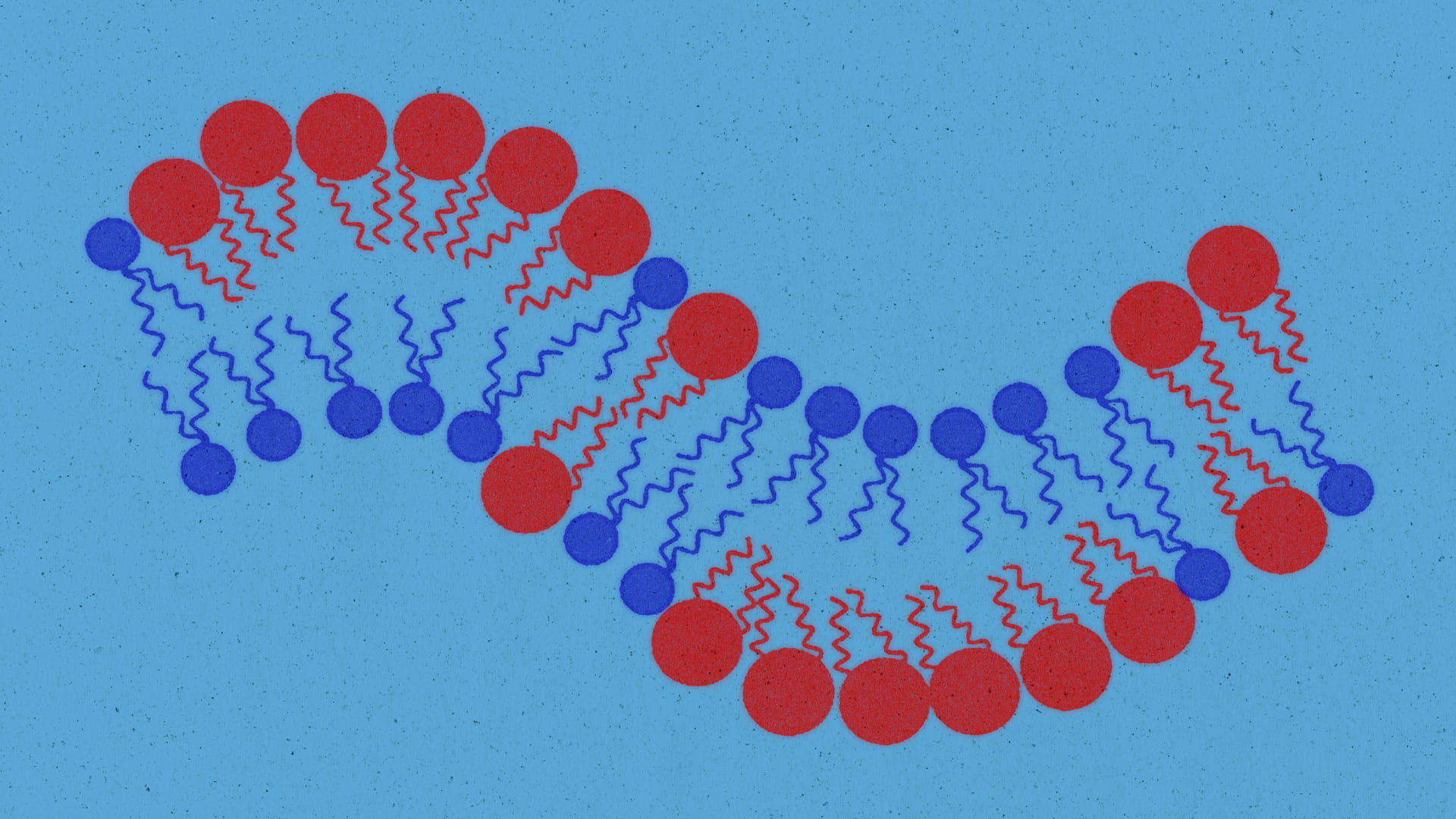
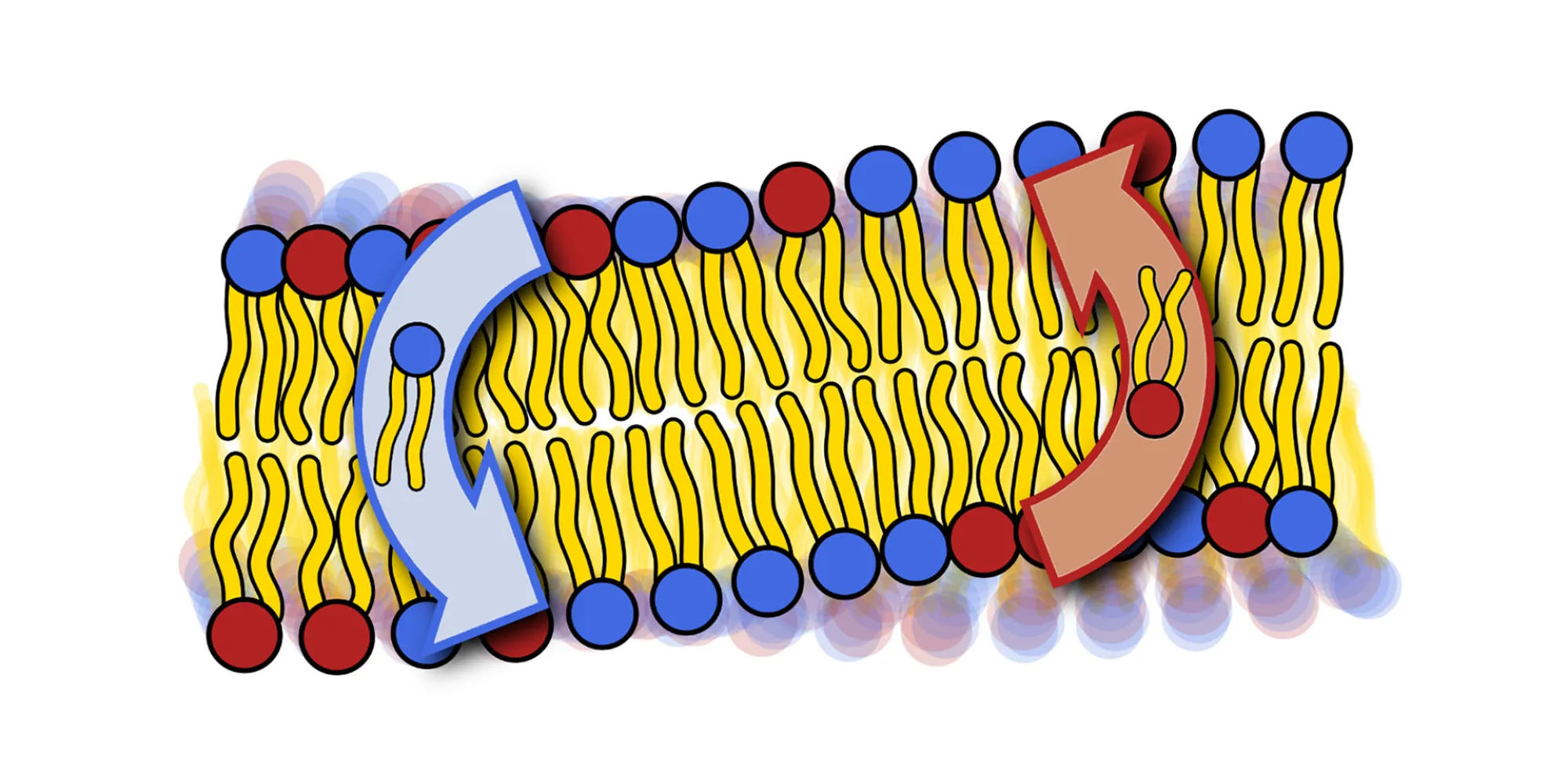
Cell membranes wrap around every cell and are far more than passive shrink wrap. They are dynamic, two-sided structures made of asymmetric lipid layers. While lipids can randomly flip-flop from one layer to the other, membrane proteins sort lipids between the two sides. How lipid flip-flopping and protein sorting interact and shape the overall asymmetric distribution remains a central question. New research from Carnegie Mellon University takes an important step toward answering it.
“Membrane biophysicists are increasingly interested in the complex distribution and dynamics of lipids in cell membranes, especially how lipids move between the two sides,” said Markus Deserno, professor and director of graduate affairs in the Department of Physics. “We found that some basic aspects of this flip-flop process remain unexplored yet are essential for understanding how cells maintain this delicate balance.”
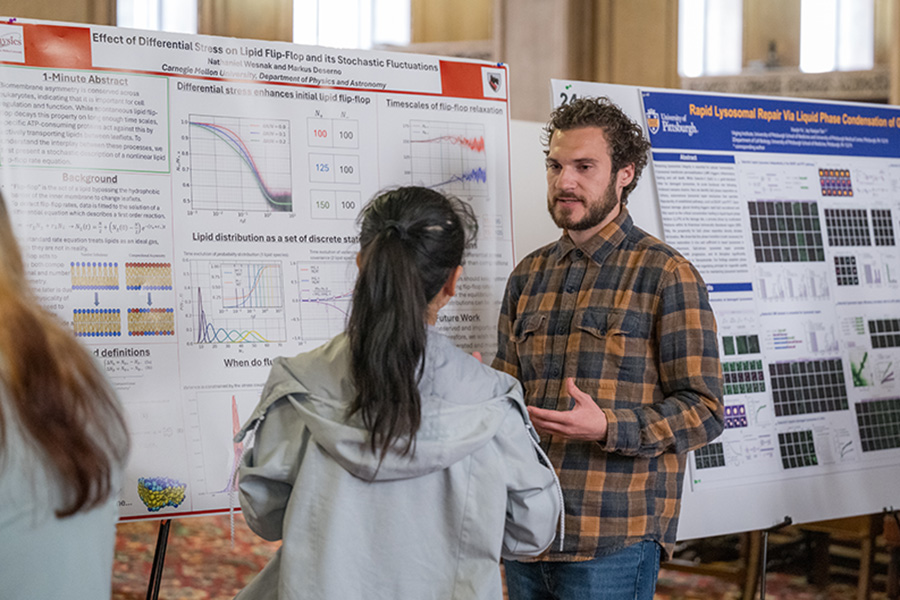
Deserno and Nathaniel Wesnak, a Ph.D. student in the Department of Physics, carried out a quantitative investigation of lipid flip-flop to help fill in this gap. Their findings appear in the Journal of Chemical Physics.
“We work out some important but probably underappreciated aspects of lipid flip-flop that are going to be really important if we ultimately want to understand the whole game — chief among them lipid packing and interactions, as well as the probabilistic time evolution of this random process,” Wesnak said.
Existing quantitative approaches to describe lipid flip-flop focus on experimental measurements or calculations at the level of the individual lipid. These do not account for the randomness of lipid dynamics or the membrane stresses that arise because of lipid interactions, such as packing or non-ideal mixing.
Deserno and Wesnak introduced a framework that treats lipid flip-flops as a series of random events and accounts for lipid interactions, directly coupling flip-flop to membrane stresses. They found membrane stress strongly accelerates flip-flop.
“This work allows us to connect macroscopic observables like asymmetry and mechanical forces to the microscopic lipid dynamics within, while predicting the fluctuating behavior around the deterministic description,” Wesnak said.
This versatile model could be extended to study other aspects of membrane biophysics, including the lipid-sorting proteins.
“Understanding how the constantly moving and reorganizing lipids within biological membranes gives rise to asymmetry remains one of the fascinating open questions in the field, and we hope our new theoretical framework proves useful for exploring it,” Wesnak said.
A version of this article first appeared in Scilight.