Action! NSF–DOE Vera C. Rubin Observatory Begins Capturing the Greatest Cosmic Movie Ever Made
The 10-year Legacy Survey of Space and Time has officially started, marking the beginning of a new era in astronomy and astrophysics
Heidi Opdyke
- Associate Dean of Marketing and Communications, MCS
- Email opdyke@andrew.cmu.edu
- Phone 412-268-9982
The wait is over: NSF–DOE Rubin Observatory, funded by the U.S. National Science Foundation and the U.S. Department of Energy’s Office of Science, is now capturing the cosmos in unprecedented detail, transforming the way we study the dynamic Universe.
From a mountaintop in Chile, under clear dark skies, NSF–DOE Vera C. Rubin Observatory has begun the revolutionary Legacy Survey of Space and Time (LSST). The ten-year survey is Rubin’s signature campaign to create the most comprehensive, cinematic record of the Universe in history.
Rubin Observatory is a U.S. government facility jointly operated by NSF NOIRLab and DOE’s SLAC National Accelerator Laboratory. NOIRLab is managed by the Association of Universities for Research in Astronomy (AURA).
Over the next 10 years, Rubin will relentlessly observe the entire southern sky every few nights to create an ultra-wide, ultra-high-definition time-lapse record of the universe. This long-awaited milestone is the culmination of years of effort by thousands of people around the world.
Carnegie Mellon University has been part of that global effort for more than two decades, helping lay the scientific and computational groundwork that makes Rubin’s discoveries possible. Researchers in CMU’s McWilliams Center for Cosmology and Astrophysics have contributed to the project from its early conceptual stages through today, developing advanced algorithms, data-processing techniques, and open-source software designed to handle Rubin’s unprecedented data stream. That work continues now through initiatives like the LSST Interdisciplinary Network for Collaboration and Computing (LINCC) Frameworks program, which brings together scientists and engineers to transform Rubin’s nightly torrent of observations into usable insights for the worldwide astronomy community.
Today’s announcement follows the celebratory Rubin First Look event that took place in June 2025, which was followed by final commissioning work, an operational readiness review and the beginning of the alert stream.
“Today, we begin filming the greatest cosmic movie ever made,” said Brian Stone, performing the duties of the NSF Director. “This moment reflects decades of vision, innovation, and the power of federal investment in science through the U.S. National Science Foundation and the Department of Energy. Every night, NSF–DOE Rubin Observatory will expand the frontiers of knowledge and strengthen America's global leadership in science and innovation.”
“With the launch of the 10-year Legacy Survey of Space and Time, NSF–DOE Rubin Observatory is opening a new window on the Universe. It is embarking on a mission that will redefine modern cosmology and astrophysics,” said Darío Gil, under secretary for science at the U.S. Department of Energy. “With its world-class design and tools, Rubin Observatory will capture the dynamic nature of our cosmos and reveal unimagined insights into our Universe’s biggest mysteries, from our own Solar System to the very structure of the Universe. By seeking to understand the enigmatic phenomena of dark energy and dark matter, we are not just observing the stars; we are striving to grasp the fundamental laws that govern our existence.”
“It is amazing and humbling to be here at this time and place as we start the Legacy Survey of Space and Time, after more than two decades of incredible work by our dedicated team,” said Bob Blum, director of Rubin Observatory at NSF NOIRLab. “Rubin Observatory is for everyone; the LSST will change how we do astronomy and astrophysics, allowing researchers anywhere to participate in cutting-edge science.”
“It’s taken 20 years of hard science, engineering, and more to get to the point where we can call ‘action’ as we start rolling on this blockbuster movie of the Universe,” said Phil Marshall, deputy director of Rubin Operations for SLAC. “Millions of alerts in just the last couple of months show that Rubin is up and running as a discovery machine. Now we’re putting it all together.”
“The decision to officially begin the LSST was made after a period of system optimization and a careful operational review of technical readiness, data system performance, and scientific validation,” said Željko Ivezić, Head of LSST. Important factors that played a role in this decision included image quality, effective survey speed, system uptime and reliability, and calibration accuracy.
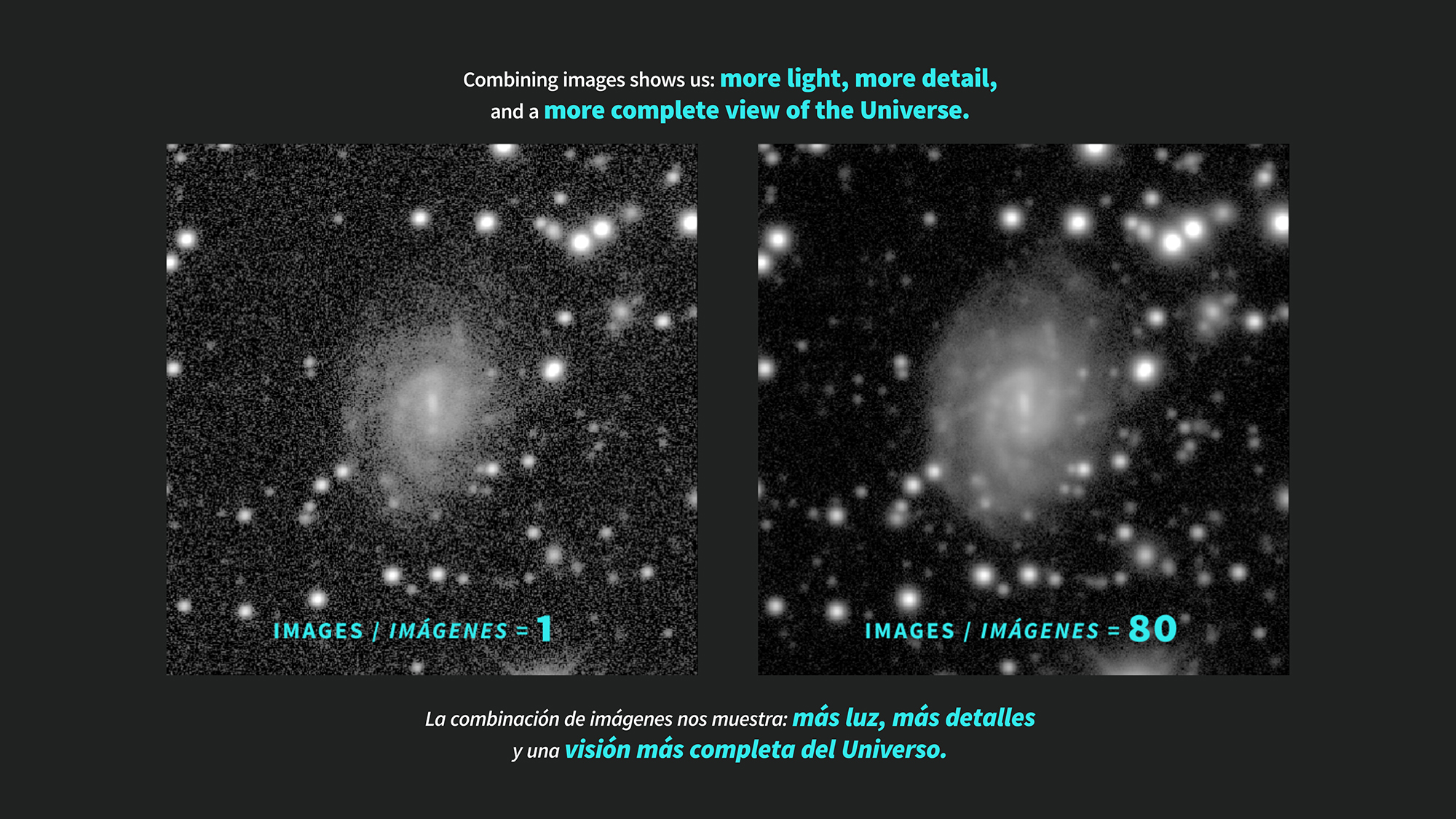
Rubin Observatory’s unique design combines enormous light-collecting power, the ability to move rapidly across the sky, and a wide field of view. Its 3200-megapixel camera — the largest digital camera in the world — is now capturing a new, detailed image approximately every 40 seconds. Operating with this speed and sensitivity, Rubin functions as a unified, well-tuned system capable of catching faint objects and fleeting events with remarkable reliability and consistency every night. Visit rubinobservatory.org to follow the status of the LSST in real time.
Rubin is bringing the Universe to life, illuminating a treasure trove of discoveries: pulsating stars, supernova explosions, the fossil record of galaxies, clues to the mysteries of dark energy and dark matter, and entirely new phenomena we’ve never seen before. Some cosmic processes unfold slowly, unpredictably, or incredibly rarely, which is why a 10-year survey is essential. By returning to each point in the sky about 800 times over a decade, Rubin data is providing the scientific community with deep, time-rich views needed to uncover subtle events, capture moving objects and study the accelerating expansion of the Universe.
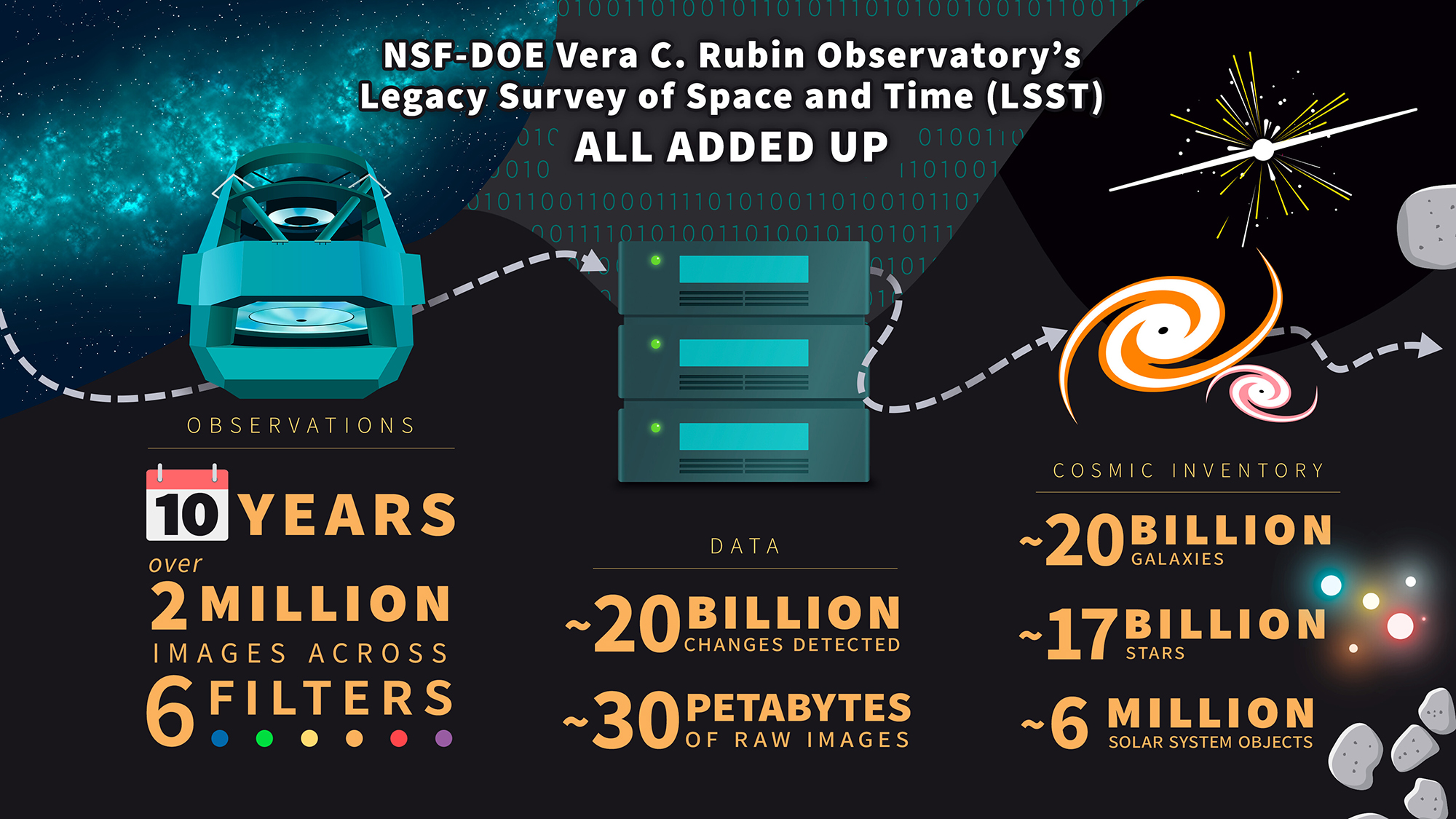
Not only is Rubin helping to unlock the mysteries of the distant Universe, it is also the most powerful Solar System discovery machine ever built. By taking about a thousand images every night, Rubin is compiling an astonishingly detailed census of our Solar System, including millions of asteroids and comets. In just a month and a half, during early optimization surveys, Rubin discovered over 11,000 never-before-seen asteroids, including 33 near-Earth objects and 380 trans-Neptunian objects.
Rubin also will advance opportunities for multi-messenger astronomy, which is the study of cosmic events using multiple signals such as light, gravitational waves, and cosmic rays. The observatory’s rapid, color-rich observations of transients such as stellar explosions, actively feeding black holes, and collisions between compact objects will guide telescopes around the world to follow up on these fleeting events.
Each night, Rubin is collecting approximately 10 terabytes of data and producing as many as seven million alerts of changes in the night sky. These alerts stream to alert brokers — automated systems that sort and classify these changes so scientists can act quickly.
When the LSST is complete, the final dataset will contain billions of objects with trillions of measurements, all accessible through regular data releases. This is the first time so much astronomical data will be available to so many people, opening the door to new kinds of discovery by both scientists and the public. Rubin invites anyone in the world to engage with its data and explore the dynamic Universe in ways never before possible.