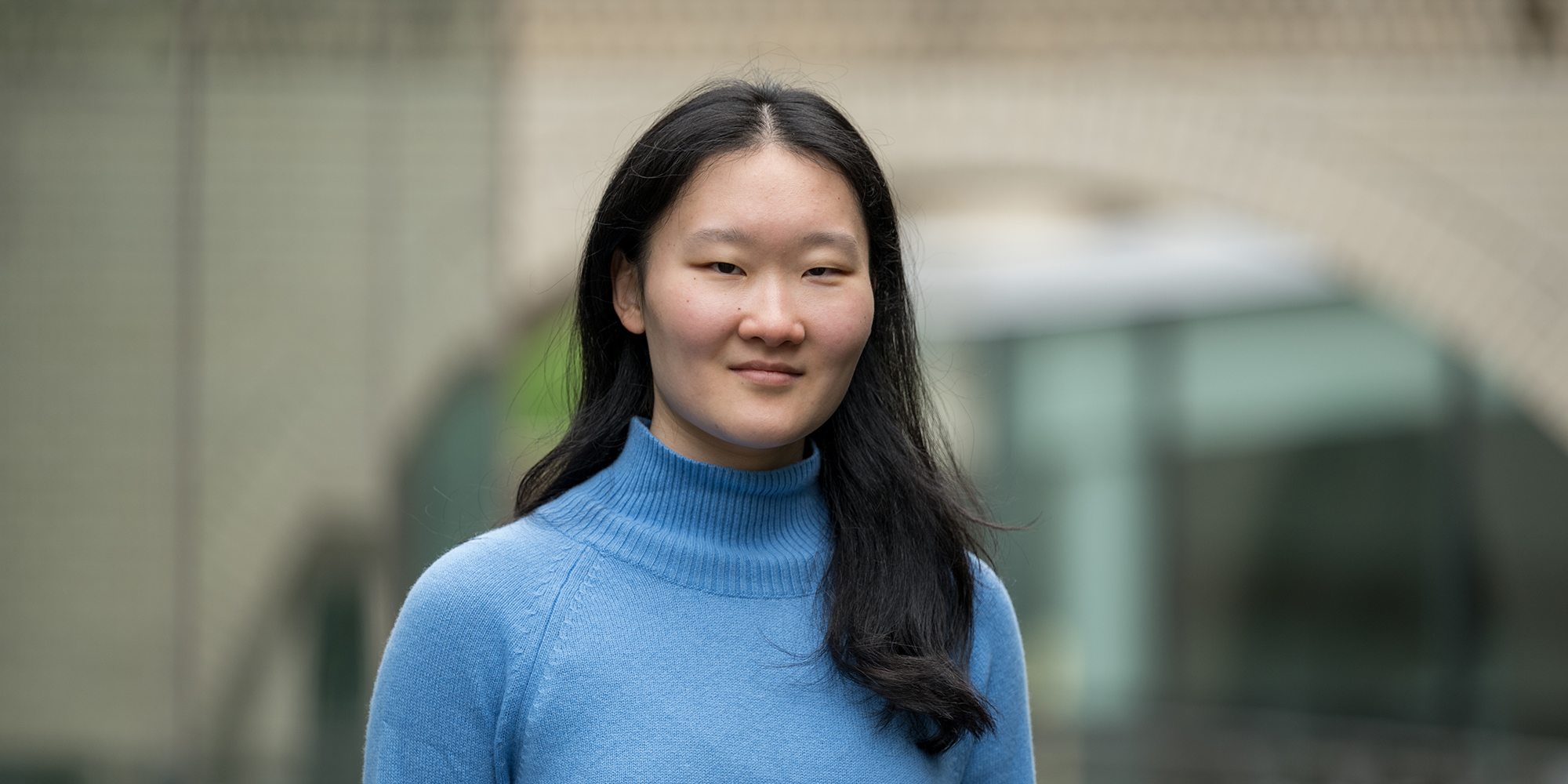

Elizabeth Lee Awarded 2025 Sutherland-Merlino Fellowship
Carnegie Mellon first-year Ph.D. student recognized for academic excellence, interdisciplinary research and commitment to community
Heidi Opdyke
- Associate Dean of Marketing and Communications, MCS
- Email opdyke@andrew.cmu.edu
- Phone 412-268-9982
Carnegie Mellon University’s Neuroscience Institute has awarded Elizabeth Lee, a first-year Ph.D. student in the Program in Neural Computation (PNC), the 2025 Sutherland-Merlino Fellowship. The fellowship provides financial support to one incoming Ph.D. student each year who demonstrates academic promise, eagerness to learn and an enthusiastic spirit.
Lee joined CMU this fall after earning her bachelor’s degree in computer science, and brain and cognitive sciences from Massachusetts Institute of Technology (MIT), where she studied how language is processed in the brain with Evelina Fedorenko. That experience sparked her interest in computational approaches and convinced her to pursue graduate training at the intersection of neuroscience and machine learning.
“I was especially drawn to the PNC program because of its interdisciplinary community and the strong focus on using quantitative methods to study the brain across multiple levels of analysis — from individual neurons and circuits to whole-brain networks and behavior,” Lee said. “It’s an exciting time in neuroscience with both the rise of large-scale datasets and increasingly powerful computational models. I’m passionate about the work, and I felt that CMU and Pitt together offered a unique environment to bridge these two areas.”
As part of her first-year training, Lee is exploring different research directions through lab rotations. She is currently working with Jenelle Feather, assistant professor of psychology and member of the Neuroscience Institute. Feather’s Laboratory for Computational Perception combines computational modeling with behavioral and brain measurements to better understand human perception and cognition.
“Elizabeth has jumped right into her rotation with curiosity and dedication,” said Feather. “She asks thoughtful questions, brings fresh ideas and has quickly become a valued member of the lab. I’m excited to see how her interests in perception language, computation and neuroscience evolve over the course of her graduate training.”
In addition to her academic achievements, Lee has demonstrated a strong commitment to expanding access in STEM. As an undergraduate, she co-developed and taught workshops through MITxHarvard Women in AI, encouraging students from underrepresented backgrounds to pursue interests in science and engineering.
The Sutherland-Merlino Fellowship was established in 2021 by Nancie Merlino, a 1964 alumna of Carnegie Mellon University’s Margaret Morrison Carnegie College, in honor of her late husband, Thomas Merlino, and her father, James Sutherland, both CMU alumni.
“Elizabeth brings a passion for thinking about computational constraints in neuroscience and a commitment to mentoring others,” said Tim Verstynen, professor of psychology and interim director of the Neuroscience Institute. “We are very grateful to Nancie Merlino for supporting students like Elizabeth who are the next generation of leaders in neuroscience.”
