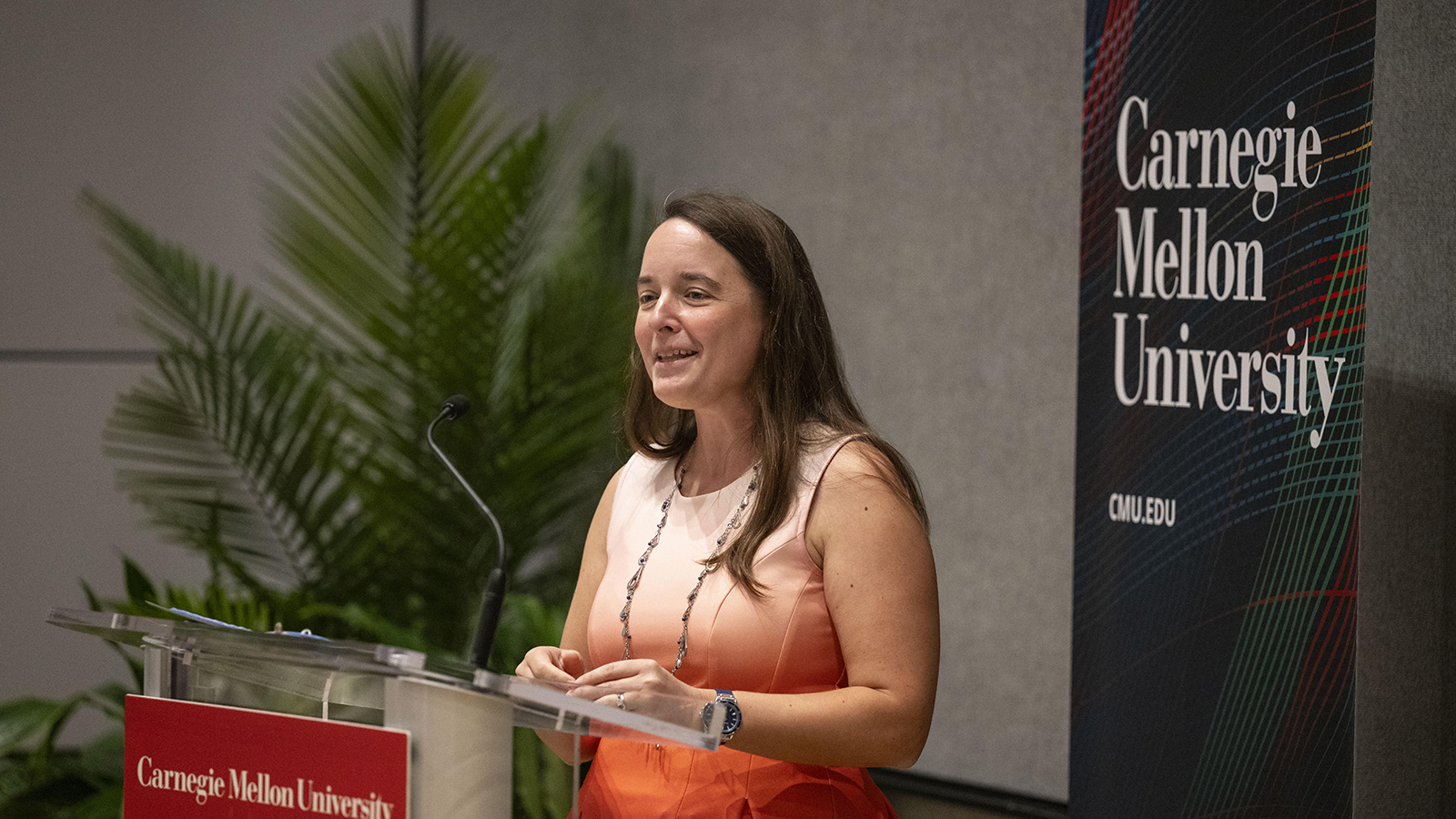

Mandelbaum Appointed Head of Physics Department
Heidi Opdyke
- Associate Dean of Marketing and Communications, MCS
- Email opdyke@andrew.cmu.edu
- Phone 412-268-9982
Carnegie Mellon University has appointed Rachel Mandelbaum as the head of the Department of Physics in Carnegie Mellon University. Mandelbaum, a distinguished physicist and member of the McWilliams Center for Cosmology and Astrophysics, has served as interim head since September 2024.
“Rachel is a visionary leader whose interdisciplinary approach and commitment to collaboration will continue to elevate our department’s global impact,” said Barbara Shinn-Cunningham, Glen De Vries Dean of the Mellon College of Science.
The Department of Physics at Carnegie Mellon is internationally recognized for its interdisciplinary research across biological physics, condensed matter and nanophysics, astrophysics and cosmology, and high energy physics. It is a leader in developing advanced computational tools and simulations, often in collaboration with Carnegie Mellon’s School of Computer Science and the College of Engineering. The department has a rich legacy, including five Nobel Laureates and numerous nationally and internationally acclaimed researchers.
“I’m honored to lead a department with not only a strong legacy but also a vibrant future,” Mandelbaum said. “Our faculty and students are pushing the boundaries of physics, and I’m excited to help shape that next chapter.”
Mandelbaum joined Carnegie Mellon in 2011 and is a nationally recognized expert in weak gravitational lensing, a technique that has advanced understanding of cosmology and galaxy formation. Her research integrates cosmological observations with computer science, statistics and data science.
She leads Carnegie Mellon’s contributions to a major collaboration with the University of Washington and supported by Schmidt Sciences for developing software for analyzing massive datasets from the Legacy Survey of Space and Time (LSST), conducted by the Vera C. Rubin Observatory in northern Chile. This work, part of the LSST Interdisciplinary Network for Collaboration and Computing (LINCC) Frameworks initiative, is transforming how scientists use computational methods to interpret big data.
The Rubin Observatory, a joint initiative of the National Science Foundation and the Department of Energy, will collect over 20 terabytes of data nightly, totaling up to 10 petabytes annually for a decade. These data will enable the creation of detailed composite images of the southern sky, capturing changes over time with unprecedented precision.
“In recent years, the Department of Physics has invested in new faculty who expand our research horizons, and they and other professors share my commitment to the power of mentorship and collaboration,” Mandelbaum said. “I look forward to fostering an environment where students and postdocs are supported not just as learners, but as the next generation of leaders in science.”
Mandelbaum earned her Ph.D. from Princeton University and has held numerous leadership roles in the field. She was elected a Fellow of the American Physical Society in 2024, served on the Particle Physics Project Prioritization Panel (P5) in 2023, and was the spokesperson for the LSST Dark Energy Science Collaboration (DESC) from 2019–2021. Her accolades include the Annie Jump Cannon Prize, a Department of Energy Early Career Award, an Alfred P. Sloan Fellowship, and designation as a Simons Investigator.
She succeeds Scott Dodelson, who served as department head from 2017 to 2024. Dodelson is deputy director of the Particle Physics Directorate at Fermilab and professor at University of Chicago.
