
New Gold Quantum Rods Shine Light on Atomic-Level Design
The materials could serve as light sources for fiber-optic networks and improve deep-tissue imaging
Heidi Opdyke
- Associate Dean of Marketing and Communications, MCS
- Email opdyke@andrew.cmu.edu
- Phone 412-268-9982
Most people value gold for its beauty and rarity. Chemists, however, value it as a versatile building block that can be arranged atom by atom to create materials with dramatically different properties.
Carnegie Mellon University researchers have demonstrated just how powerful those atomic-scale changes can be. They have successfully created and isolated a new family of gold quantum rods that emit exceptionally bright near-infrared light. The discovery could advance technologies ranging from deep-tissue medical imaging to fiber-optic communications while demonstrating how small changes at the atomic scale can dramatically alter a material’s optical properties.
“It’s a bit like performing surgery at the atomic scale,” said Avirup Sardar, a Ph.D. student in the Department of Chemistry. “By moving, adding or rearranging just a few atoms, we can change how the material interacts with light and learn which structural features are responsible for those changes.”
The study, published in Angewandte Chemie International Edition and selected as a very important paper, is part of a broader effort to understand how atomic structure influences the way materials interact with light.
Developing molecules that emit in the near-infrared, specifically wavelengths between 1,000-1,700 nanometers (nm), offers advantages in a variety of medical applications, including deep, non-invasive imaging and image-guided cancer surgery. Unlike visible light, near-infrared wavelengths can penetrate tissues more deeply, dramatically improving the image resolution.
The newly isolated quantum rods, composed of 52 gold atoms (Au₅₂) and 70 gold atoms (Au₇₀), emit light at 1,100 and 1,360 nanometers, respectively. They also exhibit quantum yields of 20.9% and 14.8%, meaning they convert absorbed light into emitted light with exceptional efficiency. Those values are unusually high for this wavelength range, where most commercial dyes typically achieve only one to, at most, a few percent.
The materials also could prove useful in telecommunications. Au₇₀ emits at 1,360 nm, a wavelength near the O-band used in fiber-optic communication networks, which transmit information as pulses of light through glass fibers.
“Most dyes that emit in this region are not very bright. And the brighter materials, such as quantum dots, are not atomically precise,” Sardar said. “Our quantum rods are much brighter than dyes and are atomically precise, so every rod is identical. That means they have the potential to produce better signals using less material, and their emission can be tuned simply by changing their length.”
The quantum rods are fast, too. In fiber optics, how quickly a material releases light after absorbing energy dictates how fast it can be switched on and off to encode data.
The Carnegie Mellon quantum rods do so in just 1 to 1.4 nanoseconds, a key advantage for device applications. The work builds on former CMU Chemistry Professor Rongchao Jin group’s 2024 discovery of the first series of gold quantum rods, which demonstrated that rod-shaped gold nanoclusters could strongly absorb and emit near-infrared light.
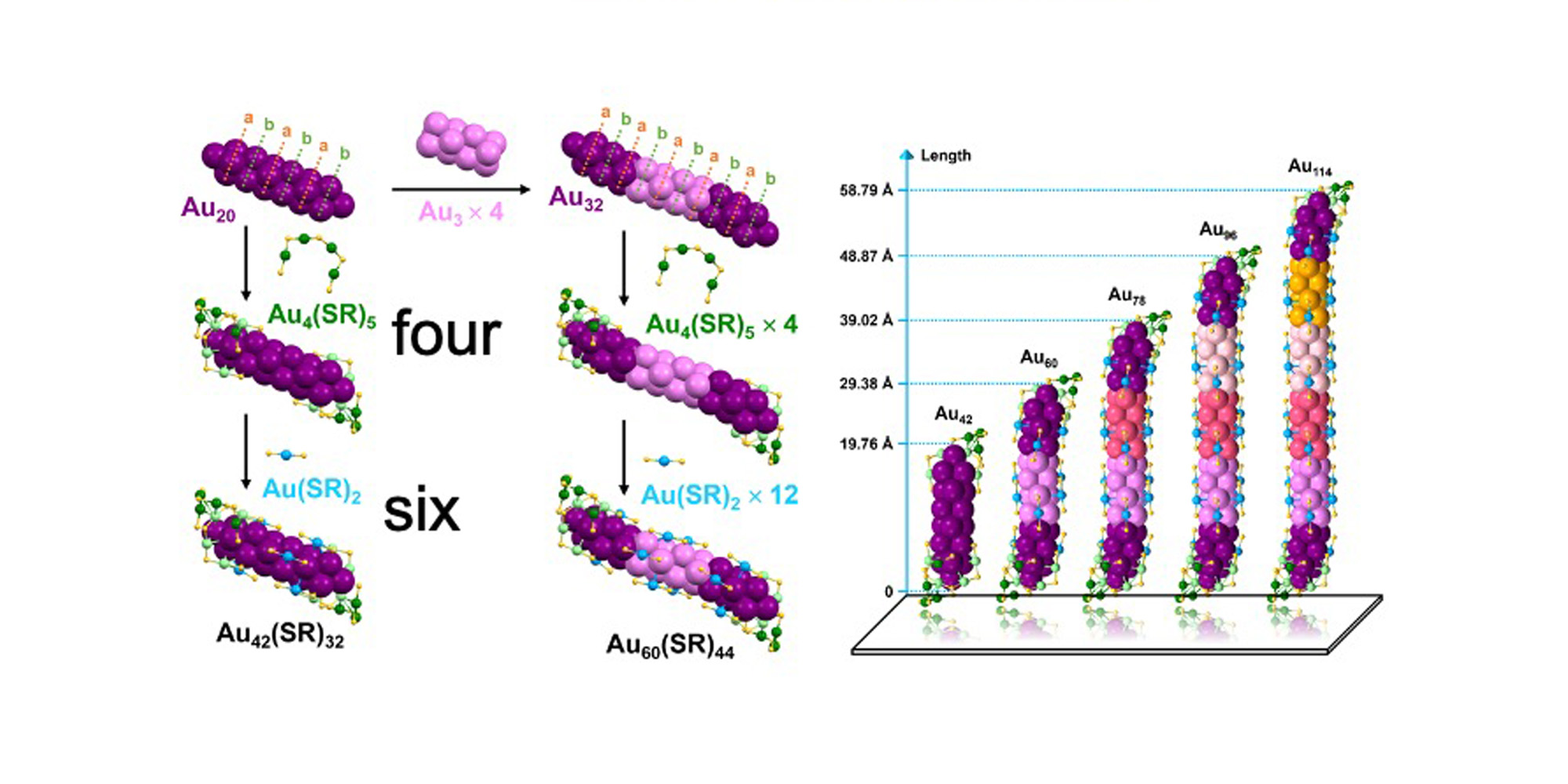
In the new study, Sardar and CMU alumnus Lianshun (Evan) Luo were the first to isolate a second family of quantum rods. Like the original series, the new rods grow through the repeated addition of identical gold building blocks. The researchers found an important difference, however. The first series originated from a cluster containing 24 gold atoms and produced rods that tapered to points at both ends. The second series begins with a 34-atom cluster, resulting in rods with one pointed end and one flat end.
Researchers expected those structural differences to affect how the rods interact with light. Instead, both series followed the same relationship between rod length and the wavelengths of light they absorb and emit.
“The result tells us that length is the key factor,” Sardar said. “That gives us a much clearer roadmap for designing new materials.”
By demonstrating that researchers can systematically engineer optical behavior through atom-by-atom structural control, the study expands the design space for gold quantum rods and offers new guidance for creating next-generation materials for imaging, communications and photonic technologies.
This work was supported as part of the Atomic-C2E project by the U.S. Department of Energy, Office of Science under award number DE-SC-0024716.