RE2 Robotics hosts students for a site visit
Preparing the workforce for a career in Robotics
SMART Robotics Technician Training
Develop foundational skills for robotics and advanced manufacturing through Carnegie Mellon Robotics Academy’s Smart Manufacturing and Advanced Robotics Training (SMART) program.
SMART is open to anyone interested in learning—including people exploring technical careers, workers developing additional skills, and educators preparing to teach these subjects. Its hands-on curriculum introduces concepts and practices used to build, program, maintain, and troubleshoot robotic systems.
CMRA and its partners help to facilitate an initial talent pipeline of high school students interested in technical careers. By partnering with local colleges like Community College of Allegheny County and Westmoreland County Community College, CMRA further incentivizes new audiences to pursue training in the emerging robotics technician field. Graduates of the SMART program can enter community colleges’ accelerated fast-track training with credits waived due to curriculum alignment, saving thousands in tuition dollars and reducing the overall cost of attendance.
Why the SMART program?
- Teaches the KSA needed of Robotics Technicians in the industry
- Utilizes relatively low-cost materials
- Utilizes CMRA's Learning Management System for Tracking Progress
- Earn credits at participating Community Colleges
- Registered PA Pre-Apprenticeship Program
Research-Based
The SMART Robotics Technician Curriculum originated as a set of five courses developed through a research project funded by the ARM Institute, known as the Smart Manufacturing and Advanced Robotics Training (SMART) Project. This comprehensive program focuses on the essential Knowledge, Skills, and Attitudes (KSA) required for Robotics Technicians—skilled professionals who build, maintain, and troubleshoot robotic systems across various industries. The KSAs were identified through extensive research involving industry professionals, exploring critical skills, tools, and workplace dynamics.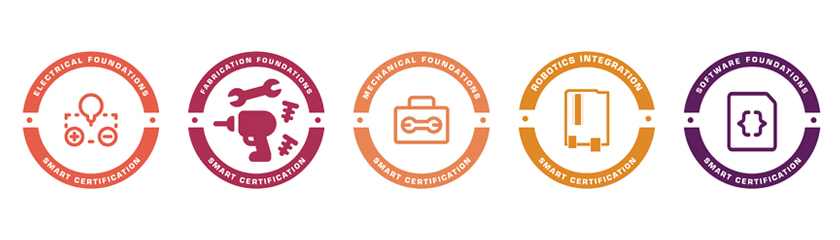 With additional support from the National Science Foundation and the Office of Naval Research, we have continuously updated and refined these courses. This support has allowed us to expand the curriculum to include additional robotics platforms and introduce new micro-credential topics such as Robot Operations and Autonomy Foundations. These curricula are designed to align with Workforce Development and Career and Technical Education (CTE) goals, ensuring that students develop the practical skills needed for success in this rapidly evolving field.
Learn More About the Research Behind SMART
How to Get Started
1) Preview the Curriculum
The SMART curriculum includes an estimated 200 hours of hands-on learning activities. Each micro-certification course contains units that describe real-world application examples to provide context to the student, deliver step-by-step direct instruction to construct hands-on artifacts, and end with a project to apply their newly learned knowledge and skills.
Learn More About The SMART Curriculum
2) For educators and facilitators: Prepare to teach SMART
Educators and program facilitators who plan to teach SMART can take professional development to strengthen their technical knowledge and learn how to deliver the curriculum. Participants work through hands-on activities and explore teaching strategies, troubleshooting methods, and ways to support their learners.
The following professional-development courses are available:
- Electrical Foundations with Arduino - Online Training
- Mechanical Foundations with VEX V5 - Online Training
- Mechanical Foundations with REV DUO - Online Training
- Robotics Integration & Software Foundations with Arduino - Online Training
- Fabrication Foundations with Hand Tools - Online Training
- Jetson Nano with JetBot AI - Online Training
3) Access the curriculum through CS2N
SMART courses are delivered through the CS-STEM Network (CS2N), Carnegie Mellon Robotics Academy’s online learning platform. Learners can access course materials, complete activities, and track their progress. Educators and facilitators can also use CS2N to organize groups and support their learners.
4) Earn SMART micro-certifications
Demonstrate your learning by completing the activities and assessments required for SMART micro-certifications. Review your selected course for its specific requirements.
Educators interested in offering certifications to their learners should review the additional instructor-training and certification requirements.
Facilitator Training
- Electrical Foundations with Arduino - Online Training
- Mechanical Foundations with VEX V5 - Online Training
- Mechanical Foundations with REV DUO - Online Training
- Robotics Integration & Software Foundations with Arduino - Online Training
- Fabrication Foundations with Hand Tools - Online Training
- Jetson Nano with JetBot AI - Online Training
Implementer's Guide
We've put together a guide for organizations who wish to implement the SMART program. It contains descriptions for each course, links to needed materials, and costs.
Program Pathways
State Credentialing
- Alabama - Mechanical Foundations (with VEX V5) - Approved
- Pennsylvania - Registered Pre-Apprenticeship
- Virginia - Board-approved Industry Credentials for Students [Link]
Note: Other states may have approved the program/courses! Many times it is a teacher who champions the program and gets approved without us knowing (amazing!). If you are one of them, please let us know!