
CMU Advances Defense Manufacturing and Military Education at Pennsylvania Defense and Innovation Summit
Media Inquiries
Carnegie Mellon University showcased a number of exciting new partnerships, technologies and research during the 2026 Pennsylvania Defense and Innovation Summit(opens in new window). The event, hosted by U.S. Sen. David McCormick(opens in new window), ran from July 14-15 at the U.S. Army War College in Carlisle, Pennsylvania.
Among its announcements, CMU introduced a new initiative devoted to strengthening the nation’s manufacturing pipeline for autonomous technologies and a new academic partner — and first military college — to join its national AI-enabled education network.

"This year’s summit underscores the power of partnership. Once again, Senator McCormick has convened key players from the public and private sectors — leaders from across government, industry, academia and labor — who are fueling our innovation ecosystem. This network is working together to build on Pennsylvania’s strong manufacturing and energy base while accelerating technologies that will define our future,” said CMU President Farnam Jahanian(opens in new window). “It is yet another example of how bold collaborations can meet the urgency of the moment and transform breakthrough ideas into emerging technologies that will strengthen national security and American competitiveness for generations to come."
Additional Resources
- Carnegie Foundry: Bringing AI, Robotics and Energy Innovations to Market
- Building Mission-Ready Technology and Talent
- Meet the Experts - Defense, Innovation and Workforce Preparation at CMU
- When One Drone Isn’t Enough: CMU Builds Swarms for High-Stakes Response Efforts
- Military Education and Workforce Preparation(opens in new window)
- Carnegie Mellon Expands Learnvia to Military Colleges


CMU and Carnegie Foundry,(opens in new window) in partnership with American drone manufactures, launched an initiative to develop reusable production, inspection, testing and automation capabilities to help U.S. manufacturers produce autonomous technologies more efficiently and at greater scale.
The university also announced that Learnvia, its nonprofit learning collaborative, will expand to military colleges, beginning with Valley Forge Military College near Philadelphia. The partnership will bring AI-enabled courseware and decades of CMU learning science research to students preparing for military leadership and national service.
Together with robotics demonstrations and workforce discussions led by CMU faculty and staff at the summit’s trade show, the announcements highlighted the university’s role connecting technological innovation, manufacturing capacity and talent preparation in service to the nation’s security.
Building manufacturing capacity for autonomous systems
On Wednesday, CMU’s National Robotics Engineering Center(opens in new window), Carnegie Foundry — a Pittsburgh-based venture studio that builds and scales companies — and U.S. drone manufacturers ViDARR Inc. and Envision Technology LLC, announced a national initiative to scale drone production through robotics, automation and advanced manufacturing.

Drawing on more than $50 million in CMU investments in robotics, advanced manufacturing and commercialization infrastructure, the initiative will create a new Autonomous Systems Manufacturing Platform that American manufacturers can deploy in their own factories to produce drones at the scale and speed needed to support national security priorities.
“As large-scale manufacturing of advanced autonomous systems becomes a strategic imperative, Carnegie Mellon is leveraging its decades of pioneering research to bridge the gap between invention and production,” said CMU Vice President for Research Theresa Mayer(opens in new window). “By fostering deep industry partnerships, we are strengthening the nation’s innovation ecosystem and ensuring vital advancements reach the field."
Expanding educational tools to military learners
CMU also announced that Learnvia(opens in new window), its nonprofit, AI-powered national learning collaborative, will expand to military colleges. Valley Forge Military College(opens in new window), Pennsylvania's only military college, is Learnvia’s first academic military partner, with additional military colleges expected to join over the next year.
Launched earlier this year, Learnvia combines free AI-enabled courseware and great teaching with decades of research in learning science to improve student success in gateway mathematics college courses. Designed to complement classroom instruction rather than replace it, the platform integrates lessons, interactive learning activities, homework, assessments, discussion forums and an AI tutor into a single learning environment.
Showcasing robotics, AI and workforce expertise
The announcements were accompanied by CMU faculty and researchers leading demonstrations and impromptu discussions throughout the summit.
Wennie Tabib(opens in new window), who leads the Resilient Intelligence Systems Lab at CMU’s Robotics Institute, showcased autonomy and agile flight used in complex, unstructured environments, while Howie Choset(opens in new window), CMU’s Kavčić-Moura Professor of Computer Science, demonstrated snake robots and motion-planning approaches for confined, hazardous and hard-to-reach environments.
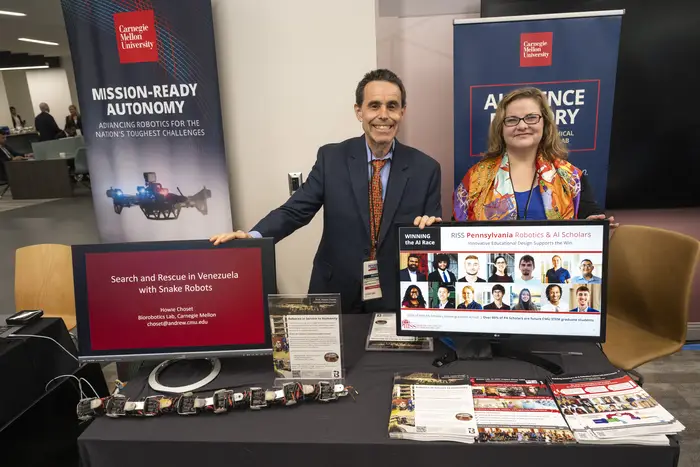
“It’s nice to find collaborators who can use the technology and ideas we’ve developed,” Choset said of the connections he made at the summit. “Sometimes we find people who give input to our ideas, and academics don’t hold a monopoly on being able to generate new concepts.”
Choset said feedback from rescue workers, medical professionals, manufacturing workers and others who use technology in practice has helped his research group identify problems over time and develop more innovative solutions.
The summit also helped to connect organizations and experts working across different parts of the defense ecosystem. Thomas Longstaff(opens in new window), chief technology officer at CMU’s Software Engineering Institute(opens in new window), said those interactions enable summit attendees to better understand how capabilities in areas like cybersecurity, AI and software engineering fit together in support of the nation’s defense goals.
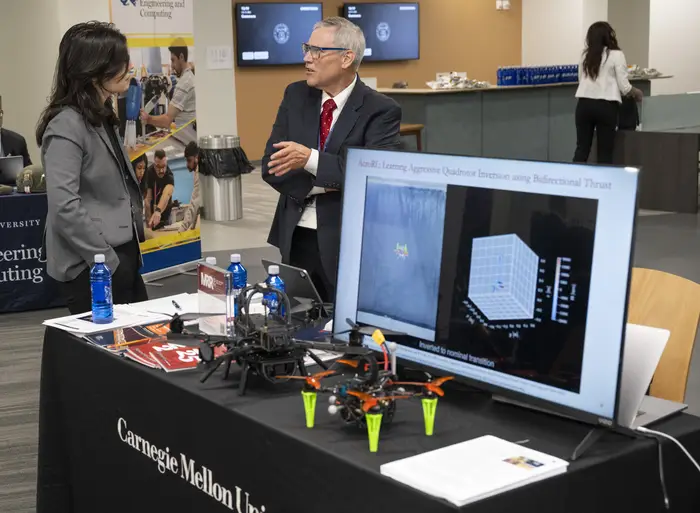
Other CMU participants addressed the workforce and talent pipelines required to implement new technologies successfully.
David Ulicne, executive director for executive education at the Heinz College of Information Systems and Public Policy, said companies often underestimate the human and organizational dimensions of technology adoption.
“We often say that the technology is easier than the people and process side of things,” Ulicne said. “Workforce development is critical — both to get people up to speed on new technologies and to give them the confidence to implement them.”
Building a stronger defense workforce also requires expanding the pipeline of U.S. students prepared for advanced study in computer science, robotics, AI and related fields. Rachel Burcin(opens in new window), global programs manager for the Robotics Institute, spoke to summit attendees about her work to provide domestic undergraduates sustained research experience(opens in new window) and a clearer path to graduate education.
“There are certain industries and certain positions where U.S. residency is especially important,” she explained. “By combining research opportunities with talent-pipeline programs, we can help more U.S. students move into graduate education and prepare for those needs.”
Supporting Pennsylvania’s defense innovation ecosystem
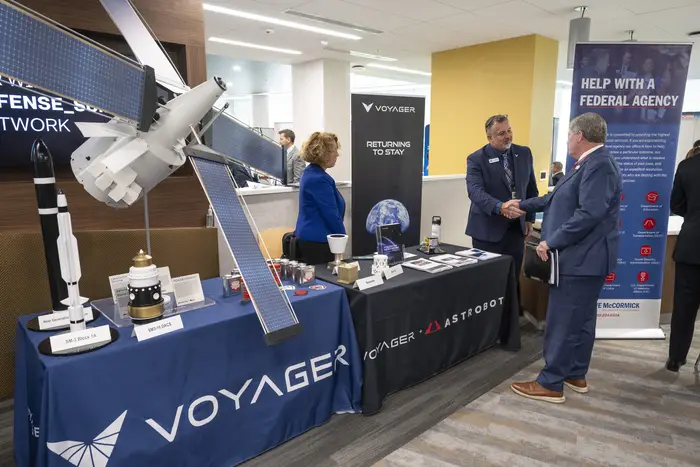
In addition to university leaders and faculty, several CMU-connected startups — including Astrobotic, Lovelace AI, Near Earth Autonomy, Gray Swan and Strategy Robot, Inc. — participated in the summit, underscoring the university’s role in connecting Pennsylvania’s research strengths to its manufacturing and entrepreneurship base.
CMU spinout Carnegie Robotics announced it was selected for Phase III of the Army’s GEARS/ATV-S autonomous ground logistics program, positioning the company for a future production opportunity worth up to $400 million across more than 750 Army tactical logistics vehicles.
Voyager Technologies noted its recent acquisition of another CMU spinout, Astrobotic — valued at up to $300 million — alongside a roughly $297 million NASA task order for lunar surface delivery.
In all, the summit served as the backdrop for nearly $10 billion in investment-funds(opens in new window) revealed in more than 30 individual announcements and devoted to advancing Pennsylvania’s defense industrial base, innovation ecosystem and workforce pipeline.

CMU and Our Nation’s Military: A Unique and Historic Partnership

For more than a century, Carnegie Mellon University has partnered with the U.S. military to help meet the demands of a changing world.
Explore CMU’s legacy of military education and innovation(opens in new window)


