

2026 Student Internship Spotlight
By Evan Lybrand
Media InquiriesEvery year, students from each of our five programs take part in summer internships with top companies, government agencies, research firms and startups across the country. With these internships, our students get to utilize the skills and lessons gained from their courses in real-world settings, working alongside industry professionals.
Some of our current students shared their internship experience with us:
Fenglin Yu
MS in Information Networking (MSIN)
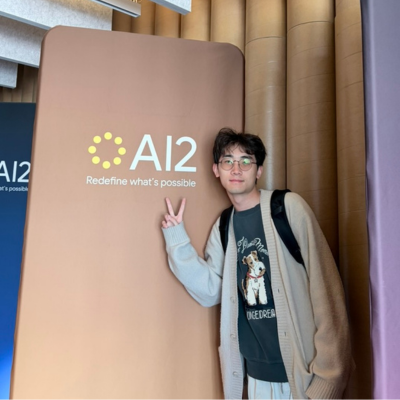 Company: Google
Team: Google Network Infrastructure Team
Projects: I designed and built a distributed telemetry service for network configuration delivery. The network is divided into multiple sharded domains, and the service collects and aggregates telemetry across those domains. This provides better end-to-end visibility into the network configuration delivery pipeline. I contributed to the project throughout its lifecycle, including design, implementation, testing, integration and production rollout.
Most Exciting Aspect: The most exciting part was building a brand-new service from the ground up and deploying it into production. This allowed me to experience the complete lifecycle of a production service—from understanding the problem and developing the initial design to implementation, testing, monitoring and rollout.
It was especially valuable to see how an infrastructure team with high standards for quality and reliability approaches each stage of development. Seeing something I built become part of a production environment was both exciting and rewarding.
Lessons: One of my most important lessons was how much thoughtful preparation goes into writing good production code. Before beginning implementation, it is important to create a clear design document, evaluate the advantages and disadvantages of different approaches and explain why a particular solution was selected. I also learned that there is not always a perfect solution. Engineering often involves choosing a practical compromise because of technical constraints, existing systems or limitations in the production environment. Good engineering means understanding these tradeoffs and documenting the reasoning behind the final decision.
Another important lesson was how to communicate technical ideas effectively. I realized that although Artificial Intelligence (AI) tools can accelerate parts of the development process, relying on them without developing a complete understanding of the underlying design and code can make it difficult to explain decisions or discuss the system with other engineers. I learned to treat AI as a supporting tool while maintaining ownership of my work. By making sure I could clearly explain what I designed, how the code worked and why I made each decision, I became a more effective communicator and collaborator.
How INI Coursework helped: 14-736: Distributed Systems: Techniques, Infrastructure and Services was especially helpful during my internship. Distributed systems are fundamental to infrastructure engineering, and concepts such as scalability, fault tolerance, communication between components, consistency and failure handling frequently arise in infrastructure projects.
Having this foundation helped me understand the project’s architecture and terminology, communicate more effectively with the team and ramp up more quickly. It also helped me reason about the challenges of collecting telemetry across multiple distributed and sharded domains.
Jasmine Watissee
MS in Information Security (MSIS)
 Company: Cloudflare
Team: Application Security Team, Web Integrity & Trust Sub Team
Projects: I worked on two projects. The first focused on product research around malicious bots. Many malicious bots ignore robots.txt directives set by website owners and even try to bypass WAF rules by changing their attributes such as their IP address or user agent. For many websites, unauthorized scraping can undermine the value of their content and negatively affect their business model, so preventing malicious bot activity is important. However, blocking alone is only a partial solution since bot operators continuously adapt to detection and mitigation techniques. My project was to explore techniques to disrupt bots rather than block them, for example by serving them misleading or synthetic content.
My second project was to improve an internal threat intelligence platform. This platform tracks publicly available tools designed to bypass Cloudflare protections such as Turnstile and Challenges. The platform did not have a dedicated owner and was rarely used as it was not giving each team the information they needed so my initial task was to improve it. The project was initially scoped as a series of small changes but after evaluating the platform, I identified fundamental architectural limitations and proposed rebuilding it from scratch instead of doing incremental improvements. I wrote a Product Requirements Document (PRD) and began rebuilding the platform, although the internship ended before I could complete the implementation.
Most Exciting Aspect: The most exciting aspect was working at Cloudflare! I really admire the work Cloudflare is doing and getting to see it from the inside was amazing. Every team was working on exciting projects that are especially relevant right now, particularly at the intersection of AI and security. My manager, for example, was thinking about and designing the future of web browsing. As people increasingly rely on AI agents and AI-generated search summaries instead of visiting websites directly, an important question is how to build an ecosystem that still works for users, search engines and website owners.
Every team was tackling real-world problems that felt incredibly relevant, and one of the best parts of my internship was simply talking with people from other teams and learning about their work!
Lessons: I learned a lot during my internship, but the most important lesson was that even as an intern, I have something to bring to the table and I shouldn’t be afraid to take initiative. At the beginning of my internship, I relied heavily on my manager’s guidance, but as I became more familiar with the team and its workflows, I grew more confident making my own decisions and proposing ideas that could be useful for the team. By the end of the internship, I had learned to trust my own judgment and speak up when I saw an opportunity to improve something.
How INI Coursework Helped: Technical courses such as 14-742: Security in Networked Systems helped me understand the technical concepts for my projects. Even though I was a product manager, that technical background allowed me to communicate effectively with engineers and make better product decisions together. Another course that greatly helped me was 14-817: Cyber Risk Modeling, which taught me to approach product decisions by considering risk, usability, customer impact and security together. Finally, 14-601: Academic and Professional Development helped me develop the communication, teamwork, presentation and networking skills that I used throughout my internship.
Serena Gomez
MS in Artificial Intelligence Engineerong – Information Security (MSAIE-IS)
 Company: Cisco
Team: AI and Software Platforms team
Projects: I worked on automated multimodal tests for Cisco's AI Canvas product, and enhanced Cisco's internal AI QA tooling to improve bug verification for AI Canvas.
Lessons: I learned that continuous edge-case validation is essential for non-deterministic AI systems, clear communication between platform and model teams speeds up bug resolution, thorough documentation saves major engineering time during integration and people are generous with their time if you approach with genuine curiosity
How INI Coursework Helped: 14-763: Systems and Tool Chains for AI Engineers gave me the foundation to navigate Cisco's data platform, authentication layers, and deployment pipelines from day one. My Independent Study on Zero-Trust Architecture for Multi-Agent AI Systems translated directly into my work strengthening bug verification for AI Canvas. And 14-602: Academic and Professional Development sharpened the technical communication skills I relied on constantly.
Raghav Trivedi
MS in Artificial Intelligence Engineerong – Information Security (MSAIE-IS)
Company: Bank of New York (BNY) AI Hub 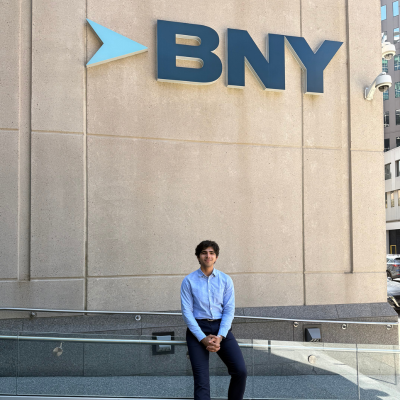
Team: AI Governance and Controls team
Projects: My work focused on automating governance processes across the AI development lifecycle, aimed at improving the overall risk and compliance posture of the company. Additionally, I developed adversarial evaluations for speech-to-speech systems that are deployed enterprise-wide.
Most Exciting Aspect: The most amusing aspect was seeing how BNY truly operationalizes its motto: "AI for everyone, everywhere and for everything." Reflecting on my role within governance, it was rewarding to see how baking controls directly into developer environments accelerates innovation rather than merely existing as a checklist. I also really enjoyed diving into BNY’s "Digital Employees" initiative to see how these multi-agent workflows operate in practice. Plus, having La Prima baristas serving complimentary coffee right on our floor was a fantastic daily perk.
Lessons: Beyond engineering a "perfect build," I learned the importance of addressing cross-functional intangibles when working across diverse teams and stakeholders. It challenged me to look beyond a good looking solution on paper, and communicate the broader organizational impact of my work. I also took to heart the principle that "it is better to be consistently good than occasionally great." Building a reputation as a dependable, consistent team member is essential in an enterprise setting, and that is an attribute I strive to cultivate continuously.
How INI Coursework Helped:
-
14-741: Introduction to Information Security: This course gave me a strong security-first perspective that helped when evaluating AI development frameworks. Applying fundamental security primitives helped me holistically analyze modern architectures by continually asking what could break and how to defend against potential vulnerabilities.
-
14-691: AI Ethics (taught by Prof. Lake Dai): The seminar-style structure brought in CEOs, research scientists and industry leaders to discuss AI safety, interpretability and risk management. Hearing directly from those on the front lines gave me valuable real-world context that directly informed my perspective on AI governance during my internship.
Rohin Joshi
MS in Information Technology – Information Security (MSIT-IS)
 Company: Qualcomm
Team: Windows on Snapdragon team
Projects: I was responsible for designing the control plane for the windows kernel fuzzing infrastructure.
Most Exciting Aspect: I really enjoyed the work because it was a strong mix of systems and security, and I had a lot of ownership over the project. Since the team was small, I got to work fairly independently and take responsibility for designing the control plane from the ground up. I also really enjoyed interacting with the highly talented engineers around me and learning from their experience.
Lessons: I developed a much stronger understanding of designing distributed systems in high-failure environments, as well as fuzzing, compiler code generation and OS internals. I also learned more about where Large Langauge Model (LLM) agents can be useful in infrastructure and, equally importantly, where they should not be used.
How INI Coursework Helped: While a lot of the work required self-learning, several INI courses were particularly helpful. 14-513: Introduction to Computer Systems was probably the most impactful because it gave me a broad understanding of systems and memory, 15-440 Distributed Systems helped me understand the tradeoffs involved in system design, 18-739: Hacking and Offensive Security and 14-741: Introduction to Information security gave me a strong introduction to fuzzing and various vulnerability classes, which was directly relevant to my work. Finally,14-740: Fundamentals of Telecommunications and Computer Networks helped me understand and debug some of the unusual networking issues I encountered while working on the infrastructure.