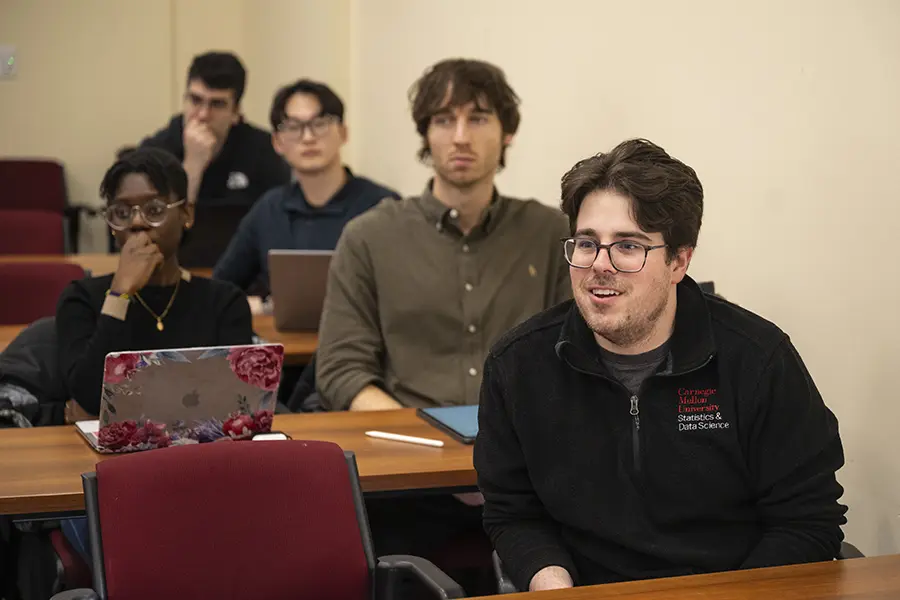
Statistics & Data Science Ph.D. student Tristan Luca Saidi presents to the Causal Inference Working Group.
How to Separate Cause From Coincidence
The Causal Inference Working Group, hosted by the Dietrich College Department of Statistics & Data Science, leads to real-world impacts.
By Jason Bittel
One month, coffee is bad for you. The next, it’s a superfood. Similarly, butter, eggs, wine and a host of other products have gone from villain to hero and back again. And while stories like these grab many headlines, correlation-heavy studies can also erode the public’s trust in science altogether.
But at Carnegie Mellon University’s Dietrich College of Humanities and Social Sciences, an interdisciplinary group of researchers is working to design studies that don’t just find patterns and correlations — they actually infer causation. And this cohort has already generated exciting, new research across a wide range of topics, from criminal justice and healthcare to social services and human rights.
 “The correlation-doesn’t-imply-causation line is perhaps the greatest public relations thing that anyone’s ever done for statistics,” said Zach Branson, an associate teaching professor and assistant director of the undergraduate program for the Department of Statistics & Data Science. “But it does also make some people think that you can never get a causal inference.”
In fact, researchers are getting better at proving causation all the time, and new tools, such as machine learning and artificial intelligence, are helping them in that quest. Since 2016, the Statistics & Data Science Department has looked to serve as an incubator for this type of work by hosting something called the Causal Inference Working Group.
“Broadly speaking, this is a group of faculty and graduate students who are all interested in causal inference from a statistical perspective,” said Branson. “But it’s also open to other departments, and we sometimes have people from the Department of Philosophy, Information Systems and the Heinz College’s School of Public Policy and Management, or even colleagues from other institutions, like epidemiologists from the University of Pittsburgh.”
The group meets weekly and works to develop statistical and computational methods that help researchers move beyond correlation and toward evidence they can use with more confidence. Sometimes, a researcher will present on an interesting new paper published in the field, while other times, a member will come to the group looking for advice on a study or experiment that is already taking place.
 “Causal inference is something that comes up everywhere,” said Eli Ben-Michael, an assistant professor in the Department of Statistics & Data Science and Heinz College. “They care about it in economics, and in medicine, and anywhere where you want to compare two groups and make sure the only thing that’s different is the thing we actually care about.”
Why Causation Matters
Edward Kennedy, professor in the Department of Statistics & Data Science and co-founder of the working group, helps build tools that researchers can use to find causal inference out in the real world.
He’s been part of massive experiments at Facebook, Meta and Instagram that looked at how algorithms can affect people’s consumption of social media, and what that might mean for, say, political polarization. Interestingly, one study published in the journal Nature in 2023 found that echo chambers don’t actually cause polarization.
“Which was surprising,” Kennedy said.
However, there’s a chance that the causal inference models he developed for that suite of research might be more useful in detecting causality in much smaller subsets of participants. Interestingly, these so-called “personalized causal effects” — or situations where the overall group does not show causality, but subgroups within the whole do — are one of the ways machine learning can help researchers discover new insights that would have been invisible before.
“This comes up a lot in medicine, where researchers may want to try to tailor medical decisions to certain kinds of people,” said Kennedy. “For instance, we know that some drugs don’t work on some types of people.”
Rather than dismissing the drug or treatment altogether, causal inference methods can help researchers hone in on the populations that can best use them.
“We’re getting good at finding subtle stories in the data you might miss with more classical methods,” he said.
Wide-Ranging Applications for Causal Inference
Name a field, and there’s a way causal inference can add insight.
In 2025, Ben-Michael used causal inference to assess whether AI could help judges make better decisions from behind the bench, and Branson was able to disentangle the relationship between the house prices and good school districts.
In a study from 2023, Kennedy used causal inference to estimate how many victims of armed conflicts are never recorded. In 2026, Ph.D. student JungHo Lee collaborated with the Allegheny County Department of Human Services to develop a way to introduce carefully controlled randomization into priority-based waitlists for homelessness programs — a move that allowed the team to test the effects of the system without taking housing opportunities away from the people who need them most.
Another Ph.D. student, Lorenzo Testa, showed that the same data can yield substantially different conclusions about how genes act in the mouse and human brains, as well as in human breast cancer tissues, depending on how the data is handled — a problem Testa was able to account for using, you guessed it, causal inference.
“So I always tell students, I know these examples can seem theoretical, but this can also be life and death,” said Branson.
From to economics and criminal justice to determining whether public policies actually achieve the results they intend or how cancer is detected, causal inference is everywhere.
“The Causal Inference Working Group is a wonderful example of interdisciplinary research that has momentous societal impact,” said Rebecca Nugent, the Stephen E. and Joyce Fienberg Professor and head of the Department of Statistics & Data Science. “These faculty also have developed foundational and cutting-edge courses in causal theory, methods and applications for undergraduate students, graduate students and working professionals that are in constant demand.”
“While correlation may not imply causation, having a background in causality is certainly correlated with interesting work,” said Nugent.