
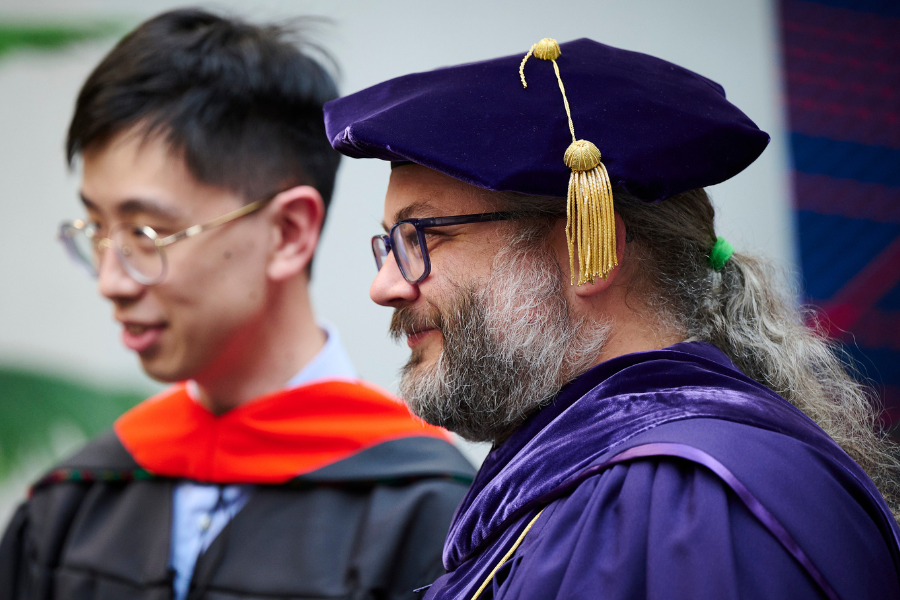
Associate Teaching Professor Dr. Patrick Tague Receives Philip and Marsha Dowd Fellowship for Innovating Embedded Systems Course
By Evan Lybrand
Media InquiriesDr. Patrick Tague, Information Networking Institute (INI) Associate Teaching Professor, has been awarded the 2026 Carnegie Mellon College of Engineering Philip and Marsha Dowd Fellowship for his work on improving his course on embedded systems. The Dowd Fellowship recognizes an engineering faculty member’s contribution and encourages them to pursue educational projects. Dr. Tague has been teaching at Carnegie Mellon University (CMU) since 2009, focusing on graduate courses at the intersection of information security, mobile technologies and embedded systems.
The Fellowship recognizes Dr. Tague's work to develop a new course in addition to 14-642: Introduction to Embedded Systems. 14-642 focuses on bridging software and hardware by looking at the countless computer systems that live inside many of the everyday products that people might not think about. “It goes a lot deeper than a normal embedded systems class," said Dr. Tague. "But it isn’t a security-focused course; it’s purely systems and focused on the fundamentals.”
INI Associate Director Dr. Michael Mattarock was was on the nomination committee for the Dowd Fellowship. “This award is a great recognition of the timely and pragmatic approach the INI takes in educating the next generation of cyber and AI leaders through hands-on experience,” he said.“Dr. Tague’s work will continue to reinforce these strong tenets of both the Dowd award and the INI's greatness.”
Securing Everyday Connected Objects
In his course, one of the first activities Dr. Tague does with students is ask them a question: How many embedded systems have you interacted with today? It sounds like a pretty simple question at first. “Most people think they haven’t used any,” said Dr. Tague. “Then you think through it: You cooked something in the microwave; you used an electric toothbrush; maybe made coffee in a wirelessly connected coffee pot; stopped at a stoplight. It’s only 10 o’clock in the morning, and you’ve interacted with dozens.”
Embedded systems are tiny computer systems inside thousands of devices, from heavy machinery and automobiles to video game consoles and cookware. These devices are so ever-present that the average person rarely thinks about them. However, for those in the technology and security field, they pose a complex challenge: How do you keep them safe and secure when anyone can hold the physical device in their hands?
This subject is the center of competitions like MITRE embedded Capture-The-Flag (eCTF), where teams work to secure and attack embedded systems through the lens of simulated real-world challenges. CMU has a long history in this competition, with a record-breaking five consecutive wins. It was Dr. Tague’s experience as a faculty advisor of the MITRE team that inspired him to develop a new Embedded Systems course.
“The motivation for the original proposal that I put together was thinking about how students who want to join the eCTF competition get the skills they need,” he said. “Most of them learn on the fly during the competition. They spend long hours and late nights teaching each other, which is amazing, but it’s because the material isn’t covered anywhere.
“I want to create something that both serves as an on-ramp to the competition to help more people get involved, and as an opportunity for students to learn those skills and get practice with the tools in their future roles.”
Dr. Tague has recognized the growing popularity of the eCTF competition — currently 40 students are hoping to compete next year. Beyond the growing popularity of MITRE itself, interest in hacking and securing embedded systems has been sparked by news stories such as the first successful hack of the Xbox One. Microsoft’s game console has been available for 13 years, and just last year, it was successfully hacked. Unlike many of the cyberattacks that make the news, this was a fully hardware-based attack.
Securing the physical hardware is one of the most challenging aspects of working with embedded systems. “If you’re thinking about an Internet of Things device, one of the biggest risks is that a company makes them and then puts them in the hands of people around the globe,” said Dr. Tague. “Literally, you are selling your product to your adversary, which makes it a very strong adversarial model.”
Preparing Students for the Future
To help prepare students to work with embedded systems, Dr. Tague is giving them hands-on experience with the real tools they’ll use in their career. “Students are working with the real design tools — the real attack tools — and I want all of that to happen in the class,” he said. “I also want to give them the knowledge to know which tools are useful for what. There are dozens of hack tools and some of them cost $5 and some cost $5,000, and I want to give them the knowledge to figure out what you need. People always want the biggest, best tool, and what ends up happening is like tapping in a thumbtack with a sledgehammer.”
In his course, Dr. Tague wants to bridge the two worlds of hardware and software. “I don’t only want to focus on the software side of things and how we develop software for embedded systems,” said Dr. Tague. “I also want to look at how it can go wrong and how the interaction between the hardware and the software creates vulnerabilities that aren’t present in the software."
Dr. Pedro Bustamante, assistant teaching professor, wrote a nomination letter for Dr. Tague. Dr. Bustamante spoke to the importance of studying embedded systems. “As AI continues to reshape the world, the connection between hardware and software becomes essential for building efficient and secure systems,” he said.“Embedded systems teach students how computation interacts with the physical world, how optimizations emerge from understanding constraints at every layer and why security must be considered from the ground up. This curriculum prepares students to design modern systems, including AI-optimized platforms, low-power edge devices and secure interconnected infrastructures.”
Dr. Tague is continuing to develop a new course that combines the fundamentals of embedded and security to give students to succeed in the MITRE eCTF and their future careers.