
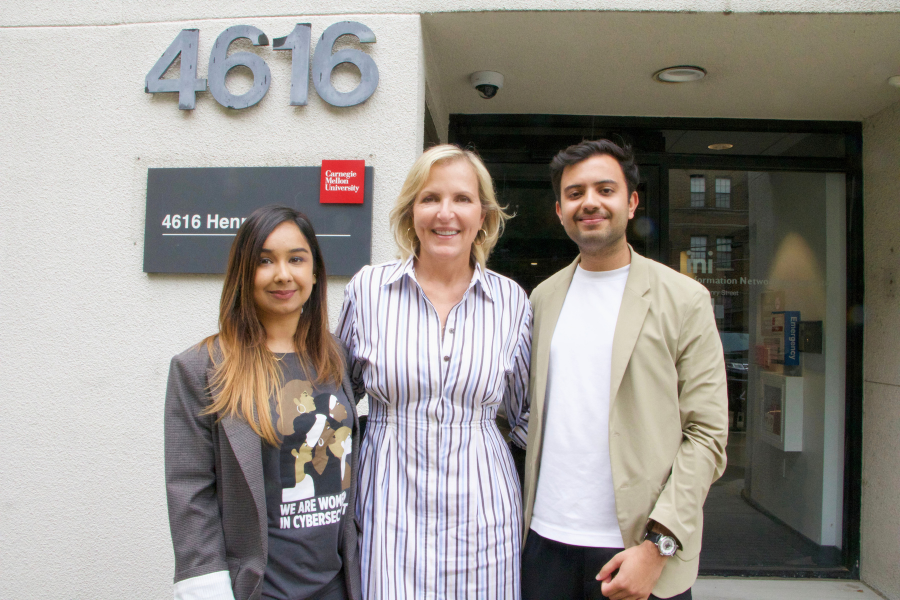
INI Alumni Neha Gautam and Prerit Pathak Explore How Artificial Intelligence is Impacting Quantum Computing
By Evan Lybrand
Media InquiriesAI and Quantum Computing
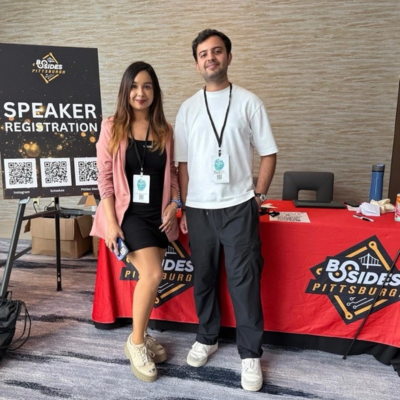 Two Information Networking Institute (INI) alumni, Neha Gautam and Prerit Pathak, made their way to Pittsburgh for the security conference BSidesPGH. As part of a global community of security conferences built by experts, BSidesPGH is a growing event in the Pittsburgh region that draws leaders in the security field and students alike.
The pair held a talk, Cracking the Future: How AI is Fast-Tracking the Quantum Apocalypse, on quantum computing and AI, an area of study the INI has trained them to be curious about.
“We’re always looking forward to what’s new,” said Pathak. “We’ve been curious about quantum computing, and because we are INI alums and security people, we think of everything from that particular lens.”
“It’s already AI plus quantum,” added Gautam. “AI is like a force multiplier for potential quantum attacks.”
Quantum computing is an evolution of classical computing that promises to accelerate and disrupt existing technologies. Classical computers work in a definitive binary system, where in any slot there can only be a one or zero at any given time. Quantum computers are based on the principle of superposition — where multiple states can exist at the same time — which radically expands the processing potential.
“Why that matters is that once we have the power of quantum computing, we can do operations very quickly,” explained Pathak. “That’s why it’s important to start migrating data today and invest in more research.”
“Now, AI comes into the picture,” said Gautam. “It fast-tracks everything 100-fold. Right now, Quantum Day or ‘Q Day’ is predicted to happen in 2029. That is when we’ll have quantum computers, but with the speed of AI, it could happen next year. And security practitioners should be aware and have an actionable plan.”
Both Gautam and Pathak worry about the use of AI in cybersecurity attacks to collect large amounts of data now to decrypt later. “We want to share best practices and a guide on how we can use AI to get ready,” said Gautam.
Pathak added a need for critical thinking: “We have a tool called AI, and we just trust it implicitly,” said Pathak. “We need to understand how that can be a problem. We shouldn’t lose our critical thinking ability.”
Gautam and Pathak are both M.S. in Information Technology - Information Security (MSIT-IS) graduates. Gautam started her program at the INI after working at Cisco in network security. Like many INI alumni, Gautam learned about the program from another alum and was inspired to attend. Pathak was working at Dell, had a passion for cybersecurity and wanted to explore Capture-the-Flag (CTF) competitions. Finding an exploit on a university’s website showed him how much of an impact he could have.
Connecting with the INI Community
On a calm Thursday afternoon before the conference, Gautam and Pathak arrived at the INI for an exclusive event with current students to share their experience and career advice. Following a tour of their former home away from home, the pair met with a select group of current students for an intimate session where students could ask questions about life after graduation and advice on the career journey.
“Mentorship is one of the things that has helped us since our INI journey,” said Gautam. “Giving back — that volunteering piece — is something we both wanted to do. That’s why we were asking how we could help out.”
Neha Gautam and Prerit Pathak speaking to students at the INI
And for students entering this new world, Gautam and Pathak shared some advice.
“The first thing I would say to students would be, if you are here, you’ve already made it,” said Gautam. “There’s so much pressure, and if you remove it for just a second, you realize how far you’ve already come. It starts with showing up. It shows you're curious and authentic. And don’t forget to follow up.”
“I would say take initiative,” said Pathak. “Do projects, go to conferences; you don’t have to be an expert, you can learn about a topic and give a local conference talk. Because once you take initiative, you meet people, people see you and people want to help you. If you take enough initiative, you can build credibility and create your own opportunities.”