
Snake Robots Support Earthquake Search and Rescue in Venezuela
CMU contributes 'exactly the type of technology' needed after disaster
Media Inquiries
Carnegie Mellon University researchers worked alongside international search and rescue teams in Venezuela to explore collapsed buildings with snake robots(opens in new window) following two massive earthquakes that devastated cities.
The robots, developed developed by Professor Howie Choset(opens in new window) in the School of Computer Science’s Robotics Institute(opens in new window), look and move like snakes. They can slither into tight spaces, and a camera mounted on the front of the robot gives responders a look inside spaces people can’t access. CMU researchers hope this technology can improve the search for survivors.

“The Venezuelan people are extraordinary. Despite unimaginable loss, they showed us remarkable kindness, resilience and gratitude. In only a few days, I came to feel genuinely connected to them,” said Choset, the Kavčić-Moura Professor of Computer Science and director of the Biorobotics Lab(opens in new window). “This mission was a powerful reminder of both our shared humanity and the promise and challenges of deploying robotics during disasters.”
Choset led a team from Carnegie Mellon that included Kimberly Elenberg, an RI staff member and retired Army and U.S. Public Health Service nurse, and Biorobotics Lab members Nico Zevallos-Roberts and Darwin Mick. RI staff Yizhu Gu, Lu Li and Ralph Boirum worked around the clock in Pittsburgh to prepare the systems for transport before the team left.
Two earthquakes struck the northern part of Venezuela on June 24, and recent reports indicate that more than 5,000 people have died as a result. About 16,800 people were injured, and nearly 6,500 people have been rescued. The earthquakes left about 18,000 people homeless. The CMU team worked with the Venezuelan and Colombian Red Cross, members of Mexico's Topos search and rescue team, volunteers, and search and rescue teams from around the world in La Guaira, one of the hardest-hit cities in the country.
The team helped search several sites during three days in Venezuela from June 30 to July 3. While the team did not locate any survivors, surveying a location and determining no one was trapped helped search and rescue crews and reassured loved ones.
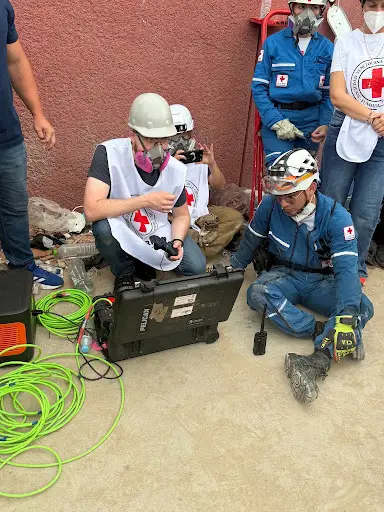
The hope that CMU’s snake robots could help started with Beatriz Gonzalez, a native Venezuelan living in Atlanta who was scouring the internet for anyone who could assist search and rescue efforts in her home country. Gonzalez works in technology and product development and knew there had to be something that could navigate deep into collapsed structures, help locate survivors and allow rescue teams to prioritize search locations.
“Rescue teams knew people were missing, but they didn't know where to focus their efforts within the massive debris field. Every hour mattered,” Gonzalez said. “That led me to research existing search and rescue robotics. During my research, I came across an article about the Biorobotics Lab deploying its snake robots alongside the Red Cross during the 2017 Mexico City earthquake.
“It was exactly the type of technology I had imagined.”
Gonzalez reached out to Choset and within 24 hours, the CMU team and their snake robots were in Miami, waiting for a flight to Venezuela.
Once in La Guaira, the researchers encountered changing conditions, equipment failures, logistical challenges and language barriers. Zevallos-Roberts’ fluency in Spanish and his Ecuadorian background helped the team communicate with responders and local families. Mick operated and made repairs to the snake robot during searches inside collapsed buildings.
The work tested the limits of the robotic systems, but also highlighted the critical role logistics, power, communications and transportation play in success. It is one thing for a robot to work in the lab. It is another thing for it to work in the field, where the stakes are high and conditions are not ideal.

“If a capability can help locate survivors after a disaster, it can also improve care in emergency departments, during pandemics or in the ICU. That’s the promise of dual-use technology: democratizing advanced capabilities so they’re available wherever lives are on the line,” Elenberg said.
As the team worked, new research questions and directions arose that will help improve the reliability, portability and operational readiness of robotic systems designed for disaster response. The experience also gave researchers a rare opportunity to evaluate how their technology can be improved under the demanding conditions it was built to address, while contributing to an international humanitarian effort during one of the region's most challenging moments.

“What makes me proudest is my team. Their professionalism, technical excellence and willingness to leave everything behind on a moment’s notice filled me with pride,” Choset said. “This deployment also reinforced two important conclusions. First, I genuinely believe no university other than Carnegie Mellon could have assembled the people, technology and culture needed to respond as rapidly and effectively as we did. Second, the mission exposed fundamental research challenges that only academia is positioned to solve.”
More information about the Biorobotics Lab(opens in new window) is available on its website. For more information about working with snake robots in the field, contact Howie Choset(opens in new window).
Work That Matters
Researchers at CMU are working on real world solutions to the biggest challenges.
Read more about the latest discoveries.(opens in new window)
NSF AI Institute for Societal Decision Making
AI-SDM brings together AI and social science researchers to develop human-centered AI that supports better, more trusted decisions. Its work includes a disaster simulation research and training platforms and AI tools for rapid post-disaster damage assessment.


