

Alumni Spotlight: The Power of Perspective
Jeni Huang (Master of Integrated Innovation for Products & Services ’22) applies an innovative mindset to shape AI product experiences at Microsoft and evaluates global AI projects as an international awards juror.
By Tundi Gaspar
Reimagining how everyday life, workplaces, and entire industries may change as AI becomes more widely adopted requires creativity, open-mindedness, and collaboration. Jeni Huang (MIIPS ’22) brings these qualities to her work as an AI Product Designer at Microsoft and as a juror for international design and business awards.
Jeni has always considered herself a creative person, having painted throughout childhood. She has also always known that she wanted to create a positive impact in the world. Extending her artistry beyond the canvas and to real-world situations felt like the perfect career path for her.
“What I like is solving problems for real people, real users,” shared Jeni. “...I realized, okay! Design is a better choice for me [than art].”
This calling to problem-solve ultimately led Jeni to the Integrated Innovation Institute (iii) at Carnegie Mellon. Her time in the Master of Integrated Innovation for Products & Services (MIIPS) program was strongly shaped by the collaborative, interdisciplinary nature of her courses, including the Integrated Product Development (IPD) Capstone project.
Each year, the IPD Capstone brings together industry sponsors and student teams to solve a business challenge through human-centered insights. Jeni’s capstone team was curated by faculty to have experience across three major disciplines: business, design, and engineering.
While Jeni brought a more design-centric approach to her group’s project, she noted that those with business backgrounds focused on creating models, while engineers assessed whether each idea was feasible.
Embracing alternative approaches to problems paved the way for Jeni's professional career. More than three years into her career at Microsoft, she designs AI-powered workplace experiences that make everyday work more intuitive and productive.

Jeni has worked across Microsoft Places and Microsoft 365 Copilot. She previously served as a key designer for Microsoft Places, a workplace app launched in 2024 to support the evolving needs of hybrid work. The product received nearly 50 pieces of international media coverage following its launch. She later designed agent experiences within Microsoft 365 Copilot, helping users move from natural-language intent to service discovery and task completion.
As AI becomes increasingly embedded in workplace tools, Jeni's work is shifting from defining fixed user flows to shaping experiences that respond to uncertain, changing contexts.
“AI product design is about creating certainty around uncertainty,” Jeni said. “The outputs may be probabilistic, but the experience still needs deterministic structures that help users understand, trust, and act on what the system provides.”
Through this work, Jeni considers how AI should interpret user intent, recommend actions, support decision-making, and help people navigate complex workplace contexts with clarity and trust.
“These details matter because they shape whether people trust the experience,” Jeni said.
“AI is powerful, but power alone does not create a good product. Designers need to turn uncertainty into experiences that feel useful, understandable, and grounded in real human needs.”
Jeni’s passion for her career in AI also extends into giving back as a juror to organizations inspiring global initiatives. After winning awards from the International Design Awards, MUSE Design Awards, and the A’ Design Award, Jeni was invited back to judge projects alongside industry leaders. She’s been a juror for over 10 international business and design awards, including the A’ Design Award, Awwwards, Indigo Design Award, Spark Design Awards, and The Stevie® Awards.
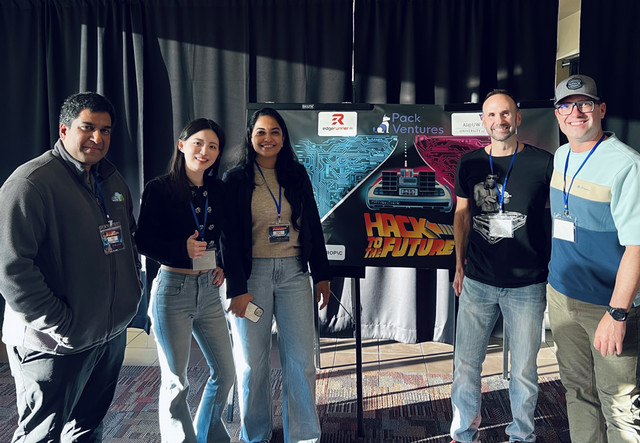
In some judging settings, Jeni and her fellow jurors review projects individually before discussing the strongest entries together. While reaching a consensus can require thoughtful discussion, Jeni noted that truly exceptional projects often stand out quickly and earn broad agreement.
So, what makes a project stand out? “Simplicity.”
For Jeni, simplicity does not mean a lack of ambition or innovation. The strongest projects use technology with purpose. This can mean improving a workflow, supporting better decisions, creating a clearer experience, or delivering measurable real-world value.
Ultimately, Jeni’s two roles are connected by a shared question: What makes innovation meaningful?
“As a designer, I often work at the product level,” Jeni said. “As a juror, I get to evaluate AI at a broader organizational level: how companies apply it, commercialize it, and translate it into real-world value.”
Serving as a juror has given Jeni a broader view of how organizations around the world are applying AI. Companies use AI not only to create new interfaces but also to transform operations, improve customer experiences, increase efficiency, and achieve measurable impact. That perspective also informs Jeni’s work as a product designer at Microsoft.
Many AI initiatives are neither purely design nor technical challenges. Rather, AI projects require teams to understand users, build reliable systems, define business value, and consider long-term impact. For Jeni, this is where the iii’s interdisciplinary approach becomes highly significant.
“The training at the iii helped me develop a more holistic way of evaluating innovation,” Jeni said.
“A strong AI solution should not only be technically feasible or visually polished. It should solve a real problem, create value for users, and make sense as a product or business solution.”
Looking to the future, Jeni hopes to continue learning from and elevating the projects she judges. With the ultimate goal of giving back to the design community, Jeni plans to continue serving as a juror and offering mentorship to new product designers.
For students interested in AI, product design, or innovation, Jeni encourages them to develop not only skills but judgment.
“In the age of AI, the ability to create is becoming more accessible,” Jeni said. “What will set designers apart is taste and judgment. Don’t just learn how to design—learn how to recognize what is worth designing.”