
About Mellon College of Science
At Carnegie Mellon University’s (CMU) Mellon College of Science (MCS), we are innovators and forward-thinkers, entrepreneurs and world-famous pioneers. And we are co-creators, mentors, lifelong learners — and friends.
Who We Are
Across the Mellon College of Science, you’ll find a community driven by curiosity and connection. We share ideas, tackle big problems and support one another — as people and as scientists. Students, faculty, alumni and industry partners all contribute to a vibrant, intellectual environment that sparks breakthrough discoveries and changes global systems — and occasionally makes pickles glow with electricity.
This is a place where Nobel Laureates and Rhodes Scholars walk the same halls as first-year students just beginning to chart their path. Where bold research meets human warmth, and world-changing breakthroughs begin with a lab joke, a late-night brainstorm or a mentor who sees your potential. At MCS, we know that solving society’s biggest challenges starts by showing up for each other.
Explore the latest developments at Mellon College of Science in the Science Connection.
Enhancing Science Education at Carnegie Mellon and Beyond
At MCS, we pride ourselves on doing things differently. Our educational initiatives are transforming how science is taught at the college level. From our innovative Core Education curriculum to our university-wide initiative for health science students, we work actively on new methods of maximizing learning outcomes.
Mellon College of Science Departments
Our four distinguished academic departments are named for the foundational disciplines of science. But dig one level deeper, and you’ll find an array of cross-disciplinary programs and research exploring areas that are changing the world as we know it.

Biological Sciences
A vibrant research and learning environment, with world-class faculty leading the way in the areas of biotechnology, computational biology, bioinformatics, genetics, genomics, neuroscience, microbiology and more.

Chemistry
A supportive community of learners and experts brings unique strengths in molecular science and engineering to important issues in sustainability, human health and quality of life. They examine green chemistry, biochemistry, energy storage, catalysts, nanoscience, machine learning and computational chemistry.

Mathematical Sciences
A highly ranked department with a strong interdisciplinary culture, focusing on algebra and number theory, combinatorics, geometry, logic, mathematical finance, numerical analysis, probability and topology, among others.

Physics
An internationally engaged department, with students and theoretical and experimental faculty contributing to major projects like CMS at CERN, KATRIN and JLab, and focusing on the fields of condensed matter physics, nuclear and particle physics, quantum electronics, astronomy, cosmology and biological physics.
Interdisciplinary Programs
At the Mellon College of Science, we believe answering critical questions for society demands more than one way of thinking. Our interdisciplinary programs — spanning undergraduate through doctoral levels — bridge scientific domains to open new fields of discovery. By blending disciplines, we equip students with the professional skills to think in systems, collaborate across boundaries and drive impact in science, technology, policy, entrepreneurship and beyond.
See All Interdisciplinary Programs

Shaping the Future of AI
Artificial intelligence is driving the next wave of discovery at MCS. Our researchers are redefining what’s possible through developing and applying AI applications. Physicists, mathematicians, biologists and chemists leverage big data, vision learning and large language models to drive breakthroughs across science — from understanding the universe to transforming computational chemistry. Computer-aided reasoning is shaping the future of uncertainty modeling. Students benefit from early access to cutting-edge tools, working alongside faculty who are advancing AI in the same way that groundbreaking science has long defined our global reputation.

Career-Advancing Undergraduate Research
More than 70% of MCS undergraduate students conduct research — and start it earlier in the curriculum than at other universities. The caliber of research and faculty expertise provides invaluable opportunities for undergraduates to build sharper professional skills and produce work that proves their readiness for what’s next.
“CMU defined my life. It made me who I am. I had support from research faculty who saw my passion and drive.”
Jeff Milton
Co-founder, Chief technology officer, La Jolla Labs Inc., MCS 2004
MCS by the Numbers
793
Undergraduate Students
315
Graduate Students
6: 1
Student-to-Faculty Ratio
MCS Community Highlights
Nobel Prize Winners
MCS has been home to 10 of the university's 17 Nobel Laureates, including John Nash Jr., who earned his bachelor's and master's degrees in mathematics in 1948 and won the Nobel Prize.
Out of This World
If you look with a telescope into the night sky, you may see 4177 Kohman, an asteroid named for Emeritus Chemistry Professor and Adjunct Professor of Physics, Truman Kohman.
Bulletproof
Stephanie Kwolek, who graduated from MCS in 1946,invented Kevlar®, the fabric used in bulletproof vests, aircraft and sporting goods.
Global Impact
Wolf Prize winner and internationally renowned J.C. Warner University Professor Krzysztof Matyjaszewski developed atom transfer radical polymerization, which redefined the way plastics are made.
Going Green
Professor Terry Collins’ Green Chemistry course — the first Carnegie Mellon course on green chemistry — teaches students to design safer substitutes.
Life Changing
Professor Alan Waggoner created the CyDye™ labeling technologies, fluorescent dyes that have been widely commercialized and have made a profound impact on biomedical research.

Meet the MCS Dean
Barbara Shinn-Cunningham is the Glen de Vries Dean of Mellon College of Science at Carnegie Mellon University. She joined Carnegie Mellon University in 2018 as the founding director of the Neuroscience Institute. An author of more than 200 scientific articles, Shinn-Cunningham is recognized for her expertise in spatial hearing, auditory attention and sensory hearing deficits — and she is the recipient of honors from the Alfred P. Sloan Foundation, the Whitaker Foundation and the Vannevar Bush Fellows program.
She is a Fellow of the American Scientific Affiliation (ASA), a Fellow of the American Institute for Medical and Biological Engineering and a lifetime member of the National Research Council. And she is particularly proud of the recognition of her mentorship, which has garnered awards from both the ASA and the Society for Neuroscience.
Mellon Students of Science


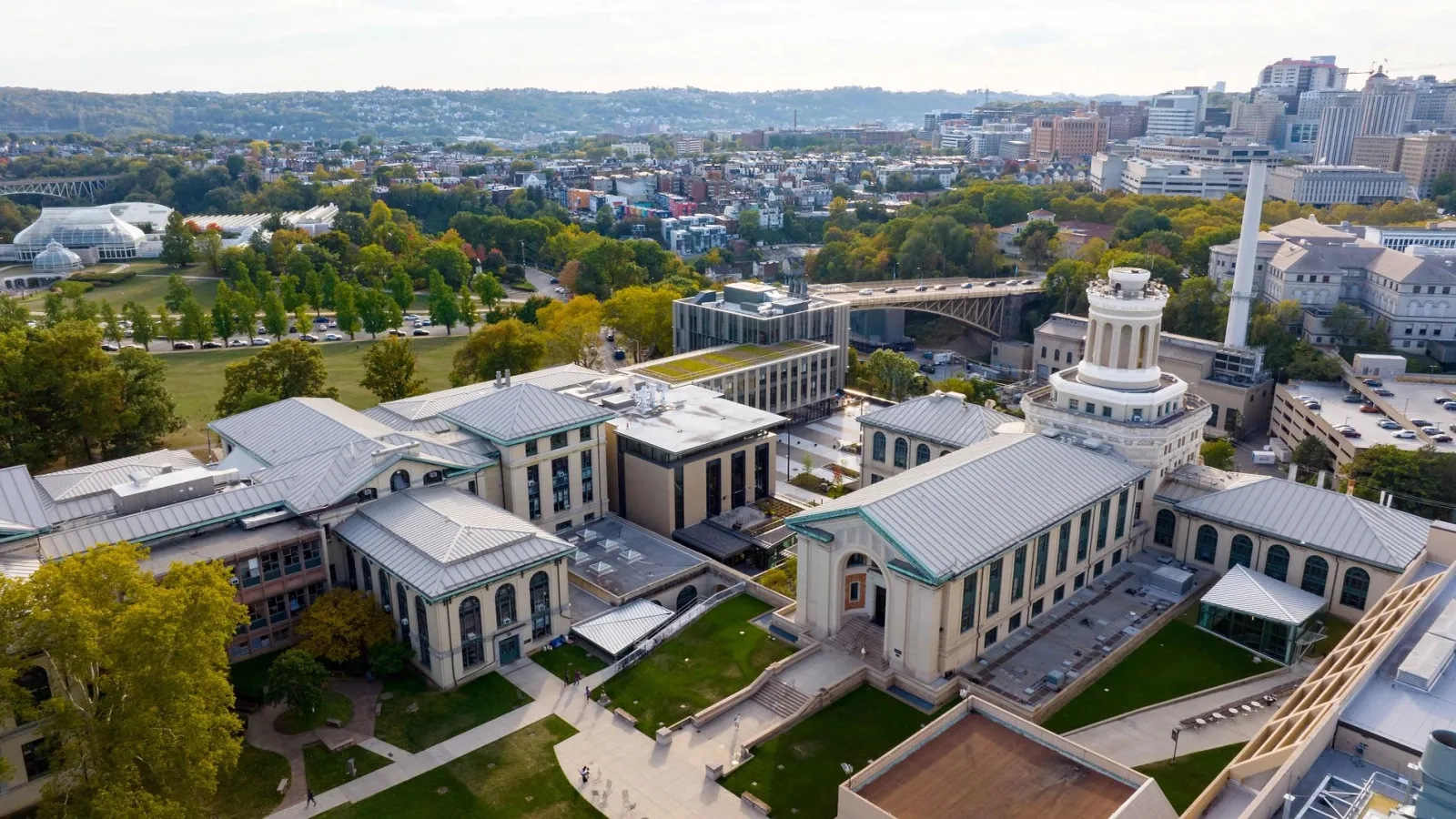
This Is Where Your Breakthrough Begins
Whether in the lab, in the field or at the whiteboard, MCS is where scientific ambition meets human connection. Need proof? Explore our programs to learn more.