
CMU Commemorates America250
Media Inquiries
Throughout the 2026-2027 academic year, Carnegie Mellon University is hosting a variety of events to reflect on 250 years of American independence. These CMU America250 lectures, exhibitions, performances, conversations and community initiatives provide an opportunity to explore the past, examine the present and prepare for the challenges of tomorrow.
Democracy Day coincides with Election Day
To support informed participation in democratic and community life, CMU will celebrate Democracy Day on Tuesday, Nov. 3. Students, faculty and staff are invited to participate in campus events, regardless of citizenship status or voting eligibility, and classes prior to 5 p.m. are canceled.
“Members of the campus community are encouraged to use the day in ways that are meaningful to them, whether by voting, serving as a poll worker, volunteering or participating in opportunities for learning, dialogue and reflection,” said Elizabeth Vaughan, co-chair of the Democracy Day Committee, associate dean of Student Affairs, and James & Sharon Rohr Director of Community Engagement.
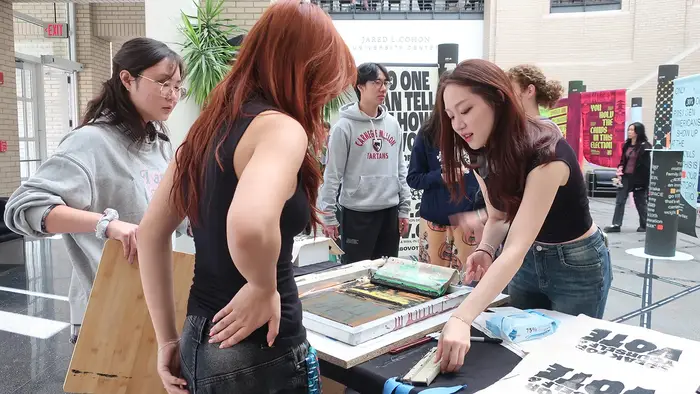
A 15-member committee will host a celebration in the Cohon University Center on Nov. 3 from noon to 2 p.m., with activities, snacks and raffles. The event includes the Tartans Taking Action Fair, where attendees can meet representatives from community organizations working on issues important to the campus community. Those interested in engaging in a wellness activity are invited to attend an ongoing Tai Chi and QiGong series that evening from 5 to 6 p.m. in the Well-being Lab (Room 104) at the Highmark Center for Health, Wellness and Athletics. A nonpartisan election night watch party in Hunt Library’s IDeATe Studio B will offer an opportunity to follow live coverage, hear real-time analysis and discuss results from 7 to 10 p.m.
“Democracy Day is about more than what happens on Election Day. Throughout the year, we want to give members of the CMU community opportunities to better understand our democratic institutions, engage thoughtfully with different perspectives and recognize the many ways they can participate in civic life,” said Shannon Riffe, Democracy Day Committee co-chair and associate dean of marketing and communications for University Libraries, ETC, IDeATe and Sustainability.
Constitution Day Symposium Kicks Off Year-Long Celebration
Earlier in the fall semester, The Humanities Center at CMU and The Law and Humanities Institute celebrated Constitution Day with a public symposium titled “Humanities, Law and an Inflection Point for our Constitution.” The Sept. 17 event encouraged participants to engage the Constitution as more than a legal document, examining it as a historical, linguistic and cultural text shaped through interpretation over time. The previous evening, the University Lecture Series hosted Eli Merritt, a political historian, psychiatrist and research professor from Vanderbilt University, who spoke on “The Pursuit of Happiness: Happiness as a Social, Political and Personal Force.”
Inside Government Relations: A Lunch & Learn with Tim McNulty
The lunch and conversation will give CMU students a look at how McNulty works to represent the university and build relationships with government officials. McNulty will share tips on how students can make their voices heard.
Advance registration is recommended.
Read essays from CMU’s Constitution Day Symposium speakers in Pittsburgh Review of Books (PRoB). An interdisciplinary humanities periodical housed in Dietrich College of Humanities and Social Sciences and published by the English Department in association with Belt Media Collaborative, PRoB features essays, reviews, interviews and excerpts that engage with salient and pressing issues.
E Pluribus Unum: Are, or Should, We Be One United People?
Sanford V. Levinson
Ghostwriting the Constitution: Phillis Wheatley’s Letters
Samantha N. Pinto
The Deuteronomic Constitution
Richard H. Weisberg
American Abolition and the Legacy of Constitutional Choice
Emma Brush
The Constitution as Literature
Brian Soucek
How Literary Culture Renews the Constitution
Andrew Lanham

CMU Provost and Chief Academic Officer James H. Garrett Jr. began the Constitution Day Symposium by noting how deeply committed the university is to fostering an environment where complex — and even polarizing — ideas can be debated openly, respectfully and rigorously.
“The questions facing our constitutional system today are profound, pressing and often contentious. Yet, moments of inflection are also moments of opportunity. They invite us to pause, re-examine our foundations and engage in thoughtful, civil dialogue.”
— James H. Garrett Jr.
Edda Fields-Black, director of The Humanities Center and professor of history in the Dietrich College of Humanities and Social Sciences, greeted participants and noted that anniversaries invite celebration but also impose an obligation to remember carefully, examine critically and ask what the past demands of us in the present.
“America250 should therefore be more than a commemoration of what happened in 1776. It should be an occasion to consider the long, unfinished struggle over the meaning of the nation created in that revolutionary moment. Who constituted the people? Who was excluded from that category? How have successive generations challenged, enlarged and sometimes contracted the promises of American democracy, and what responsibilities do we inherit as we carry those promises into the next 250 years? Those are fundamentally humanistic questions.”
— Edda Fields-Black


Richard Weisberg of the Law and Humanities Institute, Floersheimer Professor of Constitutional Law, Emeritus, at Yeshiva University’s Cardozo Law School; and distinguished visiting professor of law and humanities at CMU which co-sponsored the symposium, echoed Fields-Black as he remarked on how important stories are in understanding the law.
“The law is a system of narratives. It's not just rules that judges and other officials enunciate. It's a story. It's an ongoing story. Certainly, this is true of the Constitution. It has life because it's based on language, and language builds from whatever the original text is, which could be oral or written.”
— Richard Weisberg
In his keynote address, Sanford Levinson, W. St. John Garwood and W. St. John Garwood Jr. Centennial Chair in Law at the University of Texas at Austin’s School of Law, explored the relationship between the Declaration of Independence and the U.S. Constitution. He discussed what he views as praiseworthy of the framers of these documents, as well as the need to revisit the documents in the context of today.
“One celebrates worthy ancestors not because they closed the books, as it were, on further inquiry, but rather because they had the willingness and the courage — what is what I mean by audacity — to confront the central challenges of their own time, whether those of politics, technology or riddles of the universe.”
— Sanford Levinson
Jonathan Cervas, assistant teaching professor with the Carnegie Mellon Institute for Strategy and Technology (CMIST), moderated an audience Q&A with Levinson.
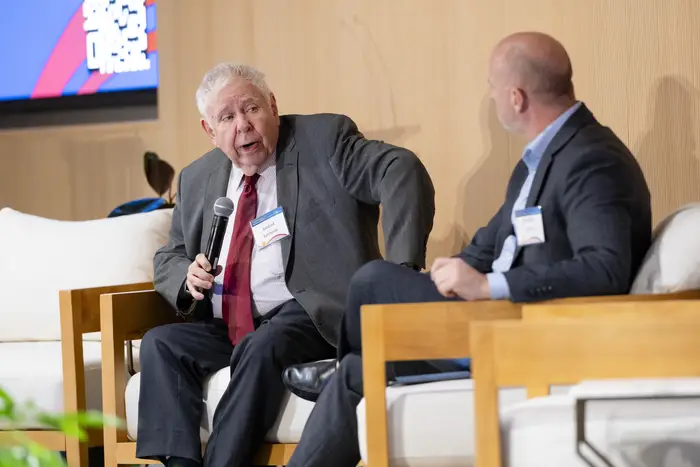

Afterward, Christopher Warren, CMU Department of English head and Thomas Stockham Baker Professor of English Literature, facilitated a panel discussion titled “The Humanistic Origins of the Constitution,” featuring Aaron Hall, assistant professor of law at the University of California, Berkeley; Andrew Lanham, assistant professor of law at the University of Houston Law Center; and Samantha Pinto, professor of English at the University of Texas at Austin. Warren posed a question about how institutional histories and 18th-century disciplines like rhetoric and literature influenced the language and culture of the Constitution. Among answers was the following:
“If we're thinking kind of the institutional history or the map of the disciplines that people were operating under, the very claim that we can have a revolution and remake the world and remake the political system, and it can be human beings choosing their sovereign for themselves, is itself a kind of humanistic claim about the nature of politics.”
— Andrew Lanham
Doug Coulson, CMU associate professor of English, facilitated a second panel discussion titled “Sacred Texts and the Constitution: Textual Interpretation and Biblical Hermeneutics,” featuring Haider Ala Hamoudi, dean and Nippert Professor of Law at the University of Cincinnati; Jeffrey Miller, associate professor of English at Montclair State University; and Weisberg. Panelists explored how principles of Christianity, Judaism and Islam influence constitutions, not only of the U.S. but also other countries. In addition, they discussed the separation of church and state.
“It's a lot more complicated than just sort of imagining some wall of separation that can exist. I mean, you can say that the state itself has no religion; it doesn't endorse any particular religion. You don't have the Ten Commandments in the classroom, and you provide some level of free exercise. And again, these are all sort of relatively obvious things to say, but at the same time, there are questions about what, when does one of these things end, and when does another one begin?”
— Haider Ala Hamoudi
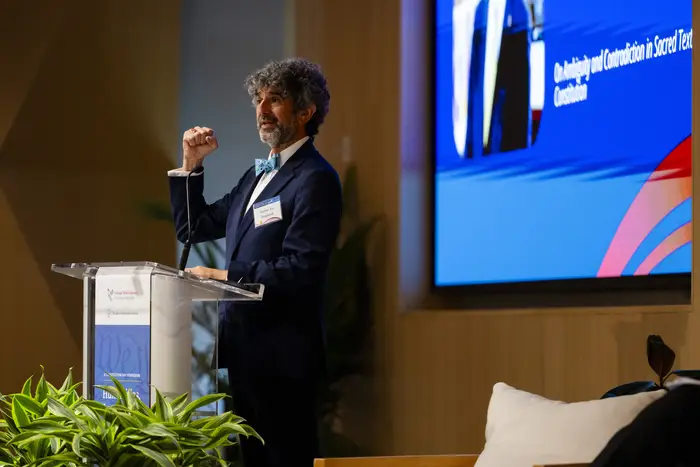
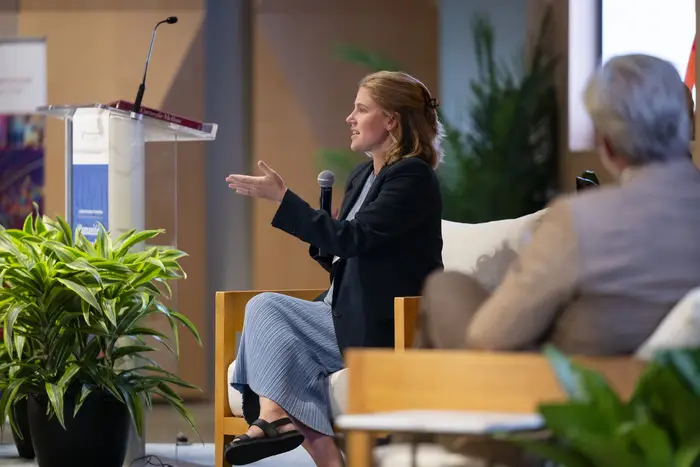
Lisa Tetrault, CMU associate professor of history, moderated the final panel of the day, “The Constitution as Literature and Literary Inspiration.” Panelists included Emma Brush, assistant professor of law, jurisprudence and social thought at Amherst College; Brian Soucek, Martin Luther King Jr. Professor at UC Davis School of Law; and Simon Stern, professor of law and English at the University of Toronto.
“The Constitution could be and potentially should be treated like a text that, like literature, we create as much as we receive, and that ultimately, you know, extends to this idea that we might ultimately decide it does not speak for us. How else, in the end, could we understand a document that governs us, but to view it as a document by which we choose to govern ourselves?”
— Emma Brush
In the evening, participants visited the Posner Center for Special Collections to view its copy of the United States Bill of Rights — one of only five known surviving copies of the first official printing issued in 1792. Samuel Lemley, curator of Special Collections and director of the Posner Center for Special Collections, explained that the Bill of Rights is not only a foundational constitutional text, but also a remarkably fragile material artifact of American history.


The daylong symposium closed with a series of theater, poetry and music performances, recognizing the Constitution as a living source of artistic inspiration, reflecting on its enduring legacy, evolving interpretations and continuing role in American public life.


