
NSF awards $10M for Next-Generation Supercomputer at Pittsburgh Supercomputing Center
Bridges-3 will expand national computing infrastructure that powers AI, scientific discovery and advanced research.
Media Inquiries
The National Science Foundation (NSF) has awarded funding for Bridges-3, the next-generation flagship supercomputer at the Pittsburgh Supercomputing Center(opens in new window), expanding access to advanced computing resources that enable breakthroughs across science, engineering, medicine and artificial intelligence.
Backed by a $10 million NSF award, the Pittsburgh Supercomputing Center — a joint research center with Carnegie Mellon University and the University of Pittsburgh — will build the new system to meet growing demand for high-performance computing to be broadly available to researchers, educators and students across the United States.

As AI models become larger and scientific questions more computationally complex, access to advanced computing infrastructure has become increasingly essential. Bridges-3 will provide the computing power needed to accelerate simulations, analyze massive datasets and support advancements that would otherwise be impossible using conventional computing resources.
“Advanced computing has become foundational to breakthroughs across nearly every field,” said Theresa Mayer(opens in new window), vice president for research at Carnegie Mellon University. “Bridges-3 will strengthen the nation’s research infrastructure while expanding opportunities for researchers, faculty and students to tackle ambitious problems in AI, health, materials, manufacturing and other disciplines. This investment reflects Carnegie Mellon’s longstanding commitment to developing the computational capabilities that enable transformative research.”
Bridges-3 will expand the capabilities of its predecessor, Bridges-2, with a flexible mix of computing resources designed to support a broad range of computational workloads. The system will combine state-of-the art NVIDIA B200 graphics processing units (GPUs), high‑core‑count AMD central processing units (CPUs), large memory and fast data storage.
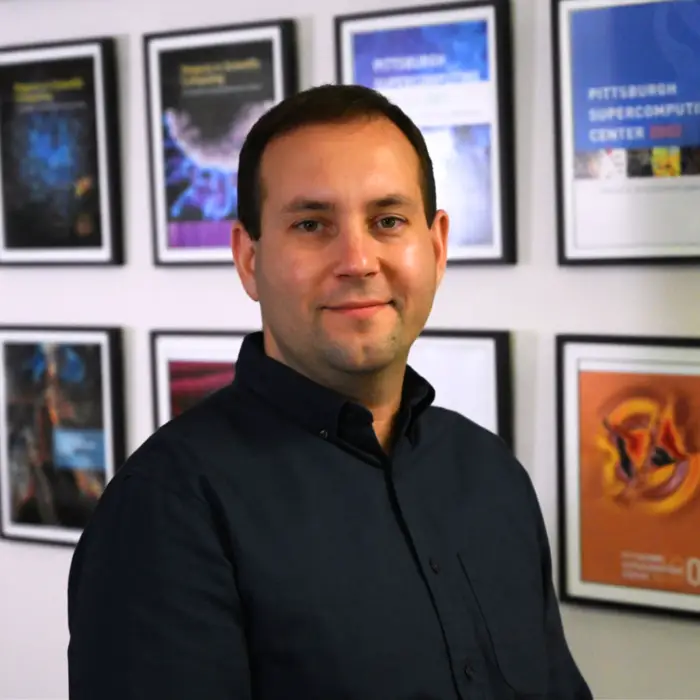
“The system design reflects the practices successfully established through the Bridges family: selecting technologies that support a wide range of scientific disciplines, enabling flexible workflows, and ensuring that users at varying levels of experience can make productive use of the system,” said Bruno Abreu(opens in new window), PSC’s deputy scientific director and principal investigator for Bridges-3. “It maintains all the capabilities of its predecessor while offering state-of-the-art GPUs and CPUs that deliver substantial performance improvements for modeling, simulation, data analytics and artificial intelligence.”
The software environment will retain the familiar interfaces, tools and frameworks used on Bridges‑2, easing the transition for thousands of current users. Integration of selected Bridges‑2 nodes and connectivity to the Leadership‑Class Computing Facility (LCCF) data system further extends the value and continuity of existing community workflows.
The new system will advance PSC’s mission of democratizing access to advanced computing. Bridges-3 will be allocated primarily through the National Science Foundation's Advanced Cyberinfrastructure Coordination Ecosystem: Services & Support (ACCESS) program and the National Artificial Intelligence Research Resource (NAIRR) Pilot, helping ensure that researchers from institutions without local HPC resources, those with emerging research programs, classroom use cases and users new to advanced cyberinfrastructure can access world-class computational infrastructure.

In addition to supporting research, Bridges-3 will strengthen education and workforce development through training programs, workshops, internships, and Learning Lab modules that were refined through Bridges‑2. These programs support students and researchers with computational and AI skills needed across academia, industry and government.
“Our continued support of the national research community is at the heart of everything we do at PSC,” said Barr von Oehsen(opens in new window), PSC’s executive director. “With Bridges-3, we’re not just upgrading hardware, we’re renewing our promise to serve the researchers, educators and students across the country who depend on open, accessible, high-performance computing to advance their work.”
Construction of Bridges-3 by Hewlett Packard Enterprise is expected to begin at PSC’s new data center in early 2027, with the system expected to become fully operational in summer 2027.


