Ph.D. in Chemistry program at Carnegie Mellon University
Discover. Innovate. Transform.
Welcome to the Department of Chemistry in Carnegie Mellon University’s Mellon College of Science — a highly collaborative, interdisciplinary research community where graduate students push the frontiers of modern chemistry.
Here, you’ll work with world‑renowned faculty, access extraordinary facilities, and join a supportive scientific community committed to excellence and sustainability.
Fees & Deadlines How to Apply Who Should Apply Arrange A Visit Financial Support & Fellowships Chemistry Research Highlight Forms & Policies for Current Students Ph.D. In Chemistry Handbook
What You’ll Experience: A Collaborative Research Environment
Chemistry at CMU thrives on interdisciplinary connections spanning:
- Biological Sciences and Medicine
- Biomedical Engineering
- Chemical Engineering
- Machine Learning and Data Science
- Materials Science
- Physics
Graduate students conduct research in world‑class research facilities:
- Mellon Institute state‑of‑the‑art laboratories
- Doherty Hall undergraduate teaching and research labs
- The Center for Molecular Analysis
- The NMR Center
- Shared university facilities in imaging, computation and materials characterization
Mentoring and Community. You’ll join a department committed to your growth, offering:
- Close faculty mentorship
- Professional development opportunities
- Teaching experience
- Peer support within and across research groups
- Shared university facilities in imaging, computation and materials characterization
Application Fee:
$25 for all applicants
Application Deadline:
How to apply for the Ph.D. in Chemistry program
Start today on your next journey!
Step 1: Start Your Application
- Create an account through the MCS Graduate Application Portal.
- Select “MCS Graduate Application,” then choose “Ph.D. in Chemistry".
Step 2: Statement of Purpose
Submit a one (1) page Statement of Purpose. Suggested topics to cover are:
- motivation for applying to graduate school
- future aspirations and career
- why CMU is a good fit for your PhD in Chemistry
- acedemic journey etc.
Step 3: Research Background & Interest Statement
Submit a one (1) page Research Background & Interest Statement explaining:
- your research background and projects (such as independent research, coursework, internship)
- what area of chemistry you are interested in working with
The statement should include at least two (2) faculty you are interested in and why you are interested in those groups.
Step 4: Letters of Recommendation
Three (3) letters of recommendation are required for your application. Once you provide your reference names in the application, your references will receive an email describing how they can submit their letter. See the FAQ for more information. You should select individuals who are able to evaluate your ability to successfully complete a Ph.D. in Chemistry. A letter from your current or previous research advisor is especially important.
Step 5: Transcripts
Your application should include transcripts from all institutions attended. Unofficial transcripts, from each of the colleges or universities attended, are required for the application review process and should be uploaded as a pdf. International students’ unofficial transcripts should also be translated into English. One source for this service is World Education Services.
Official transcripts from all universities attended will be required from admitted students before they will be eligible to enroll.
Step 6: English-language Test Scores (if applicable)
CMU Chemistry does not require the GRE (general or subject) for admission. Official test scores and transcripts are required only upon admission and prior to enrollment.
English‑Language Requirements for Non‑Native Speakers:
Applicants who are nonnative speakers of English need to begin their academic careers with a strong foundation in academic English and a high level of proficiency with speaking, listening, reading, and writing in English. For this reason, the department requires minimum scores of:
- TOEFL: total 84 with a speaking score of at least 18 (minimum), or total of 100 with a speaking score of 22 (preferred).
- IELTS: band score of 7 with a speaking score of 6.5
- TOEFL iBT scores and IELTS scores should be not more than two years old. The department accepts TOEFL MyBest Scores.
- DuoLingo English Test (DET): Total of 105 (minimum), or a total of 120 (preferred)
Previous academic work in the US (or other English speaking countries) is not a sufficient reason to waive the TOEFL/IELTS requirement as this does not necessarily indicate a sufficient level of English mastery.
A phone interview may be required in addition to assess spoken English proficiency in more detail for both for a U.S. visa and for placement into appropriate initial course assignments as teaching assistants.
Step 7: Resumé or CV
We particularly encourage the submission of resumés or CVs. These are especially helpful with complete citations for publications (including titles of papers) and presentations (including where the presentation was given). You will be at a competitive disadvantage without a resumé or CV.
You may upload 1-2 optional items at the time you submit your application.
Step 8: Finalize Your Application
Ensure all necessary materials are submitted and the application fee is received by the deadline. After submission, monitor your application status page for updates.
Who Should Apply?
Our Ph.D. program is an excellent fit for:
- Students passionate about research‑driven careers in academia, industry, or government.
- Applicants with strong backgrounds in chemistry, chemical engineering, materials science, biochemistry, physics, or related fields.
- Students who want to conduct cutting‑edge research in:
- Atmospheric, green, and environmental chemistry
- Biological chemistry and chemical biology
- Materials and nanoscience
- Catalysis and sustainable energy
- Physical, analytical, and theoretical chemistry
We encourage you to apply if your background compares well to our median admitted student:
- Has one or more years of prior research experience
- GPA of 3.5 out of 4.0
- TOEFL 104 (total), speaking score 23
- Typical student has B.S. in Chemistry or Biochemistry, but some admitted students have degrees in biology, environmental science & engineering, materials science, or polymer science with strong chemistry course work in the area(s) most related to their research interests.
Applicants who value interdisciplinary collaboration and creativity. We especially encourage applications from students who want to work closely with faculty mentors and pursue research that spans traditional disciplinary boundaries.
Non-chemistry major applicants are encouraged to contact the Graduate Program Office (chemgradoffice@andrew.cmu.edu) early in the application process to discuss their specific coursework and preparation.
Still have questions about the program?
Fill out the Ph.D. program inquiry form. The more information you can provide, the better we can help you with your graduate program goals.
Arrange a Visit
Formal Visits: Prospective students are welcome to visit the department to learn more about our programs, research and community. You can:
- Schedule meetings with faculty, graduate students, or the graduate program manager
- Tour the Mellon Institute, Doherty Hall and other CMU science facilities
- Attend a class or research seminar, if available
Informal Visits: For those who will be in the Pittsburgh area and would like to set up a short, informal visit with 1-2 faculty of interest before applying to the Ph.D. program, please contact the chemgradoffice@andrew.cmu.edu at least two weeks in advance to discuss the possibility of a visit on your preferred dates given the availability of your faculty of interest. The department cannot reimburse for these informal visits.
Financial Support & Fellowships
Full financial support is offered to all full-time Ph.D. students, including tuition and stipend. The support is typically in the form of teaching assistantships for the first year (one semester is a degree requirement) and later as either a teaching assistant or as a research assistant. Every effort is made to provide continuous financial support for students who are in good standing in the program.
The basic monthly stipend for 2026-2027 is $3,300/month. This departmental support is guaranteed for 9 months during the academic year. Support for the summer is normally provided from research funds by the student's research advisor, so the basic annual stipend is $39,600. Additional financial support includes tuition and fees. Graduate students also receive health care coverage through the university health care plan.
Supplemental Fellowships
A small number of outstanding incoming students will receive additional fellowships beyond the basic stipend based on merit. We are grateful for the endowed funds that establish three supplemental named fellowships:
- Dr. Joseph A. Solomon Memorial Fellowship in Chemistry
- Dr. Konrad M. Weis Fellowship in Chemistry
- Dr. Julius A. Vida, S'60, S'61, Fellowship in Chemistry
Dr. Vida has a preference for students from his home country of Hungary. If there are no Hungarian students who are eligible, a top student will be selected from among other excellent applicants.
Competitive applicants are also encouraged to pursue other fellowships. Both NSF and NIH provide support for 5 years.
- Environmental Protection Agency (EPA) STAR Fellowships
- National Defense Science and Engineering Graduate (NDSEG) Fellowship
- National Institutes of Health (NIH) Graduate Fellowships
- The National Academies of Sciences, Engineering, and Medicine Fellowships
- National Science Foundation (NSF) Graduate Fellowships
Full-time Ph.D. studies are required to receive a stipend from the Department of Chemistry. More details about financial support and policies can be found in the Guide to Graduate Studies.
More Resources
The CMU Rales Fellows Program is dedicated to developing a diverse community of STEM leaders from under-resourced backgrounds by eliminating cost as a barrier to education. Applicants must be U.S. citizens, permanent residents, or DACA recipients, and applying to an eligible Science, Technology, Engineering or Math (STEM) graduate degree program on Carnegie Mellon University's Pittsburgh campus.
Breakthrough in RNA Research Could Lead to Treatment for Neuromuscular Disorders
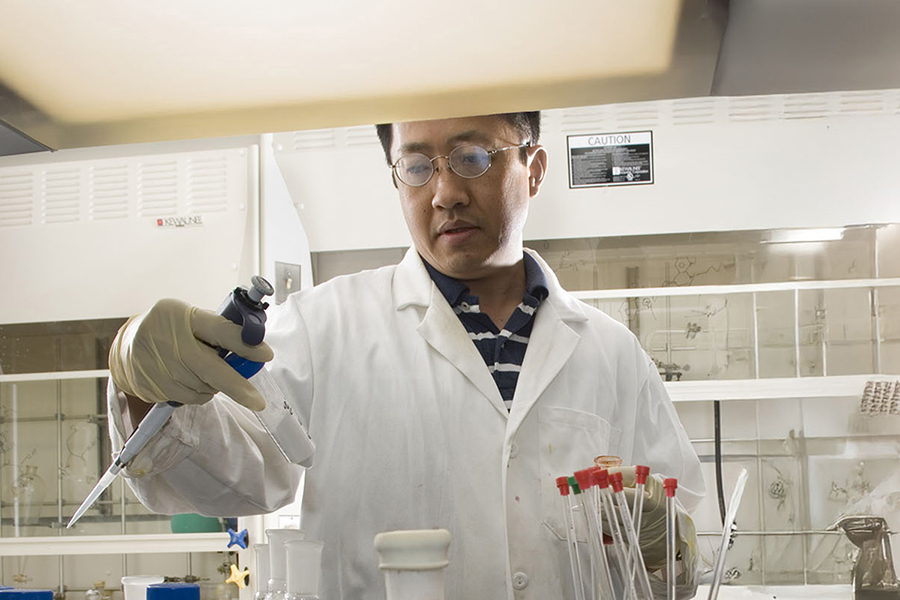
Professor Danith Ly and fellow researchers at CMU discover a new way to target RNA that could lead to new treatment options for myotonic dystrophy type 1 (DM1), the most common adult-onset form of muscular dystrophy, and other RNA-repeat expansion disorders.
Forms & Policies for Current Students
Excellence in graduate training is central to the research and teaching missions of our department. The success of our Ph.D. students is of paramount importance to us. The handbook, available here along with supplementary materials, is intended to provide a clear guide to the steps leading to the Ph.D. The majority of this handbook is specific to your academic experience in the Department of Chemistry. All Ph.D. students are responsible for familiarity with the requirements that are in place when they enter the program and should retain this handbook as an important reference.
Information about additional university resources such as The Word (Carnegie Mellon’s student handbook), the Office of the Assistant Vice Provost for Graduate Education, the Office of the Dean of Student Affairs and others are included in Appendix A of this handbook. Be sure to review your requirements at the beginning of each semester.
Ph.D. in Chemistry Handbook
Handbook requirements apply to students entering the program beginning in the year the handbook was produced. Since some requirements may differ from prior years, students should always check their own handbook to confirm and inquire with us about any questions.
Note that students must complete the academic program requirements in place when they enter unless they elect newer ones in writing. When requirements are changed, it is because the department believes the new rules offer an improvement; any such changes will be discussed at a meeting with the graduate students. However, students currently enrolled whose degree program is affected by a change in requirement may choose to be governed by the older requirement that was in place at the time of their matriculation. In case degree requirements are changed and certain courses are no longer offered, the department will try to find some compromise that allows those students to satisfy the original requirements.
Procedures such as those on program oversight, policies on financial matters and others that are not part of your degree requirements may be updated during a student’s graduate studies (e.g. based on budgetary or other constraints) and the new departmental policies will apply to all current students at that time. Selected university policies are also incorporated in this handbook. Please be aware that, in the case of a conflict, university policy supersedes departmental policy.
Feel free to discuss additional questions with Lorna Williams at any time.