
Art’s Role in Connecting Communities
Students collaborated with pop art icon and CMU alumnus Burton Morris on a Fence design to commemorate the launch of CMU Miami
Media Inquiries
Burton Morris — whose artwork helped define the space where television's most famous group of friends gathered to exchange ideas, build relationships and imagine what's next — brought that same creative energy back to Carnegie Mellon University, inspiring four School of Art friends to exchange their own ideas and imagine what's next for CMU.
"It was really enjoyable to work with the students because each one of them had something very relevant to say about building bridges, and that was the whole concept — building bridges between Carnegie Mellon Pittsburgh and Carnegie Mellon Miami, and how you would showcase that on the Fence," Morris said.
To commemorate the launch of Carnegie Mellon University Miami, senior Quinn Bryant assembled a team of fellow artists, Amelia De Leon, Sadie Han and Avery Stephens, to create a Fence design inspired by Pittsburgh and Miami. Together, they transformed the campus landmark into a colorful expression of creativity, connection and possibility.
"Being able to work through the creative process with an artist as accomplished as him was a very surreal experience, and it was exciting for him to see us work,” Bryant said. “He was open to any idea we had. He wanted to hear how a thought came into our head and where it was leading. He pushed us to keep working with each other and not rely on him, but rather to use him as a resource."
Members of Pi Kappa Alpha (PiKE) coordinated a handoff to Undergraduate Student Senate leaders who helped guard the Fence until painting could commence at the traditional midnight hour. The night before the iconic design was painted, PiKE prepared the surface for painting with a blank white canvas, a gesture that reflected the collaborative spirit behind the project. Danny Li, president of CMU's chapter of Pi Kappa Alpha, said the fraternity — which traditionally holds the fence for a week each fall as a spirit activity — welcomed the opportunity to support the university during such a historic moment.
"As one of the longest standing fraternities on campus, we deeply value CMU's history and traditions as well as the relationship between the school and its students," Li said.
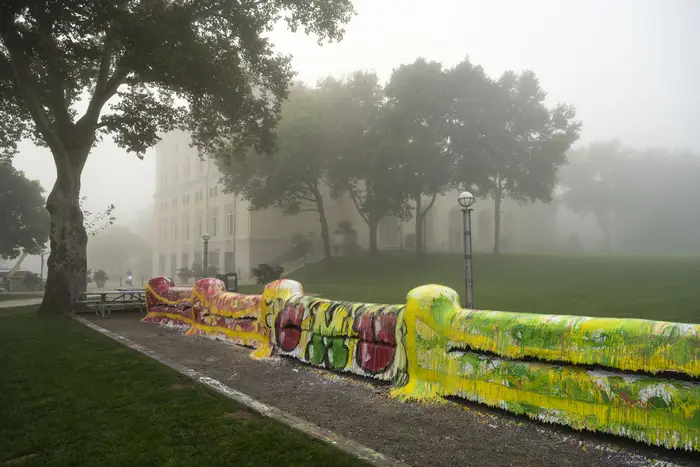
Over several hours, Bryant, De Leon, Stephens and Han painted the landmark with a colorful, graffiti-inspired design influenced by Miami's Wynwood arts district, where CMU Miami will be located. The artists moved across the Fence, sharing tasks and building the composition together as the night progressed.
"We knew we'd be up until 4 a.m., but we worked collaboratively, attacking it from both ends. One end was more red, and one end was more green. We had Sadie do the lettering in the middle, because she's very talented with graphic work. It was really fun," Stephens said.
Bryant said the group quickly settled into a rhythm, trading places throughout the night so colors, marks and visual styles felt cohesive across the entire Fence. Heavy overnight dew arrived as an unexpected collaborator, creating textures and effects that ultimately enhanced the final piece.
By morning, the vibrant colors emerged through the fog, providing a striking backdrop for the announcement of CMU Miami.
“The four of us come from different artistic backgrounds, and being able to join our different perspectives together to make one piece is a beautiful thing,” said De Leon. "Being a Miami native, it was a great opportunity to represent where I grew up in a space where I got to flourish my art practice here at CMU.”
She also sees the new campus as an opportunity to extend Carnegie Mellon's culture of innovation and creativity to future students.
"Being around a university that pushes success and advancement in anything, it really inspires me to be a better artist, a better student and to dedicate more time to my discipline," De Leon said. "I think that's the benefit that Miami's going to have. CMU bringing in those values that we have here to Miami is going to inspire people to do amazing things with their discipline or their interests."
Stephens considers art “the soul” of things, something that transcends language, and hoped their design would inspire others’ creativity.
“It felt great to actually meet with a working artist, to see how he operates,” Stephens said of working with Morris. “I love working with people in general. I think it’s important to develop the ability to see things from other people’s point of view.”
For Morris, those moments of connection are some of the most rewarding aspects of being an artist.
“When people come to my art studio, I love hearing what they respond to in the work. Some are drawn to the coffee cup, some like the King Kong, some like the spaceships. Everyone connects with something different, and there are so many reasons for that,” he said. “That's what makes art so powerful. It creates a sense of community and pride while still allowing for individual interpretation.”


