
October 2025
In this monthly section, we share updates about the research happening at the Children’s School. These research projects, observations, and special class projects support our mission and are part of our daily life as a laboratory school. Our program is enriched by these connections and opportunities and I am excited to share these updates with the Children’s School families. Please let me (Dr. Vales) know if you have any questions about research.
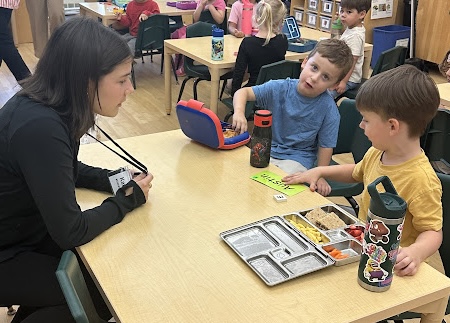
In this first research update I want to share some of the protocols we have in place to ensure the children have a positive experience when helping the researchers with their projects. Children new to the Children’s School participate in a practice research session with a familiar educator at the beginning of the year; this helps everyone learn the routine of doing a research “game”. In addition, all researchers working with children spend some time with the children in the classroom prior to starting their project; this helps make sure that the researchers are familiar to the children when the time comes to work with them.
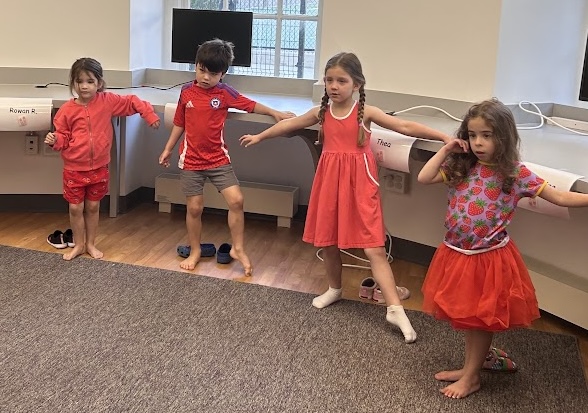
Three research projects are already underway this semester! Hilary Alonso, an undergraduate honors thesis student working with Dr. Sharon Carver, is doing the Ballet Study with the PreK/Kindergarten classroom. Mady Davis-Troller, a Ph.D. student working with Dr. Erik Thiessen, is doing the Relaxing Video and Odd-Fish-Out games with the children from the PreK/Kindergarten and the Preschool Fours classrooms for whom we have fNIRS consent. Ricky Choi, a Ph.D. student working with Dr. David Raksion, is doing the Mystery Machine study with all classrooms. Stay tuned for more details about these studies in upcoming Lab School Updates!
 Finally, we also have undergraduate students from Dr. David Rakison’s Developmental Psychology course observing in our classrooms. For each assignment, the students observe some aspect of the children’s behavior, such as language or motor development, with the goal of relating their observations to the material they are learning in class. Mrs. Stilinovich coordinates these observations to make sure that we have a small number of students observing at a time and she also helps the students be unobtrusive during their observations. We are also hosting students from the Creative Kinetic Systems course in the Preschool Fours classroom. These students are developing musical instruments and sound-producing gadgets, and the children will help them test their creations.
Stay curious!
Dr. Catarina Vales
November 2025
In this newsletter I want to share three studies that we are hosting at the Children’s School this semester. If you have any questions about research, please let me (Dr. Vales) know!
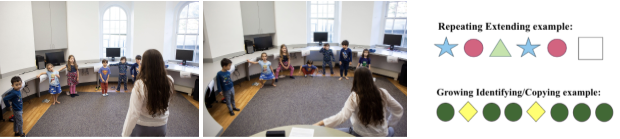
Hilary Alonso (an undergraduate honors thesis student working with Dr. Sharon Carver) is doing the Ballet Study with the PreK/Kindergarten classroom. This study is looking at the effects of ballet classes on visual patterning skills. Previous research shows that patterning skills are related to mathematical skills, likely because early math concepts like counting or quantitative reasoning include regularities, rules, and structure. Drawing on her own experience teaching ballet to young children, Hillary wondered whether ballet classes – which expose students to movement patterns – would lead to improvements on visual patterning skills. To make sure that she can attribute any changes on patterning skills to taking ballet classes (rather than, for example, learning patterning skills in the classroom), Hilary needed to have a control group; to ensure that she is not depriving half of the classroom from the potential benefits of the ballet lessons, Hilary is using a very neat study design called “switching replications”. What this means in practice is that Hilary assigned students to receive the ballet classes either in the Fall or the Spring. In the Fall, the students in the “Fall” group receive the ballet classes and the students in the “Spring” group are the control group; then, in the Spring, the groups switch – the “Spring” group receives the ballet classes and the “Fall” group does not. At three time points during the school year, Hilary works individually with students to complete assessments that require identifying, copying, and extending visual patterns. We look forward to seeing what Hilary learns from this study.
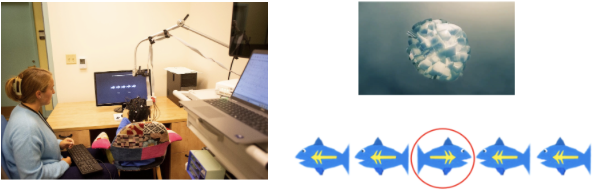
Mady Davis-Troller (a Ph.D. student working with Dr. Erik Thiessen) is doing the Relaxing Video and Odd-Fish-Out games with the children for whom we have consent to participate in fNIRS studies. Together with undergraduate student Smrithi Krishnaswamy, the research team is looking at how activity in the frontal cortex is connected to children’s developing executive function skills, like attention and self-control – which undergo marked changes during early childhood. This study has two sessions. In one session, the children wear an appropriately sized fNIRS cap while watching a short calming video (like a moving screensaver); this allows the researchers to record a consistent measure of the brain at rest. The children also play the “Odd Fish Out” game, where they see a row of fish on the screen and are asked to choose the direction the middle fish is facing, while ignoring the directions of the fish on either side. Sometimes the surrounding fish point in the same direction as the middle fish (the easier trials) and sometimes the surrounding fish point in opposite directions (the harder trials, requiring executive functioning). By comparing the two types of trials and relating the responses in the fish game to the fNIRS brain data, the researchers can measure how attention and self-control are supported by the brain’s frontal regions. Mady and her team will continue to work with the children over the school year to better understand how brain connectivity in the frontal cortex changes with age and how everyday experiences relate to growth in early childhood.
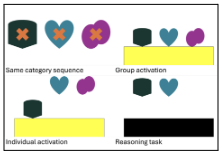 Ricky Choi (a Ph.D. student working with Dr. David Rakison) and two undergraduate students, Marissa Fernandez and Katie Bell, are doing the Mystery Machine study with all classrooms. The researchers are interested in how young children use category membership to make inferences about new information. For instance, imagine that children taste lemon and orange juice mixed together, and the combination tastes sour. Later, they taste lemon juice alone, finding it sour. How will children reason about orange juice afterward? Will they reconsider whether the orange juice contributed to the sour taste of the original mixture, or will they assume all citrus fruits are sour based on category membership?To ensure that children are not using their previous knowledge about categories like fruit, the researchers first teach children new categories in the study by showing them videos of objects belonging either to the same category (having identical internal patterns) or to different categories (each object having a unique pattern). After learning these new categories, the children get to see the three objects interacting with a Mystery Machine, successfully activating it. Then, the children see one object interact with the machine alone – either activating it or not. To understand whether category membership guides children’s inferences, the children are then asked to make guesses about which different combinations of the objects (individual objects, pairs of objects, and all three together) can activate the machine. The answers to these questions will help the research team learn more about how causal reasoning develops between ages 3 and 6, and how category membership shapes this development.
Stay curious!
Dr. Catarina Vales
December 2025
This semester, we hosted Dr. Suresh Jayaraman, a postdoctoral research associate in the Robotics Institute working with Dr. Reid Simmons. Suresh conducted a pilot study, the Group Game, with the PreK/Kindergarten children. The goal of this study was to understand how children of this age work with peers. The research team invited groups of three children to play together and complete familiar activities such as block building, cooperative board games, or a guessing game. To study patterns of collaboration – such as who spoke, who looked at whom, and how turns were taken – the researchers recorded the sessions for later coding. These observations will help the researchers understand how children cooperate with peers, and will inform future studies looking at interactions with robotic systems. We were happy to support these researchers with their pilot study and look forward to learning more about their future projects!

Teo Ozaydin and Jialin Li, working with Dr. Jessica Cantlon, started the Speedy Geometry Matching Game, which will continue into the next few months. The research team is interested in how young children understand geometric shapes. In the study, children first learn to match a shape by either its overall shape or its features (such as angles, side length, or symmetry). Children then play the same matching game, but the shapes are rotated in different directions. The researchers want to see if children can successfully transfer what they know about shapes when the shapes are rotated. The results will help identify which features children use when identifying shapes, which is an important component of early math knowledge. We look forward to seeing what the team learns from this study!

January 2026
Meet the Researchers: Mady Davis-Troller and Dr. Erik Thiessen from the ILL Lab
At the Children’s School, we’re fortunate to collaborate with researchers who work hard to understand how children learn and grow. In this newsletter we are highlighting Dr. Erik Thiessen, director of the CMU ILL Lab, and Mady Davis-Troller, a graduate student in the same lab, whose work focuses on the development of executive function: the mental skills that help children plan, focus, and regulate their behavior. As they told me, one of the reasons the lab studies executive function is that it’s one of the major tools we have in adulthood to ‘eat our vegetables,’ to put in the hard effort to get the rewards we want. Children don’t have those skills yet in the same way, so their lab wants to understand how these skills develop to help all children thrive.
 Dr. Thiessen grew up in Roseburg, Oregon, in a family that valued learning – his father was a high school science teacher and his mother a children’s librarian. After exploring multiple fields at Stanford University, Dr. Thiessen earned an undergraduate degree in Psychology and later completed a Ph.D. in Developmental Psychology at the University of Wisconsin-Madison. Today, he lives in Stanton Heights with his wife, Jill, and three cats. His favorite childhood book was “Watership Down”. Later, reading Orwell's “1984” novel and some of the work of Benjamin Whorf, Dr. Thiessen became fascinated with how language shapes thought, inspiring his career in developmental science.
 There is a Wisconsin theme in this research group, as Mady grew up in Cottage Grove, Wisconsin (which is just outside of Madison, where Dr. Thiessen went to grad school!). Her mom is a copywriter and her dad is a mechanical engineer, about which Mady remarked “I like to say I stole bits and pieces from both of their brains!” Mady attended Wesleyan University, where she double majored in Neuroscience & Behavior and Psychology. While she had initially planned to major in chemistry and Spanish, curiosity led her to take a behavioral neurobiology class, and this is how she ended up studying why and how our brains help us think, learn, and act as a graduate student at CMU. Outside the lab, Mady loves playing card games like cribbage, euchre, Blink, and Scopa (a classic Italian card game).
 Together, Mady and Erik are leading a project that uses Near Infrared Spectroscopy (fNIRS), a safe and child-friendly neuroimaging technique, to study how the brain’s frontal areas coordinate during early childhood to support executive function. Executive function skills are critical for school readiness and lifelong learning, yet much remains unknown about how they emerge in toddlers and preschoolers – years before they are critical for academic success: “Learning is a lot easier when you can reliably sit still and pay attention to the teacher!”, Dr. Thiessen said. Because young children are still learning to master these skills, executive function can be more challenging to observe in toddlers and preschool age children. But now the fNIRS technology allows the researchers to study the development of executive function skills as they are improving.
When I asked them about what a typical day at work looks like for them, Mady said her day often starts at the Children’s School, where she sets up for her project and works directly with children alongside undergraduate assistants. Afterward, she might attend a class or a colloquium talk, then dive into data analysis, experiment design, or writing. Dr. Thiessen’s day often begins with a quiet hour of reading or writing, followed by teaching responsibilities like lectures, office hours, or reviewing student work. He also spends time in meetings with the rest of the lab team, planning projects and analyzing data.
Both researchers love working with the children at the Children’s School. “My favorite part of working with the children at the Children’s School is their constant curiosity.” Mady said. “As we move through the research, they ask the greatest questions, and it’s a joy to explain what we’re doing and show them their own brain activity on the screen. Their curiosity often helps me think carefully about how to explain big ideas in simple, meaningful ways that really make sense to them.” Dr. Thiessen agreed, noting how seeing the same child for months or years also gives the research team a deeper understanding of development.
It was my pleasure to introduce these researchers to the Children's School families. Their research is helping build a future where educational practices are informed by science and we are excited to support their research.
Stay curious!
Dr. Catarina Vales
February 2026
This semester, we are hosting students from Dr. Erik Thiessen’s Developmental Research Methods course. This is an advanced Psychology course in which students have the opportunity to conduct two research projects at the Children’s School under the supervision of Dr. Thiessen and with Mrs. Stilinovich help.
The first project, the Animal Names Game, starts next week. Dr. Thiessen designed it as a group project with the goal of understanding how children remember small amounts of information for a short period of time, also known as working memory. Working memory helps us with everyday tasks like remembering a short list of instructions or repeating a phone number we just heard. As children grow, their working memory improves: they become able to hold more information in mind and keep track of longer sequences. To learn more about how this ability develops, children will play a “word span” game in which they hear a list of animal names and are asked to repeat them back in the same order. The lists start out short and get a little longer each round. Children will play the game twice: once with short animal names (like frog or bird) and once with longer names (like elephant or butterfly). The researchers will keep track of the longest list children can remember (their word “span”) in each condition. If children remember more short names than long ones, it would suggest that how quickly information can be said and rehearsed may play a role in how much children can keep in mind at once.
Later in the semester, the students will work in small groups to conduct a study of their own design, which will be approved both by their instructor and by me. Stay tuned for their research questions in an upcoming newsletter! As always, if you have any questions about research, please let me know.
Stay curious!
Dr. Catarina Vales
March 2026
This semester, we are hosting students from Dr. Erik Thiessen’s Developmental Research Methods course. This is an advanced Psychology course in which students have the opportunity to conduct two research projects at the Children’s School with Mrs. Stilinovich’s help. After completing their first project in February, the students have now started the second group project. Each group designed a study with Dr. Thiessen’s help and refined their study and procedures with my help prior to working with the children.
 Students Nmachi Emelogu-Obioma, Riley Lawrence, Adrien Marenco, and Isaac Yankel are conducting the Button Buddies Game, with the goal of understanding how young children perceive emotions in musical sounds. In this game, children are asked to listen to short musical recordings. The buttons that play the recordings show either matching or mismatching facial expressions (happy, neutral, sad); for example, the major cord is paired with the happy facial expression in the matching condition and with the sad facial expression in the mismatching condition. In both conditions, the children are asked to sort the recordings from happiest to least happy after listening to them. If children associate musical sounds with emotions in the same way that adults do, the researchers should observe that the sorting is more accurate in the matching than in the mismatching condition.
 The Sharing Game is being conducted by students Sydney Duncan-James, Marissa Fernandez, Andy Mann, and Solomon Wechter, with the goal of understanding if children learn prosocial behaviors more effectively from a story depicting a boy vs. a girl main character. In this game, children are asked how many crayons they would share between themselves and other fictional children – once before reading a sharing story and once after. The story depicts either a girl or a boy main character who shares a snack with a friend. By examining if the children share a similar or different number of crayons in each story condition, the researchers can see if the gender of the main character matters for increasing sharing behavior.
As always, if you have any questions about research, please let me know.
Stay curious!
Dr. Catarina Vales
April 2026
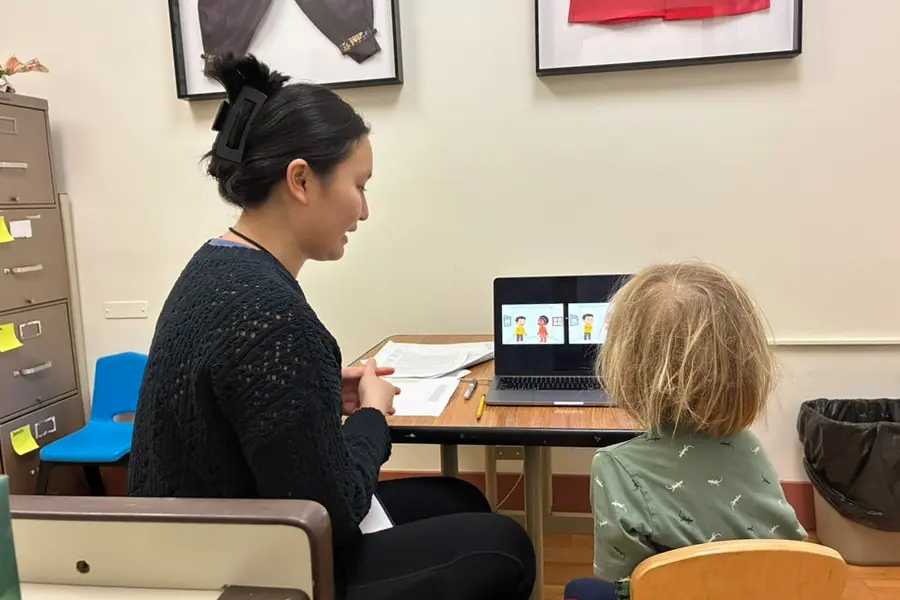
LiLi DiMuzio, an undergraduate honors thesis student working with Dr. David Rakison and recipient of a Dietrich Honors Fellowship, conducted the Friendship Game with all classrooms as part of her thesis project. The goal of her project was to understand whether children use existing friendship connections between people to infer additional friendship connections. In her study, LiLi showed children pairs of people who were friends (e.g., person A and B; then person B and C) and then asked the children whether the people who were not previously shown together (in this example, person A and C) would also be friends. If children use these kinds of transitive relations to make inferences about friendships, then they might assume that two people who have a friend in common are also friends.
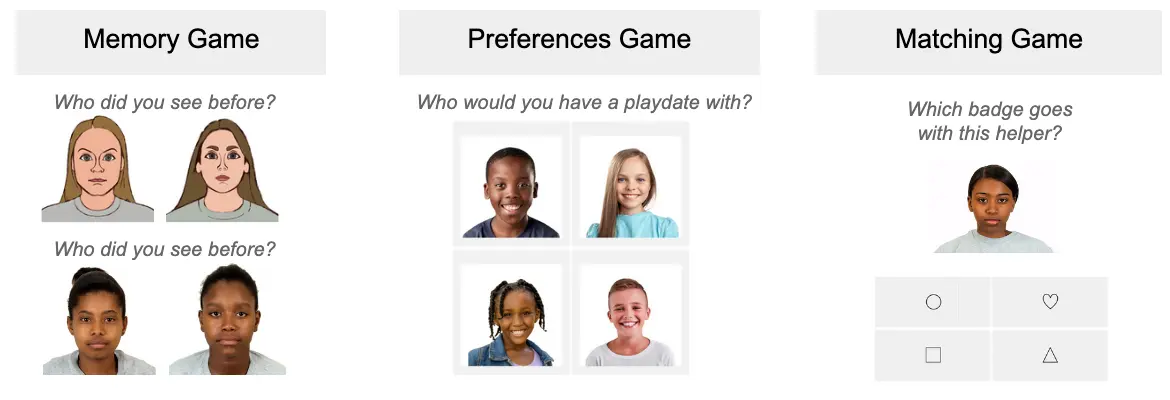
Molly Niehaus, a research associate working with me, is conducting the Who Did You See? Games. Together with students Ish Asharya and Ash Gelber, we are interested in understanding if increased exposure to different social groups can improve a common difficulty in recognizing faces of people from different racial/ethnic backgrounds (often referred to as the other-race effect). To increase exposure to faces of different social groups without explicit instruction, we use a child-friendly matching game that has been successfully used by other researchers – children are shown pairs of faces and shapes and asked to remember which face goes with which shape. To assess whether there are changes as a result of this exposure, children complete the memory game and the preferences game before and after playing the matching game with realistic or drawn faces. The results of this study will help us understand whether the cross-race effect is comparable in real and drawn faces, and whether exposure to different levels of realism in face depictions (like what children might encounter in different media) impacts the cross-race effect – opening the way for future studies examining how exposure to various types of media influences children’s ability to recognize faces across racial/ethnic groups and whether those experiences relate to social preferences.
As always, if you have any questions about research, please let me know.
Stay curious!
Dr. Catarina Vales
June 2026
During summer camp, we hosted five research projects. Just like during the school year, if a child participates in a research project, they receive an “Ask me about the __ game” sticker and a letter describing the research game they played that day is sent home in their backpack.
The first two projects – the Odd-Fish-Out Game and the Speedy Geometry Matching Game – started during the school year and you can read more about them in the archive of the research updates.
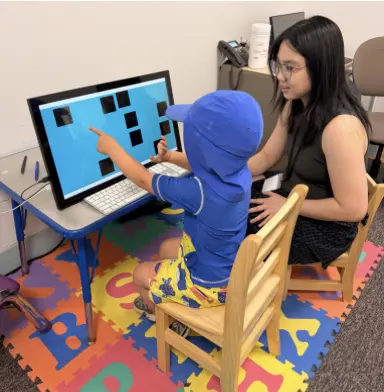
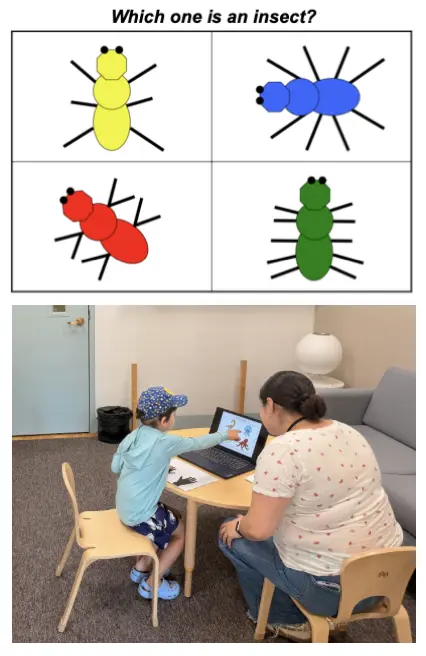 In the Learning About Insects Game, Gillian Gold, a Ph.D. student in the Human-Computer Interaction Institute, is looking at whether different ways of learning new information matter for how children learn – in particular, whether children learn differently in situations where they passively encounter new information (like when reading a book that says ‘insects have three body parts and six legs’) compared to situations where children receive feedback on inferences they generate themselves (like when guessing that a spider is an insect and being told that is not quite right because spiders don’t have three body parts). To help answer this question, children play one of three versions of the game. In one version, children are first told a fact, such as ‘insects are hard on the outside’, and are then told that ladybugs are hard on the outside, so ladybugs are insects. In another version, children are told the same fact and then asked to point to which animal was the insect (the ladybug). In a third version, children are first asked to guess which animal is an insect and are then told the same fact. By comparing how children learn the facts across the different versions of the game, the research team can find out whether these different experiences with new information result in different learning.
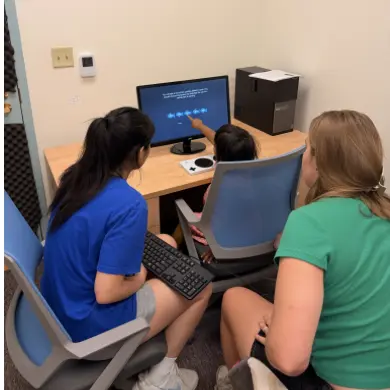
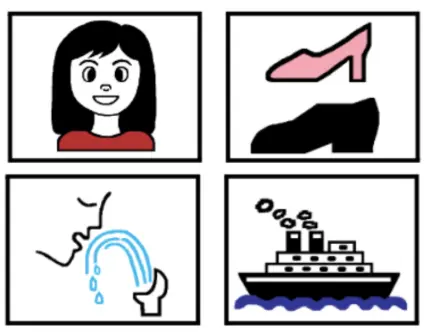
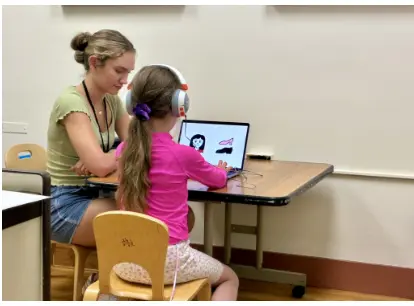 Riley Lawrence, a rising senior undergraduate student who received a summer fellowship to start working on her honors thesis in Linguistics and Psychology under the supervision of Dr. Christina Bjorndahl, is conducting the Listening and Repeating Word Games for her thesis project. The goal of Riley’s project is to understand how children learn to tell the sounds “s” and “sh” apart, both when hearing and when speaking. To answer this question, children play two word games. In the listening game, children hear words like “Sue”, “shoe”, “sip”, or “ship” and press the button that corresponds to the picture of that word. Some of the words sound ambiguous, and the children’s responses to these ambiguous words help the researchers learn what speech features children use to hear the difference between “s” and “sh”. In the repeating game, children are asked to repeat out loud a word they hear. These verbal responses are used to identify the speech features children use to say the difference between “s” and “sh”. Understanding the connection between hearing and speaking, and seeing how it changes with age, will help the researchers understand how children learn to distinguish between speech sounds.
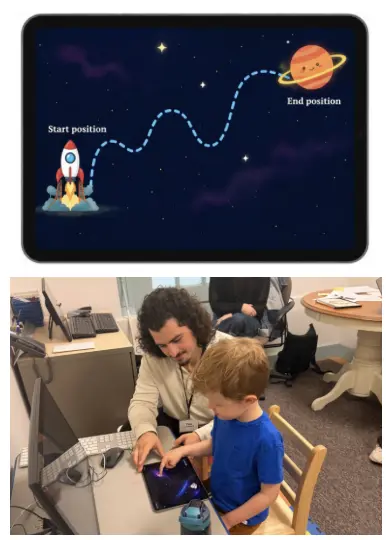 Anyone who has observed a young child learn a new motor skill like writing knows how hard it is to be fast and precise with new movements. In the Spaceship Game, Teo Ozaydin (a research associate working with Dr. Jessica Cantlon and Dr. Jonathan Tsay) is looking at how children learn new motor skills. Their team developed a space-themed game called “Galactic Navigation”, which is played on a touchscreen tablet over two days. In the game, children launch space flights by following a path with their finger until a spaceship reaches a target planet. Some paths are repeated over time and others are presented only once. By comparing flights on the repeated path with flights on brand-new paths, and by comparing the first and second days, the researchers can measure how quickly children learn a new movement skill, how well they remember it, and if it transfers to new movements – which helps understand the building blocks of everyday skills such as handwriting and drawing.
Stay curious!
Dr. Catarina Vales
(as always, let me know if you have any questions about research)