
CMU Children's School Research Questions and Answers
Who conducts the research?
The primary researchers at the Children's School are the psychology faculty, together with the post-doctoral fellows, graduate students, and research assistants on their teams. There are currently 5 research teams that conduct studies at the Children's School, led by Dr. Jessica Cantlon, Dr. Anna Fisher, Dr. David Rakison, Dr. Erik Thiessen, Dr. Catarina Vales, and Dr. Sharon Carver.
Small groups of students from the research methods class replicate famous studies, conduct observations, and then design and run their own small-scale studies at the Children's School.
In all cases involving direct interaction with children (i.e., as opposed to non-participant observation), the researchers familiarize themselves with the children, and vice versa, by visiting the classroom and engaging in an activity with the children, such as participating in circle time, having snack, reading a story, helping with an art project, etc.
With whose approval?
All research studies run at the Children's School must first be approved by CMU's Institutional Review Board as meeting the ethical standards of research with children participants and as minimal risk (meaning, not more risky than the everyday experiences children normally have).
Dr. Vales also reviews each study to ensure its consistency with our school philosophy and its potential to run smoothly without undue disruption of the school schedule.
When possible, each researcher meets with the staff to discuss the study's goals, procedure, and time frame, as well as to determine how to make it fit most appropriately with the classes' schedules. In other cases, these discussions are handled by the course instructor or Dr. Vales.
Which children participate?
To enroll a child in the Children's School, a parent/legal guardian must sign a consent form allowing the child to participate in approved research.
Typically, the kindergartners participate in more studies than the four-year-olds, who participate in more studies than the three-year-olds.
For any study, on any day, each child is invited to participate and is free to decline. The researchers do not attempt to convince or coerce the child into participating. The child is also free to end a session at any time. Researchers are instructed to heed a child's verbal request to end a session or return to the classroom, as well as to watch for non-verbal signs that the child is uncomfortable, tired, or bored.
For the most part, our children are eager to have special one-on-one time with the researchers "playing a game," and they often ask to be chosen to participate.
Where?
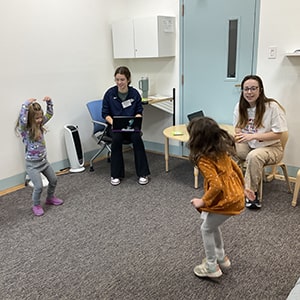
Our children usually accompany the researcher to a small lab room, near the classroom. Our policy dictates that one door to the lab must always remain open while a child is participating in a study.
Occasionally, studies take place in a quiet area within the familiar preschool space (typically the kitchen, the blue room, or the green room alcove).
No studies are conducted outside the boundaries of the Children’s School and laboratory wing security systems.
What are the children asked to do?
The experimental sessions are configured as "games." They usually begin with a warm-up involving casual conversation or playing with a special toy (not related to the actual study).
Though each study is different, sample studies have involved the following "games":
- rolling a marble down a simple maze and predicting where it will emerge,
- choosing which of two pictures best represents a story told by the experimenter, and
- selecting which paintings from a set were painted by the same artist.
In most cases, the children are asked to do several different versions of a task (e.g., different paths in the maze, different sets of pictures, etc.).
A brief description of each current study is provided to the family via the newsletter,, either just before or just after a study begins (depending on the timing of the study relative to the newsletter).
At the end of each study, the researcher thanks the child for participating and encourages the child about some aspect of his or her performance. The researcher also answers any questions or addresses any concerns the child raises. The child receives a sticker that says, “Ask me about the ______ game” to alert the family of their participation. The researcher also places a one-page description of the study in the child’s backpack on that day.
For observation studies, the children are not asked to "do" anything in particular; they follow the normal schedule of activities for the day in the normal space. Researchers choose the time of day to observe or may ask a teacher to provide certain types of materials (e.g., more dramatic play items vs. more construction items) based on the aspect of development being addressed. For example, one observation study involved children doing drawings of items in a photograph to observe the order in which they did the drawing, especially whether they worked from the large outlines to the inner features or in some other systematic fashion, such as top to bottom or left to right.
When?
Research sessions involving "games" are scheduled during activity times, when children are moving freely among multiple choices. Thus, children perceive the experience as just another activity and do not miss the structured large group times.
For how long?
Research “games” take no longer than 20 minutes. For our younger children, the "games" will typically be shorter (e.g., 5 to 15 minutes).
How often?
According to our policy, no child is asked to participate in more than one study per day that requires direct interaction with a researcher. Researchers use a log in the school office to record which children participate each day. Numerous observations may be conducted each day without altering the normal classroom activity.
During our heaviest semester of research, kindergartners participated in a special game once or twice per week. 3-year-olds participated in an average of 5 studies during the whole fifteen-week semester, and 4-year-olds participated in an average of 15 throughout the semester.
How are the sessions recorded?
Students in the research methods class typically record their observations by hand, but occasionally use audio recording. They sign a confidentiality commitment that prohibits sharing or posting their data outside the class.
Faculty research teams may use video or audio recording of their sessions, as well as collecting keystroke or touch screen data for studies run on the computer. They are required by the Institutional Review Board to provide a data security plan to ensure the children’s privacy.
In either case, children are identified by first name and last initial only. When the data are grouped, each child's name is replaced with a code. Only the codes are used in presentations of the data outside the research group.
Who has access to which data?
None of the data from any study are released to the teachers or administrators of the Children's School or to the child's family. They are in no way connected with the child's file at the school.
Raw data must be kept by the researchers for a period of years (usually 7, as with tax info) and are then destroyed.
Short clips of video or audio may be shared during seminars or conference talks, though subjects are never identified by name (and in most cases the angle of the video shows the subject’s manipulation of the task materials, not the face). Any other uses of recorded materials would require additional family permission (i.e., you would receive a form requesting permission to use specific recordings in a specific way).
How are the results communicated?
Summary results are communicated to the family via the newsletter, usually several months (or sometimes years) after the study ends. Research methods group posters are shared in the school hallway.
Researchers provide the school with copies of published results, though they typically include several studies, and the publication process often takes 1-2 years.
If you have any other questions about the research process, please feel free to contact Dr. Vales. We feel strongly that your child's participation in these studies is valuable to the child, as well as contributing to the scientific process that advances our knowledge of child development and how to best facilitate its smooth progress.