Spaced Practice
What is it?
Spaced practice is when students revisit material (e.g. through reading, listening, retrieval practice) with gaps of time between repeated study sessions on the same topic. In contrast to ‘massed practice,’ where repeated learning happens all in one session, spaced practice intentionally adds intervals of time (days, weeks, months) between when students engage with learning material. Spacing out practice is better for learning, especially long term memory retention, than massed practice. Assessments like quizzes and exams can contribute to spaced learning, since they require the student to recall information or apply it.
For example, if students are learning how to conduct linear regressions, it would be better to have them practice this skill at multiple, spaced out intervals during the semester, instead of all in one day or homework. Spacing out the practice opportunities will make it more likely that students retain the knowledge for longer.
Spaced practice is often also called “distributed practice.” Its opposite gets referred to variously as “massed,” “crammed,” or “clustered” practice. The exact timing between what counts as massed versus spaced also varies in the research; for our purposes, we are defining practice as spaced when sessions are separated by a day or more.

Figure 1: A single topic X gets multiple repetitions through different forms. Because there is a week between the practice and quiz and two weeks before the review, this counts as spaced learning. See more detailed uses of spaced practice in Figure 2 below.
What is the Evidence that it Works?
The effect spaced practice has on learning is “one of the oldest and most reliable findings in research on learning” (Pan et al., 2025), and has even been demonstrated in other species (Smolen et al, 2016). Hundreds of published research studies document benefits to spaced over massed practice (see Carpenter et al., 2012; Cepeda et al., 2006) and meta-analyses find medium to large average effect sizes. These studies have covered learning benefits for a wide range of learning outcomes, including memorization, motor skills, and problem solving. Although the majority are lab studies, evidence suggests that spaced practice also has benefits in classroom settings (reviewed in Mawson & Kang, 2025; Bego et al., 2024; Murray et al., 2025). For example, undergraduate students who reviewed material from a lecture on meteorology eight days after the initial lecture performed 7 percentage points better on a test the following month than those who reviewed the material one day after the lecture (Kapler et al., 2015). Students in a college calculus course performed better on topics which had been spaced across multiple practice quizzes than on those where all the practice questions were done at once (Lyle et al., 2022).
Why Does it Work?
Multiple, non-mutually exclusive theories suggest mechanisms to explain the benefits observed from spaced learning. For example, Encoding Variability Theory suggests that experiencing learning events in different contexts at different times creates more unique connections, leading to more robust memory than if all learning is done at once place and time. Study-phase Retrieval Theory points to evidence that creating a time lag between learning events can act as a “cognitive palate cleanser,” like hitting the “reset button” so that the next time learners engage with content it requires a bit more effort than if they did everything in one sitting. This extra effort is a desirable difficulty that has repeatedly been shown to be critical for learning. Other theories point toward cognitive disadvantages of “massing” learning events instead of spacing them out. For example, Deficient Processing Theory suggests that over the course of a study session our brains habituate to the content, leading to decreased cognitive engagement. By spacing out the same work over multiple sessions, we can avoid habituation and capitalize on our brain's learning power most efficiently. In addition, it takes time for our brains to transition what we’re learning into long-term memory. By adding time in between repetitions of the same task, we give our brains the time it needs to make that transition which ultimately leads to stronger memory connections and better learning outcomes. For further reading about the theoretical mechanisms behind this robust effect see Benjamin & Tullis (2010).
How Can I Use it in My Class?
Despite the benefits of spaced practice, most students do not incorporate it into their study strategies on their own. Spacing out studying requires more planning and self-discipline than doing it all at once. It can feel more difficult and result in lower immediate performance on the practice tasks, which may give the false impression that it is not working (see Rawson & Kintsch, 2005). Because of this, students are unlikely to choose to space out learning without clear incentives. In one study, 28% of students in a statistics course completed three sets of voluntary practice problems on the same day, but only 12% did so when the sets were spaced out over the course of a week (Ebersbach & Barzagar Nazari, 2020). In a final test five weeks after the last practice session, these students outperformed those who had crammed their practice by 7 percentage points, so the strategy was clearly effective but its uptake was low. Given this, we need to encourage students to use spacing.
One approach is to build spacing into the structure of your course. You might stagger the release of practice problem sets, and incentivize students to complete them not all at once. Another approach some instructors use is to introduce a new topic in the second half of the class session, and return to it in the first half of the next session. Homeworks, practice problem sets, or writing assignments can be made shorter but more frequent, so the same skills are covered multiple times. Similarly, if you only have a small number of high-stakes assessments (e.g., exams, papers), you might consider replacing one or more with more frequent smaller assessments, so that students have to complete tasks on the same topic with time between them but also making each assessment a learning opportunity, not just assessments (see our page on Frequent Low-Stakes Assessments).
Note that frequent assessments alone will not leverage spaced practice. In order to take advantage of spaced practice, you might spread questions on one topic across multiple quizzes instead of putting them all in one quiz and then moving on (Lyle et al., 2022; see Figure 2, Example 1). Alternatively, you might keep a smaller number of assessments but make them cumulative, folding items from earlier units into later assessments so each topic or skill recurs several times. For example, you could have students write a thesis statement one week and then the following week have them write another thesis statement but this time with a full introductory paragraph. The next weeks would repeat this sort of skill stacking, so that students get repeated, spaced practice on each subskill of writing a paper (see Figure 2, Example 2).
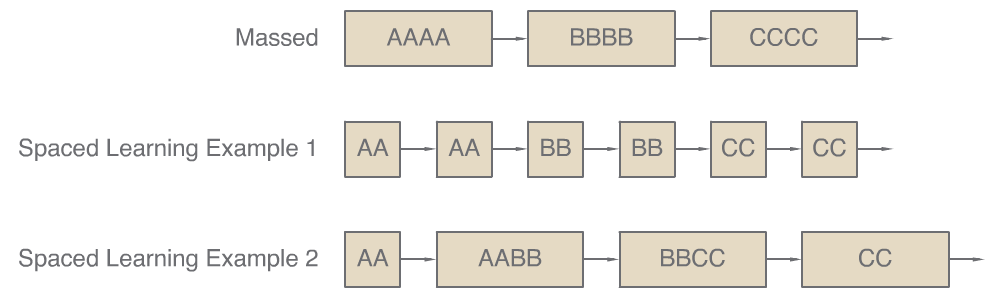
Figure 2: Diagrams demonstrating spaced learning. Each box represents a “learning event,” which could be a class session, study session, quiz, homework, writing assignment, etc. The letters represent material on each of three topics (A, B, and C), so AA represents two exposures or practice opportunities with topic A. Each option includes the same amount of each topic, just distributed differently. Important to note: not every instance of a topic has to be the same type. So, AA could mean a lecture on A and then an immediate practice problem on A.
Example 1 indicates breaking up larger massed learning into smaller, spaced out learning. This produces a higher number of learning events, but with the same amount of material. Example 2 indicates splitting up topics across learning events so that students encounter topic A twice, B twice, C twice, etc. but that each learning event is about the same size as in the Massed example.
You can also explicitly discuss the drawbacks of cramming and the benefits of spacing with your students. You might present students with the evidence that spaced learning is better for long term learning, and specifically address that although it may feel more difficult in the moment, this difficulty is desirable. Then you could ask students to reflect on the extent to which they are currently using spaced learning, and encourage them to think about how they could apply it more both in this class and to others.
What are Some Important Considerations When Implementing Spaced Practice?
Use spaced practice strategically
You probably don’t have time for every single topic to appear multiple times across your course. Prioritize spaced learning for the key concepts and skills that are the most challenging or most important for students to retain.
Favor active re-exposure over re-reading
Revisiting should mean retrieving or applying the concept through new problems on the same ideas, combining the benefits of spacing and retrieval practice. Using passive re-exposure can work, but may be less effective. See our page on Active Learning Strategies.
A few well-spaced repetitions are enough
Two or three encounters separated by time produce benefits; more may have diminishing returns. What matters is the time between, not the count.
Choosing the gap
Optimal gaps are roughly 10–20% of how long you want students to retain the information (Cepeda et al., 2006, 2008). For a final exam ~10 weeks out, space encounters ~1–2 weeks apart. Longer retention goals call for longer gaps. That said, any spacing beats massing practice.
Plan backwards
Plan backwards from when students need the knowledge (final exam, later unit, project), then place repeated encounters in the weeks leading up to it.
Caution
"Stretched out" is not the same as "spaced." Revisiting a topic in weeks 1, 3, and 6 would be spaced practice, but teaching it so slowly that you are still on the same topic in week 6 as you were in week 1 is not. Spacing requires repetition, not slowness. Research shows that students often conflate “spread out” with “spaced,” missing the key element of repetition. So if they study for an exam over three days instead of one, unless they revisit material in their studying, they are not leveraging spaced practice. (Malain & Hartwig, 2026)
Where Can I Learn More?
Bego, C. R., Lyle, K. B., Ralston, P. A. S., Immekus, J. C., Chastain, R. J., Haynes, L. D., Hoyt, L. K., Pigg, R. M., Rabin, S. D., Scobee, M. W., & Starr, T. L. (2024). Single-paper meta-analyses of the effects of spaced retrieval practice in nine introductory STEM courses: Is the glass half full or half empty? International Journal of STEM Education, 11(1), 9. https://doi.org/10.1186/s40594-024-00468-5
Benjamin, A. S., & Tullis, J. (2010). What makes distributed practice effective?. Cognitive psychology, 61(3), 228-247. https://doi.org/10.1016/j.cogpsych.2010.05.004
Carpenter, S. K., Cepeda, N. J., Rohrer, D., Kang, S. H. K., & Pashler, H. (2012). Using spacing to enhance diverse forms of learning: Review of recent research and implications for instruction. Educational Psychology Review, 24(3), 369–378. https://doi.org/10.1007/s10648-012-9205-z
Cepeda, N. J., Pashler, H., Vul, E., Wixted, J. T., & Rohrer, D. (2006). Distributed practice in verbal recall tasks: A review and quantitative synthesis. Psychological Bulletin, 132(3), 354–380. https://doi.org/10.1037/0033-2909.132.3.354
Cepeda, N. J., Vul, E., Rohrer, D., Wixted, J. T., & Pashler, H. (2008). Spacing effects in learning: A temporal ridgeline of optimal retention. Psychological Science, 19(11), 1095–1102. https://doi.org/10.1111/j.1467-9280.2008.02209.x
Ebersbach, M., & Barzagar Nazari, K. (2020). Implementing distributed practice in statistics courses: Benefits for retention and transfer. Journal of Applied Research in Memory and Cognition, 9(4), 532–541. (2020-88095-001). https://doi.org/10.1037/h0101860
Kapler, I. V., Weston, T., & Wiseheart, M. (2015). Spacing in a simulated undergraduate classroom: Long-term benefits for factual and higher-level learning. Learning and Instruction, 36, 38-45. https://doi.org/10.1016/j.learninstruc.2014.11.001
Lyle, K. B., Bego, C. R., Ralston, P. A. S., & Immekus, J. C. (2022). Spaced retrieval practice imposes desirable difficulty in calculus learning. Educational Psychology Review, 34(3), 1799–1812. https://doi.org/10.1007/s10648-022-09677-2
Malain, E. D., & Hartwig, M. K. (2026). Self-reported spaced study: Associations with college students’ grades and self-regulation. Journal of Experimental Psychology: Applied. https://doi.org/10.1037/xap0000562
Mawson, R. D., & Kang, S. H. K. (2025). The distributed practice effect on classroom learning: A meta-analytic review of applied research. Behavioral Sciences, 15(6), 771. https://doi.org/10.3390/bs15060771
Murray, E., Horner, A. J., & Göbel, S. M. (2025). A meta-analytic review of the effectiveness of spacing and retrieval practice for mathematics learning. Educational Psychology Review, 37(3). https://doi.org/10.1007/s10648-025-10035-1
Pan, S. C., González-Cabañes, E., Teo, A. Z. J., Zung, I., Sana, F., & Cooke, J. E. (2025). Distributed practice and interleaved practice: Undergraduate students’ strategies, experiences, and beliefs. Applied Cognitive Psychology, 39(3). https://doi.org/10.1002/acp.70071
Rawson, K. A., & Kintsch, W. (2005). Rereading effects depend on time of test. Journal of Educational Psychology, 97(1), 70–80. https://doi.org/10.1037/0022-0663.97.1.70
Smolen, P., Zhang, Y., & Byrne, J. H. (2016). The right time to learn: Mechanisms and optimization of spaced learning. Nature Reviews Neuroscience, 17(2), 77-88. https://doi.org/10.1038/nrn.2015.18
Eberly Center
4765 Forbes Avenue
Tepper Quad, Suite 1310
Pittsburgh, PA 15213
(412) 268-2896
Contact Us


 This work is licensed under a Creative Commons Attribution-NonCommercial-ShareAlike 4.0 International License.