Retrieval Practice for Improved Learning
What is it?
Retrieval practice (sometimes called the “testing effect” in education research) is a type of active learning that asks students to recall information from memory, increasing the strength of that memory and understanding of content, as well as their ability to apply that content. Having students do any task that requires them to retrieve information (e.g. quizzes, flashcards, practice problems, exams) can be an effective learning tool, helping students remember more and for longer.
Why Does it Work?
When information is received, it goes first into the working memory, where it can sometimes be forgotten, before being stored in the long-term memory. However, when the student goes to retrieve information from their long-term memory, pathways in the brain are activated to bring back the information into working memory. This retrieval helps make new pathways and solidify the existing ones at which point, the information is learned more deeply, making it harder to forget.
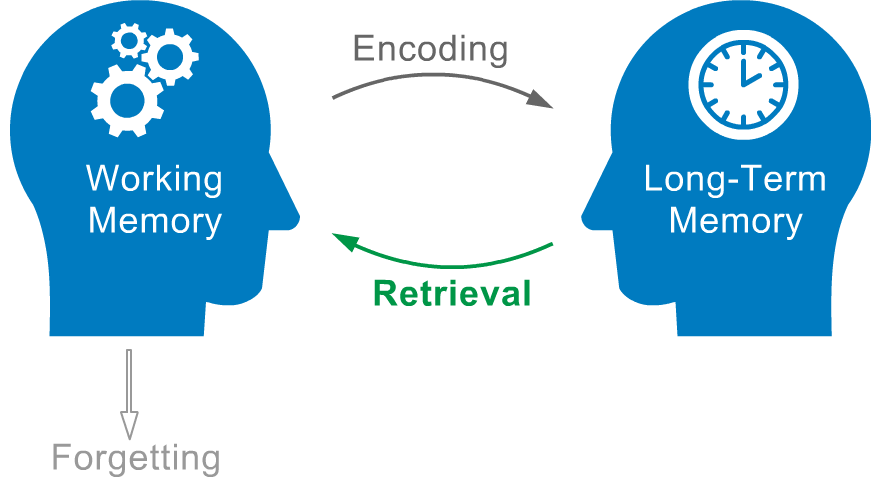
Retrieval practice works in part because it takes more mental effort than passively reviewing information. This difficulty of the process is key to learning (Yang et al., 2019). Importantly, this means that attempting to retrieve information and getting it wrong will still be more beneficial than simply reading over the correct information. As long as there is some feedback mechanism for the student to know whether they got the right answer, retrieval practice will facilitate learning even for students who made mistakes.
What is the Evidence That it Works?
Since the emergence of the concept, many studies have repeatedly confirmed the benefits of retrieval practice for student learning (e.g., Roediger & Karpicke, 2006; Trumbo et. al., 2016). Figure 1 shows an experimental result of how retrieval practice can create longer lasting learning. In another such study, Butler (2010) demonstrated that repeated recall led to greater retention of the specific information studied and also extended to novel contexts where that information must be applied. While evidence for the testing effect has been robustly replicated in the laboratory, Trumbo et al. (2016) translated this into practice, demonstrating the beneficial impact of the retrieval practice, beyond merely restudying, in a live classroom setting. Even completing an open-book retrieval practice is better for information retention than just re-reading the material (Agarwal et al., 2008).
Researchers have found that the type of recall task can impact the learning gains associated with the retrieval practice (Butler & Roediger, 2007; Endres et al., 2020). Butler and Roediger (2007) found that students who completed a short-answer test after watching history lectures performed significantly better on a test one month later than those who only studied the lecture material and even those who completed a multiple-choice test. Multiple choice tests may be less effective retrieval practice than short answer tests because students don’t need to generate the information from memory; they merely recognize the right answer.
This does not mean that one form of retrieval practice is better than another for all goals. Endres et al. (2020) found that while students who completed a short-answer recall task were more successful in the retrieval of targeted information at a later date than their peers who completed a free recall task (i.e., recalling information with no prompts or cues), students in the free recall task showed better retention of a broader range of information. In addition, students in the short-answer task group were more accurately able to judge their own learning, while students in the free recall task group showed increased self-efficacy and interest in the material. These results suggest that the type of retrieval practice can have varying impacts and should be aligned with your educational goals.
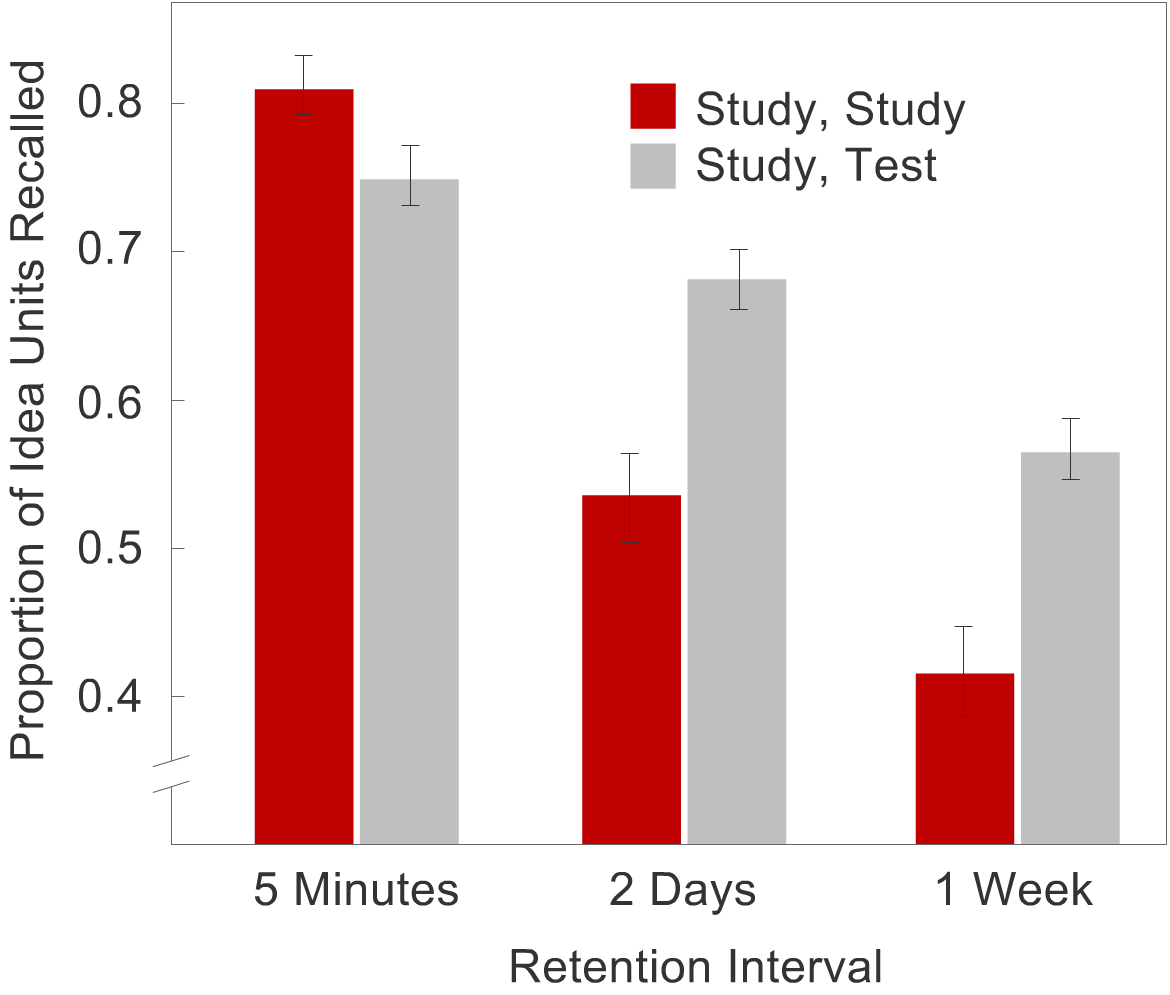
Figure 1. Results from an experiment where participants either re-studied a passage or were tested on it before taking a final test of their reading comprehension at intervals of five minutes, two days, and one week later. Note that the test condition (retrieval practice) was better for longer-term retention. (Roediger & Karpicke, 2006)
How Can I Use it in My Class?
Retrieval practice (including tests amd quizzes) is a learning opportunity, not just a way to assess student learning. We can create these learning opportunities both in the classroom and asynchronously. Retrieval practice can take many forms, but the basic principle is this:
Regularly give students tasks that require them to recall information on their own.
Here are some ideas for implementing retrieval practice:
Name |
Description |
|
Lecture Recall |
Ask students to list and explain the main ideas of the previous lecture before starting today’s class. |
| Quizzes |
Include short answer quizzes about core concepts and important definitions periodically (weekly, unit by unit, etc.). This can be done in-class or on Canvas. |
| Peer Teaching |
Have students teach each other concepts from class. |
|
Reading recall |
Have students paraphrase the reading in their own words before a discussion on it. |
|
Concept Maps |
Have students make concept maps on paper or with an online tool. |
|
Study Guide |
Have students create their own study guides or practice tests for a unit. |
Many of the activities involved in Active Learning at least partially depend on retrieval practice. Please refer to our page of Active Learning Strategies for more guidance.
Frequent, low-stakes assessments are more effective for learning (and less stressful for students!) than one or two high-stakes exams. Breaking up large exams into smaller quizzes, spread over weeks instead of a few hours, can offer retrieval practice to students while also providing the instructor with a better idea of how students are doing along the way. Reducing the stakes (i.e., the weight of the grade) by having multiple smaller parts to an assessment may reduce student stress while still providing the benefits of retrieval practice (Spzunar, 2013). See a deeper description of low-stakes practice and a diversity of options for implementing low-stakes assessments.
What are Some Important Considerations When Implementing Retrieval Practice?
Inform students about the benefits of retrieval practice
Students underestimate the power of retrieval practice, often preferring to do things like re-read or study texts instead of testing themselves with things like free recall or solving problems (instead of reviewing solutions to problems). The fact that the impacts of retrieval practice are most obvious at longer timespans means that students may not believe that testing or other forms of retrieval practice are the best uses of their time (for long-term recall). This knowledge may help students use time outside of class more effectively.
Incentivize retrieval practice
Like most assignments, students are more likely to complete them when there is some incentive (e.g., participation points, grade, etc.) attached to them. Simply informing students about the research on the testing effect and recommending that students practice retrieval may not be sufficient (Trumbo et al., 2016).
Give feedback when possible
Retrieval practice can work even in contexts where you don’t give students feedback, but adding feedback will improve student learning even more (Kang et al., 2007).
Consider your learning goals when deciding what types of questions to use for retrieval practice
Short-answer questions have been shown to promote better knowledge retention than multiple-choice questions and more targeted retrieval than free-recall responses. However, free-recall questions have been shown to increase students’ self-efficacy and overall learning of non-targeted material (Endres et al., 2020; Butler & Roediger, 2007).
Provide opportunities for practice early and often
Incorporating retrieval practice throughout the course can help solidify learning as you go. Even students who know how to use retrieval practice may leave it until they are studying the night before an exam. Consider how you can use class activities and homeworks to get students to engage in retrieval practice more regularly.
Where Can I Learn More?
Agarwal, P. K., Karpicke, J. D., Kang, S. H., Roediger, H. L., & McDermott, K. B. (2008). Examining the testing effect with open and closed book tests. Applied Cognitive Psychology, 22, 861–876. https://doi.org/10.1002/acp.
Butler, Andrew C. (2010). Repeated testing produces superior transfer of learning relative to repeated studying. Journal of Experimental Psychology: Learning, Memory, and Cognition. 36(5), 1118-1133. https://doi.org/10.1037/a0019902
Butler, A. C., & Roediger III, H. L. (2007). Testing improves long-term retention in a simulated classroom setting. European Journal of Cognitive Psychology, 19(4-5), 514-527. https://doi.org/10.1080/09541440701326097
Endres, T., Kranzdorf, L., Schneider, V., & Renkl, A. (2020). It matters how to recall–task differences in retrieval practice. Instructional Science, 48(6), 699-728. https://doi.org/10.1007/s11251-020-09526-1
Kang, S. H., McDermott, K. B., & Roediger III, H. L. (2007). Test format and corrective feedback modify the effect of testing on long-term retention. European Journal of Cognitive Psychology, 19(4-5), 528-558. https://doi.org/10.1080/09541440601056620
Roediger, Henry & Karpicke, Jeffrey. (2006). Test-enhanced learning: Taking memory tests improves long-term retention. Psychological Science. 17(3), 249-255. https://doi.org/10.1111/j.1467-9280.2006.01693.x
Szpunar, K. K., Khan, N. Y., & Schacter, D. L. (2013). Interpolated memory tests reduce mind wandering and improve learning of online lectures. Proceedings of the National Academy of Sciences, 110(16), 6313-6317. https://doi.org/10.1073/pnas.1221764110
Trumbo, M. C., Leiting, K. A., McDaniel, M. A., & Hodge, G. K. (2016). Effects of reinforcement on test-enhanced learning in a large, diverse introductory college psychology course. Journal of Experimental Psychology: Applied, 22(2), 148–160. https://doi.org/10.1037/xap0000082
Yang, B. W., Razo, J., & Persky, A. M. (2019). Using testing as a learning tool. American Journal of Pharmaceutical Education, 83(9), 7324. https://doi.org/10.5688/ajpe7324
Eberly Center
4765 Forbes Avenue
Tepper Quad, Suite 1310
Pittsburgh, PA 15213
(412) 268-2896
Contact Us


 This work is licensed under a Creative Commons Attribution-NonCommercial-ShareAlike 4.0 International License.