Models, Iron and Insights: Visualizing Bominaar’s Legacy
By Kirsten Heuring
Media Inquiries- Associate Dean of Marketing and Communications, MCS
- 412-268-9982
For more than three decades, Associate Research Professor Emile Bominaar developed theoretical frameworks behind breakthroughs in bioinorganic chemistry alongside experimental research in the Department of Chemistry at Carnegie Mellon University. At the end of the 2026 spring semester, Bominaar retired.
“The Mellon Institute and the environment here played an important role in my life,” Bominaar said. “I very much appreciate all the wonderful people I met here and the collaborations I was able to have.”
Bominaar joined Carnegie Mellon in 1993 as a research scientist on the invitation of Eckard Münck, a professor of chemistry. Münck pioneered the application of 57Fe Mössbauer spectroscopy, a form of imaging that focuses on changes in the nucleus of iron, to bioinorganic chemistry, a subfield that studies how metals play a role in biological processes.
Bominaar, who trained as a theoretical physicist, conducted research in physical chemistry, providing expertise in the interpretation of spectroscopic data in through electronic structure theory, which focuses on how electrons in an atom influence how atoms interact.
Over the course of his career, Bominaar worked with researchers from U.S. and European academic institutions and shaped new research directions into the molecular mechanisms of metalloproteins. He contributed to more than 100 research papers, advancing the field of bioinorganic chemistry.
His work at Carnegie Mellon went beyond the Münck laboratory, and he engaged in projects with other Carnegie Mellon professors, including Terry Collins, Teresa Heinz Professor in Green Chemistry; Michael Hendrich, emeritus professor of chemistry; and Yisong (Alex) Guo, professor of chemistry.
Bominaar worked with Collins on the identification of a reactive intermediate in TAML chemistry, which is key in the catalytic breakdown of water pollutants and with Hendrich on uncovering the catalytic mechanisms of some of the most challenging metalloenzymes.
Electron spin has always been a central theme in Bominaar’s research and the publications he co-authored on clusters with multiple paramagnetic transition-metal sites have been widely cited.
Together with Professor James (Jim) Peterson at the University of Pittsburgh, he worked on the development of magneto-optical spectroscopies, which analyze the influence of magnetic fields on polarized light as a tool for investigating the electronic structure of molecules. Together, they were the first to apply magnetic linear dichroism spectroscopy to metalloproteins showing the method could extend beyond studying atoms.
“Jim had the instrument and the spectroscopic expertise,” Bominaar said. “I provided the theory.”
More recently, Bominaar worked with Guo on finding new ways for iron-sulfur clusters can catalyze reactions.
“I’m very happy that Alex will continue the work on bioinorganic chemistry,” Bominaar said. “I could hardly imagine a better person to take the lead of this work.”
As an emeritus professor, Bominaar plans to continue doing research, interacting with colleagues and complete unfinished projects. Outside of the lab, he looks forward to pursuing various interests and endeavors with family, friends and wildlife.
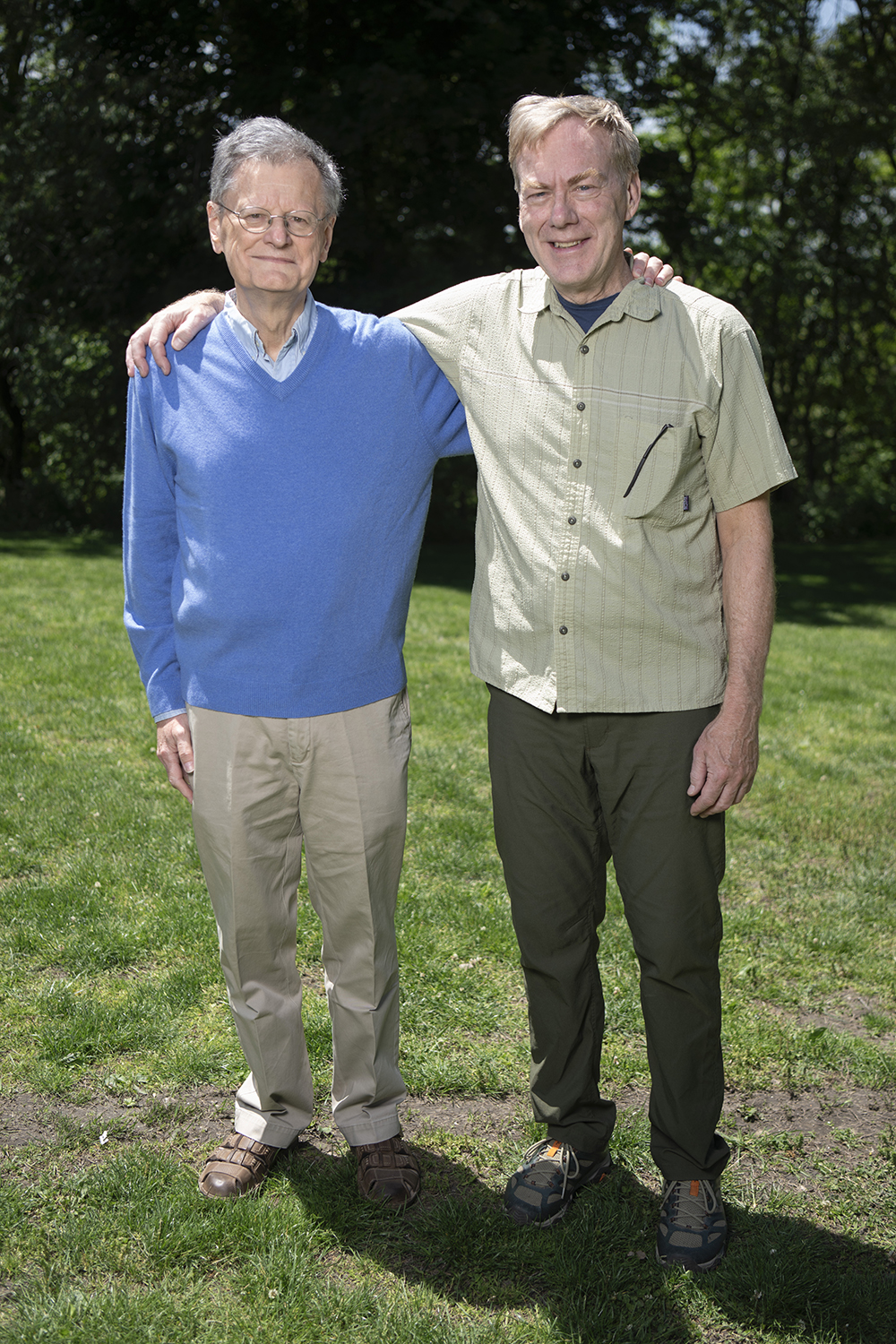
Emile Bominaar and Michael Hendrich both retired at the end of the Spring 2026 semester.