Upcoming Events
~ Stay Tuned! ~
Past Events

INGRoup
July, 2026. Twenty years ago, at a time when the study of teams and groups was largely confined to separate academic silos, a collaborative spark—spearheaded in part by CMU CoLab's Laurie Weingart led to the foundation of INGRoup, an international association that drove the growth of the interdisciplinary field. The spirit lives on at CMU through CoLab, and this year saw the convergence of the two as CMU hosted INGRoup. Nearly 200 scholars from around the world joined with over 20 CMU faculty, postdocs, and students from across CMU's campus.
Collaboratorium
February 13, 2026. This one-day mini-conference brought together scholars from across CMU's campus with local professionals to advance the study and practice of collaboration in complex, technology-enabled environments. Through keynotes, lightning research talks, an expert panel, and a "Resource Marketplace," attendees learned about cutting-edge research, forged new connections, and identified collaborators and resources like data sets, methods, and technical expertise to accelerate their work.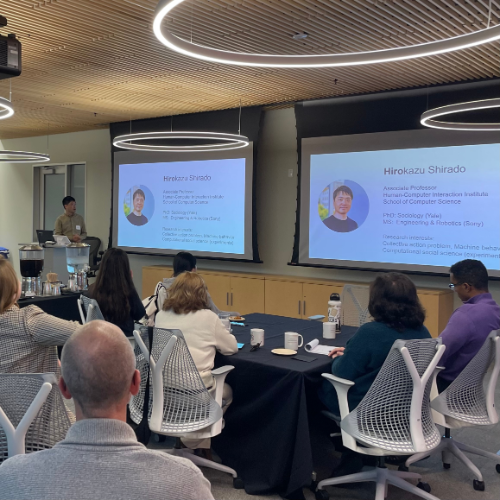
Center Kick-Off Event
November 17, 2025. CoLab's first mixer drew faculty, postdoctorates, and students from across campus. In a display of CMU's breadth of collaboration science expertise, rapid research talks ranged in topic from the study of health care teams, to the dark side of collaboration (conflict), to how AI could help--or hinder--human work on anything from product design to decision making.
Research Seminar
February 20, 2026. Sharon Arieli, Hebrew University Business School, joined us for a presentation exploring the use of natural language processing to identify human values, and also how AI agents can actively shape values and downstream outcomes like creativity.
Research Seminar
November 5, 2025. CoLab had a great soft launch with Lindsay Larson's talk, titled Teamwork in the Age of AI: How AI Function Shapes Team Effectiveness. As organizations role out "AI teammates," this work-in-progress highlights the need to think carefully about what AI can do, how human's might be receptive to that, or not, and what that means for a teams ability to work effectively.
Workshop & Research Seminar
November 21, 2025. Avi Kluger (Hebrew University Business School) joined us to offer an introductory workshop on the Social Relations Model, sparking discussion about the collaboration research that could be unlocked with this methodology. He then shared insights into his research on the power of listening for building relationships, sparking creativity, and more.
Research Seminar
April 6, 2026. Brandon Lepine (UC Santa Barbara), visiting with Matt Beane, presented his research on AI-assisted work and cognitive load. Drawing on Cognitive Load Theory, he showed how AI tools like ChatGPT can improve task quality but also introduce extraneous load that negatively impacts performance. Using a study of financial professionals, he highlighted how expertise shapes the benefits and challenges of working with AI, sparking discussion on managing cognitive load in real-world settings.Watch the recording