Student Sustainability Liaison Spotlight: Hannah Hudson & Violet McCullough
By Iris Hung
The Student Sustainability Liaison Program, initiated by the Sustainability Initiative, empowers students to research current practices, identify opportunities, and champion meaningful change within their own departments. This year, 17 liaisons across 10 departments joined the Liaison program. If you’re interested in advancing sustainability within your department, reach out to sustainability@cmu.edu to learn more.
We recently sat down with two liaisons to hear about their experience firsthand: Hannah Hudson, a sophomore in Biological Sciences, and Violet McCullough, a first-year student in Electrical and Computer Engineering. Both have completed the bulk of their departmental research and are now turning their focus toward synthesizing insights and developing concrete recommendations for their departments.
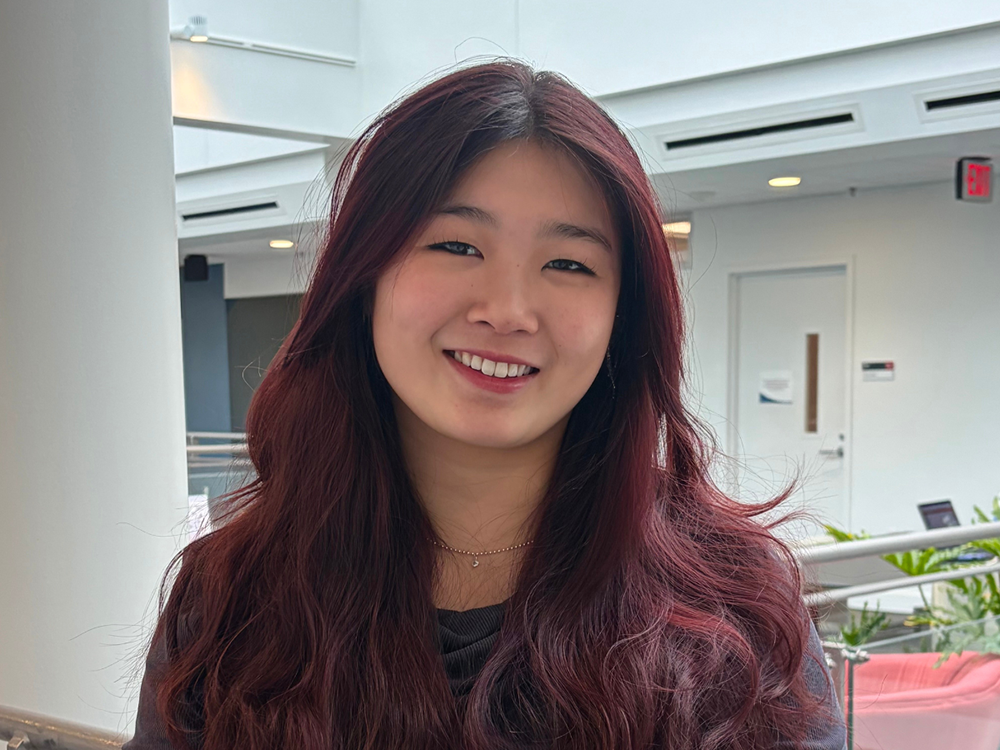
Hannah Hudson
Biological Sciences, Mellon College of Science
Q: How did your background lead you to sustainability, and what drew you to the Liaison Program?
A: I grew up in rural New Hampshire, surrounded by lakes and woods. In high school, I spent four years as a camp counselor teaching middle schoolers about wildlife conservation, and in my senior year I worked with a friend to build a native pollinator garden integrated into our lower school’s curriculum. Those experiences showed me how sustainability can be meaningfully woven into education, and it’s something I’ve been thinking about ever since.
When I got to CMU, I wanted to go beyond student clubs and engage with sustainability at an institutional level, with a direct connection to faculty and real potential for departmental impact. The Liaison Program felt like exactly that.
Q: What has your research uncovered, and where do you see the biggest opportunity?
A: I realized how little sustainability had been formally pushed or even discussed at the departmental level. Rather than trying to transform everything at once, I focused on establishing a baseline and identifying small, actionable steps.
I’ve been reaching out to my adviser, the department head, and the Mellon College of Science core curriculum advisor, while also collaborating with Qiran Sun, the Math department liaison, to look for shared opportunities across the college. The biggest opportunity I see is embedding sustainability into the Biology Colloquium, which is a required sophomore course. I’m also exploring how lab practices like waste disposal and resource use can become more sustainable, and I see it as a bigger, longer-term endeavor.
Q: What is your biggest goal as a liaison?
A: I want to actually accomplish something concrete, whether that’s earning the Scotty Goes Green certification, embedding sustainability content into a required course, or starting to reform lab waste practices. I want to move beyond planning and make something tangible happen.

Violet McCullough
Electrical and Computer Engineering (ECE), College of Engineering
Q: What first drew you to sustainability, and how did that path lead you to ECE and the Liaison Program?
A: I’m from Madison, Wisconsin, where I grew up surrounded by lakes. As a kid, we would collect water samples to monitor quality, and by the time I was in middle school, the runoff damage had become irreversible. That planted the seed for me: I want future kids to be able to go out on that lake and see fish and organisms thriving.
As I got older, my interest in physics led me to ECE. The summer before college, I visited Iceland, where they run almost entirely on geothermal energy. That experience cemented my interest in ECE for clean energy purposes, and brought me to the Liaison program to see what I could do as an undergraduate student.
Q: What has your research process looked like?
A: I worked with the department librarian, Haoyong Lan, who pointed me to the Institute of Electrical and Electronics Engineers (IEEE) website, the external platform that ECE faculty already use to publish and reference research. What struck me was that IEEE has its own sustainability frameworks and requirements embedded within it. Since the department already treats it as a standard, I saw an opportunity to bring those outside standards in and use them as a lens for what the department could adopt internally.
Q: What has your research revealed about your department’s sustainability landscape?
The biggest surprise was discovering that out of the ECE faculty I surveyed, 76 professors are doing research that connects to at least one of the Global Goals. Affordable and Clean Energy was the most common, but others were contributing to Good Health and Well-Being, Quality Education, and Industry, Innovation and Infrastructure. Seeing researchers in a deeply technical STEM department working toward goals you wouldn’t immediately associate with engineering was really eye-opening.
However, the gap between research and implementation is where I see the biggest opportunity. Right now, a lot of the sustainability-focused research in ECE is happening at the Ph.D. level, which leaves a lot of undergraduates out of the picture. One idea I’ve been developing is a program that connects undergraduate students with ECE professors, using IEEE standards as a starting point, and gives students a defined project to build or implement with the professor serving as a mentor.
Q: What is your biggest goal going forward?
A: Working with other liaisons from across CMU has shown me how many people are genuinely invested not just in their own futures, but in the futures of people who come after them. My biggest goal is to create a wider understanding that sustainability is not a single, isolated concept. It lives across every discipline, field, and level within our community.
The Student Sustainability Liaison Program is open to students from all CMU colleges and departments.