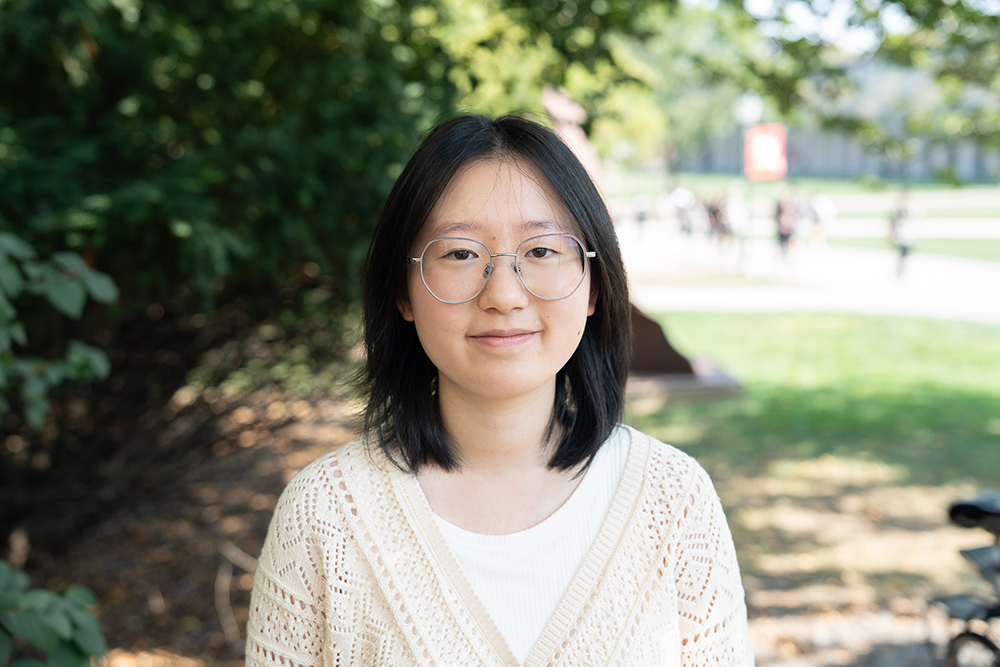
Fellow Spotlight: Ruoyun Xu
SURF-Sustainability Fellow, Summer 2025
This past summer, the Sustainability Initiative partnered with the Office of Undergraduate Research to offer several Summer Undergraduate Research Fellowships related to Sustainability. These opportunities funded summer research that focused specifically on the Sustainable Development Goals, also known as the Global Goals.
We asked College of Engineering sophomore Ruoyun Xu, one of our summer fellows, to answer a few questions about her experience.
Q: Share a brief description of your research and why it’s important.
A: My research utilizes statistical methods to find aerosol distribution patterns’ correlations to the weather conditions, such as wind speed and direction, rain intensity, UV intensity, etc. Aerosol particles play a large role in climate because they contribute to the formation of clouds, which reflect sunlight and cool the climate. My research contributes to prediction of how particles move around in the atmosphere, sources of the particles, and what affects their concentrations, so we can understand climate change better.
Q: Why did you decide to apply for SURF-Sustainability? What did the fellowship allow you to accomplish?
A: I decided to apply for SURF-Sustainability because my research is closely related to sustainability. The application process and post-program writeup of this fellowship incentivized me to think about how exactly my research is related and contributes to sustainability.
Q: The SURF fellowship required your research to contribute to the Global Goals. Can you share a little about which goal(s) your work relates to, and how?
A: My research findings can contribute to three Global Goals: Climate Action, Good Health and Well-Being, and Sustainable Cities and Communities. Our findings contribute to Climate Action by advancing understanding of aerosol patterns, which are critical for improving climate models and predicting climate change. Aerosols, especially in the nanoscale, can impact air quality and therefore human health. Thus, we contribute to Good Health and Well-Being by identifying the conditions in which these particles are redistributed, hence protecting people from air-pollution-related health risks. Finally, we contribute to Sustainable Cities and Communities by providing a scientific basis that can be used to develop effective mitigation strategies for nano-scale aerosols in cities and communities.
Q: How will you use what you learned about the Global Goals and sustainability in your work moving forward?
A: Although I have decided not to move forward with research in aerosol due to a shift in personal interests, I am still doing sustainability-related research, specifically in polymer fields. Moving forward, I would still keep the Global Goals in my mind and think about how my research contributes to different sides of sustainability. This experience has taught me to evaluate research not just by its scientific merit but also by its potential impact on environmental and social systems. In the future, I plan to actively seek collaborations and projects that align with multiple Global Goals, particularly those addressing responsible consumption and climate action.
I would like to express my deep gratitude to my PI, Professor Coty Jen, for her invaluable mentorship during this research experience. The completion of my SURF-Sustainability project would not have been possible without her guidance and support. I am especially grateful that she offered to mentor me directly and provided consistent and thoughtful feedback throughout the summer. This research opportunity not only gave me the chance to explore a topic: atmospheric science, which I have always wished to explore, but also raised my curiosity about how computational methods can be applied to polymer designs, which is a topic that I am about to explore soon!
Applications for the 2026 SURF-Sustainability Fellowships are now open. Visit the webpage to review requirements and apply. The deadline is February 18, 2026.