
Jennifer Spirer Turns Culture Shock Into Campus Comfort For CMU-Africa Students
By Rob Biertempfel
Twenty-eight hours after boarding a jetliner in Kigali, Rwanda, Bisamaza Ghislain and about a dozen other Carnegie Mellon University in Africa engineering students arrived at Pittsburgh International Airport late on a warm night in August 2023.
Dazed and weary after their 7,000-mile journey, the students tried to get their bearings in the sprawling airport. It was the first of many changes, challenges and opportunities in store for them during their semester at Carnegie Mellon’s Pittsburgh campus through the CMU-Africa Student Exchange Program.
To their surprise, Jennifer Spirer was waiting at baggage claim. Spirer, the College of Engineering’s director of graduate affairs, had already arranged transportation, student ID cards, travel adapters to charge depleted cell phone batteries, a hot meal and kitchen essentials for their apartments.
“Jennifer was truly our guardian angel helping us transition smoothly into a completely new life in Pittsburgh,” Ghislain said. “She is now my best friend for life, thanks to this program.”
Launched in 2017, the Student Exchange Program brings engineering graduate students based in Kigali to Pittsburgh for a semester. They take courses, learn from mentors, immerse themselves in campus life, build career networks and experience American culture. For many, it’s their first time outside Africa.
The program faced challenges in its early years, as some students felt disconnected and out of place. “They described their experience as being difficult and not integrated into the campus community,” said Lisa Porter, the College of Engineering’s associate dean for faculty and graduate affairs.
Spirer joined CMU in 2019 to help direct admissions and recruitment for the Information Networking Institute. After becoming the college’s director of graduate affairs in 2023, she became involved with the exchange program and crafted a broad plan to ensure students encounter a smooth transition and receive support throughout their stay.
“This exchange program is a life-changer for these students,” Spirer said. “Why not not give them the best possible experience?”
The program’s routine now includes organized shopping trips, casual get-togethers and field trips to local corporate headquarters, landmarks and social events. Partnering with CMU’s CyLab Security and Privacy Institute, Spirer developed a mentorship program with more than a dozen professors. Everything is coordinated through a dedicated Slack channel.
Spirer quickly became known for her extra-effort approach and personal touch — qualities that earned her an Andy Award nomination in 2024. “In one year, Jennifer has brought the program to a new level,” said Mark Chimel, assistant director for Institutional Research and Analysis.
Preparation for the students’ arrival begins months in advance. Before her first cohort arrived in 2023, Spirer visited the CMU-Africa campus and spent time with each of the students. “She answered our many questions about what to expect,” Ghislain said.
“Jennifer gave us essential things to help us adapt to the U.S. system and life,” said Farida Eleshin, a native of Ghana who studied in Pittsburgh in spring 2024. “Who would have thought we needed travel adaptors to charge our electronics? Jennifer did — and she came to the airport with one for each of us. So, on our first night, we immediately felt welcomed and comfortable.”
The first two weeks in Pittsburgh are critical. Students need to set up bank accounts, find their classrooms and labs, and figure out how to navigate public transportation.
This is when Spirer is the most hands-on with the group, leading campus tours and shopping trips to help students settle in. “I try to eliminate some of the hurdles so they can focus on their studies,” she said.
The students live in the Margaret Morrison apartments on campus. The flats have a shared kitchen and are spacious enough to handle good-sized gatherings and shared meals.
“I enjoyed our dinners and game nights the most,” Eleshin said. “They freed my mind from the stress of academics and always came when we were overwhelmed and needed an escape.”
Spirer has put together trips to Niagara Falls, the Duquesne Incline, Penguins and Pirates games, the Pittsburgh Zoo, and Phipps Conservatory. Last Thanksgiving, her mother cooked a turkey dinner for the entire cohort.
“I had a packed (full course) workload over just 13 weeks, so you can imagine how important it was to have someone anticipate what I wanted to learn about the city and institution — and then make it happen,” said Temitope Oguntade, a native of Nigeria who was in the fall 2023 cohort.
“Despite knowing little about basketball, Jennifer even joined me for an NBA game in Cleveland to watch LeBron James,” Ghislain said. “That gesture alone showed how deeply she cared.”
Many of the extra activities Spirer sets up require her participation and occur outside of normal business hours. The students value Spirer’s availability.
“She was always willing to pick up her phone whenever any of us reached out to her for help,” said Sanuratu Koroma, a native of Sierra Leone who studied in Pittsburgh in fall 2023.
When Koroma came down with an illness, Spirer went with her to the hospital emergency room, stayed with her and took her back to the apartment around midnight.
“I’ll never forget how much that helped me,” Koroma said. “The American (health care) system was new to me and there was a lot to understand about all the paperwork. She made it so much easier.”
For Spirer, the most rewarding moments are the simple, everyday things.
“The conversations we’ve had, traveling with them and learning about their family life and experiences have been the best part of it,” she said. “I like to help people and solve problems, and this program has allowed me to do that. The work I do creates a smoother path for people who can change the world.”
Do you know CMU colleagues who have interesting, uncommon or praiseworthy stories to tell? Suggest them as candidates for Staff Spotlight stories in The Piper!
CMU-Africa students explore Pittsburgh
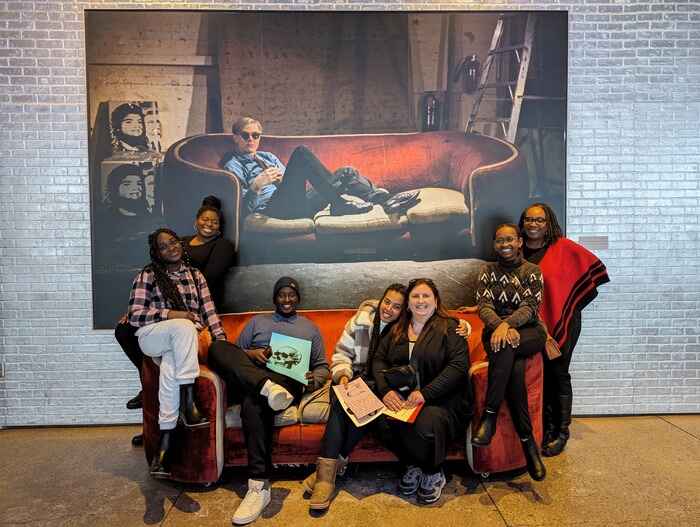
At the Andy Warhol Museum on the North Side
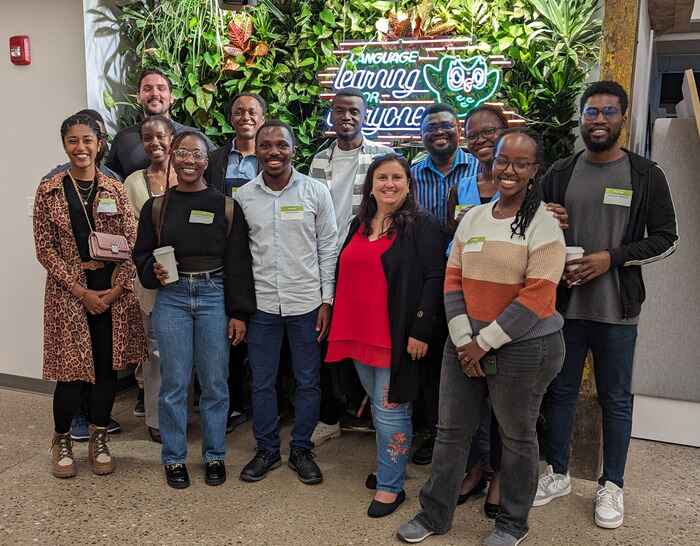
At Duolingo's corporate headquarters
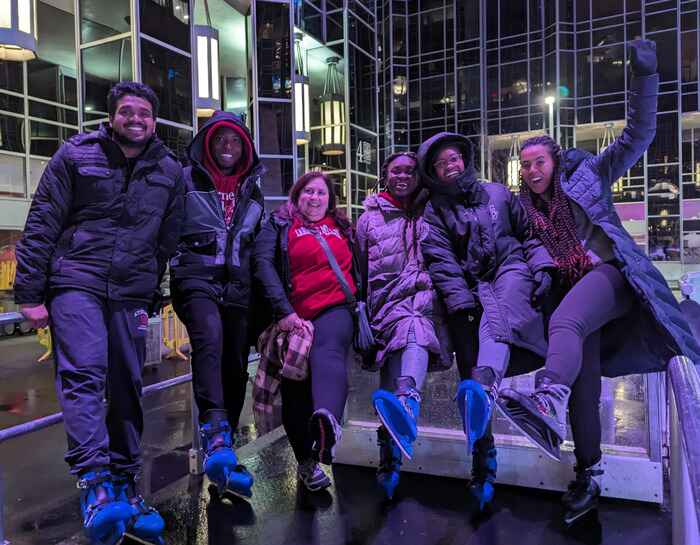
At the skating rink in Market Square
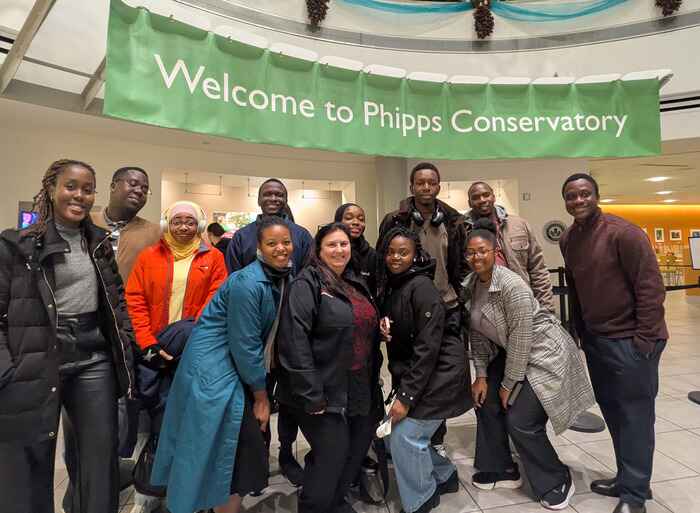
At Phillps Conservatory