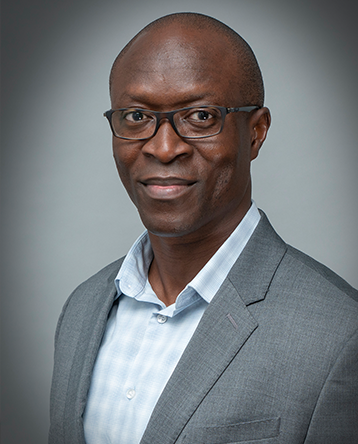
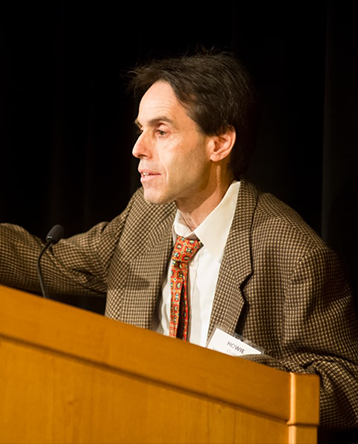
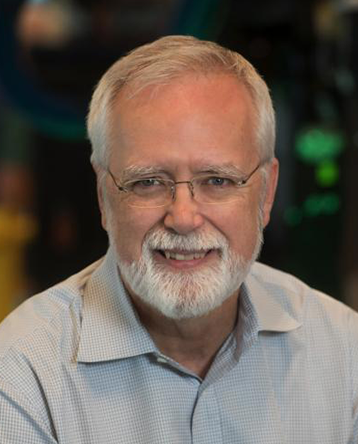
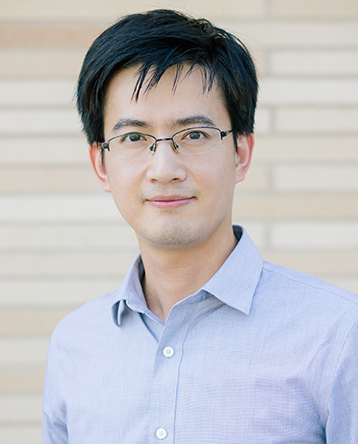
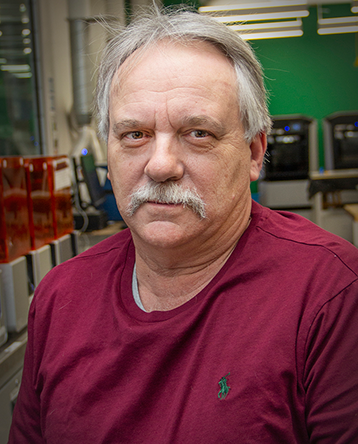
Gary Fedder
Director of the Institute for Complex Engineered Systems (ICES), the Howard M. Wilkoff Professor of Electrical and Computer Engineering, and Professor of The Robotics Institute
Courtesy Appointment, Mechanical Engineering

Address:
1201C Hamburg Hall
Carnegie Mellon University
5000 Forbes Avenue
Pittsburgh, PA 15213
1201C Hamburg Hall
Carnegie Mellon University
5000 Forbes Avenue
Pittsburgh, PA 15213
Phone: 412-268-8443/5352
Fax: 412-268-5229
Email: fedder@cmu.edu
Bio
Dr. Fedder earned his B.S. and M.S. degrees in EECS from MIT in 1982 and 1984, respectively. From 1984 to 1989, he worked at the Hewlett-Packard Company on circuit design and printed-circuit modeling. In 1994, he obtained the Ph.D. degree from the University of California at Berkeley, where his research resulted in the first demonstration of multimode control of an underdamped surface-micromachined inertial device. His research interests include design and modeling of microsensors and microactuators, fabrication of integrated MEMS with electronic circuits using conventional CMOS processing, and implantable microsystems.
In 2007, he was elevated to IEEE Fellow for contributions to integrated micro-electro-mechanical-system processes and design methodologies. His awards include the 1993 AIME Electronic Materials Society Ross Tucker Award, the 1996 Carnegie Institute of Technology George Tallman Ladd Research Award, and a 1996 NSF CAREER Award. Currently, he serves as a subject editor for the IEEE/ASME Journal of Microelectromechanical Systems, on the editorial boards of the IoP Journal of Micromechanics and Microengineering, IET Micro & Nano Letters, and SPIE Journal of Micro/Nanolithography, MEMS, and MOEMS, and as co-editor of the Wiley-VCH Advanced Micro- and Nanosystems book series. In 2005, he served as general co-chair of the IEEE MEMS Conference and as general chair of the IEEE Sensors Conference in 2010. Professor Fedder has contributed to over 200 research publications and holds several patents in the MEMS area.

Education
B.S. 1982, Massachusetts Institute of Technology
M.S. 1984, Massachusetts Institute of Technology
Ph.D. 1994, University of California, Berkeley
Research
As information systems have evolved from isolated computational engines to distributed networks, the autonomous ability to gather and act on information is becoming increasingly important. My research is in the interdisciplinary area of MicroElectroMechanical Systems (MEMS): sensor and actuator systems with performance derived from integration of electronics and mechanical structures with features measured in microns to millimeters. Fabrication of the batch-fabricated electromechanical devices and the development of related processes leverage the enormous investment in mature Very-Large-Scale Integrated (VLSI) circuit manufacturing. Benefits of this approach include much lower manufacturing cost, greater miniaturization, greater integration, and in many cases higher performance than can be achieved with conventional methods used to build systems requiring sensors and actuators. My research focus on integrated MEMS will eventually lead to the manufacture of low-cost sensor-and-actuator Application-Specific Integrated Circuits (ASICs). Integrated MEMS technology will be pervasive in future embedded systems.
Our research group designs, fabricates, and tests microdevices that are primarily made using a process in high conventional foundry CMOS is followed by simple micromachining steps. This process provides us with high-performance electronics integrated on chip with electrostatically actuated microstructures, capacitive and piezoresistive sensors, and polysilicon thermal heaters. Projects include active probe arrays for high-throughput tip-based nano-writing systems, accelerometers and gyroscopes for inertial sensing, a Stirling microcooler, ultra-compliant neural probes, capacitive gas chemical sensors, implantable pressure and temperature sensors, nonlinear parametric microresonators, and self-healing RF microresonaotr oscillators and filters. Issues include system design and integration, distributed control and communication, and interfacing to the environment.
MEMS are coupled multi-domain systems and, therefore, are difficult to design without expertise in a diverse set of fields. To address this problem in our lab, MEMS designers and CAD developers work closely together in a synergetic research environment. We are developing a multi-domain hierarchical design methodology to speed up the design cycle. A MEMS schematic is being developed in which mechanical, electromechanical, and electronic elements are graphically interconnected, resulting in rapid simulation and evaluation of designs.